


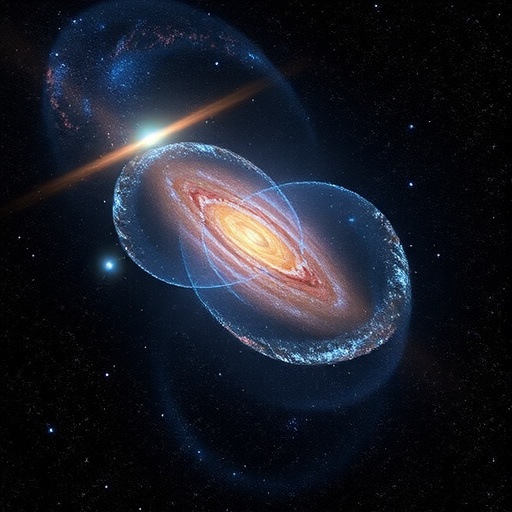
In the vast, enigmatic cosmos, an invisible yet omnipresent force shapes the very fabric of our universe: dark matter. While it neither emits nor absorbs light and remains undetectable through conventional means, dark matter’s gravitational influence governs the assembly and evolution of galaxies. Recently, a groundbreaking study led by a team at Rutgers University has illuminated this elusive component by meticulously tracing the clustering patterns of distant galaxies known as Lyman-alpha emitters. Their research offers unprecedented insights into the cosmic scaffolding that dark matter forms, unveiling the deep connections between these galaxies and the unseen matter that cradles them.
By harnessing some of the largest samples of Lyman-alpha emitting galaxies ever assembled, the Oxford-Delaware Imaging in Narrowbands (ODIN) survey enabled researchers to peer billions of years into the past. These galaxies are remarkable cosmic signposts due to their pronounced emission in the ultraviolet Lyman-alpha spectral line—a marker of intense hydrogen gas activity fueled by star formation. The Rutgers-led team scrutinized over 14,000 such galaxies spread across three pivotal eras: shortly after the Big Bang, specifically at redshifts z = 4.5, 3.1, and 2.4. This temporal window spans roughly 1.4 to 2.8 billion years after the universe’s birth, capturing formative stages of galactic development.
Through advanced clustering analyses—specifically, calculating the angular correlation function—the team quantified how these galaxies are spatially distributed relative to one another compared to random expectations. Essentially, this method identifies how galaxies grouped within dense regions of dark matter halos, the massive clumps of invisible material that seed galaxy formation. These halos, though unseen, exert gravitational pull, corralling ordinary matter to coalesce into stars and galaxies. The clustering signals retrieved offered a proxy for mapping where dark matter density peaks, akin to tracing the “fingerprints” of this cosmic dark scaffolding.
A remarkable aspect of their findings reveals that only a small fraction—between three to seven percent—of dense dark matter clumps capable of hosting galaxies harbor Lyman-alpha emitting galaxies. This suggests these galaxies represent a fleeting and transient phase in galactic evolution, shining in the ultraviolet Lyman-alpha line for tens to hundreds of millions of years before transitioning into other stages. This brief luminous epoch provides a unique observational window into the energetic youth of galaxies, where vigorous star formation and complex gas dynamics dominate.
The contours of dark matter density inferred from the data resemble topographical elevation lines on a hiking map, illustrating peaks and valleys in the dark matter distribution across large swathes of the cosmic landscape. This innovative visualization technique allows astronomers to identify not only the densest regions where galaxies are most likely to cluster but also to study how these structures evolve over cosmic time scales. It confirms theories positing that dark matter acts as the universe’s gravitational “glue,” assembling the vast cosmic web while guiding galaxy formation and growth.
Beyond merely mapping dark matter, the study strengthens the link between Lyman-alpha emitters and the destiny of galaxies like our own Milky Way. The dark matter masses associated with these emitters align with models where these galaxies evolve into present-day spirals, bridging a crucial gap in understanding how primordial gas clouds transitioned over billions of years into the structured galactic systems we observe in the nearby universe.
Integral to this research was the use of the Deep Evolution Survey (COSMOS) Deep Field dataset—one of the most comprehensive deep-sky surveys ever conducted. It provided high-resolution, wide-field images essential for detecting faint distant galaxies amid the cosmic background. This rigorous approach was essential to capture the subtle clustering patterns indicative of dark matter’s gravitational footprint.
The implications of the ODIN survey extend far beyond cataloging galaxies; they refine cosmological models by providing empirical constraints on how dark matter halos assemble and how galaxy populations trace the underlying matter distribution. Future expansions of this survey will incorporate larger datasets and additional epochs, promising to unravel further the intricate architecture of the cosmic web.
While the fundamental nature of dark matter remains one of the most profound mysteries in physics, studies such as this underscore its pivotal role in cosmic history. By illuminating where dark matter resides and how it shapes galactic evolution, astronomers edge closer to solving the riddle of the universe’s composition and the forces sculpting its destiny.
“Understanding dark matter’s distribution is critical,” says Eric Gawiser, a distinguished professor at Rutgers University and co-author of the study. “Though invisible to our instruments, its gravity informs how matter organizes across the universe, guiding the formation of galaxies and the large-scale structures we observe today.”
Led by doctoral student Dani Herrera, this collaborative effort demonstrates the power of observational astronomy combined with innovative data analysis techniques, pushing the boundaries of what we can learn about the cosmos through the faint glow of distant, youthful galaxies.
As the ODIN survey continues to penetrate deeper into the cosmos, it promises to shed more light on the cosmic web—the vast network of filaments composed primarily of dark matter that binds the universe together—and to reveal the lifecycle of galaxies within this hidden framework.
Keywords
/Space sciences/Astronomy/ Celestial bodies
/Space sciences/Astronomy/Astrophysics/ Astroparticle physics
Cite Scienmag News
Bethany Barker. (September 18, 2025). Early Universe Galaxies Unveil Hidden Dark Matter Maps. Scienmag. https://scienmag.com/early-universe-galaxies-unveil-hidden-dark-matter-maps/
Bethany Barker. "Early Universe Galaxies Unveil Hidden Dark Matter Maps." Scienmag, 18 September 2025, https://scienmag.com/early-universe-galaxies-unveil-hidden-dark-matter-maps/. Accessed 5 September 2026.
Bethany Barker. "Early Universe Galaxies Unveil Hidden Dark Matter Maps." Scienmag. September 18, 2025. https://scienmag.com/early-universe-galaxies-unveil-hidden-dark-matter-maps/


