


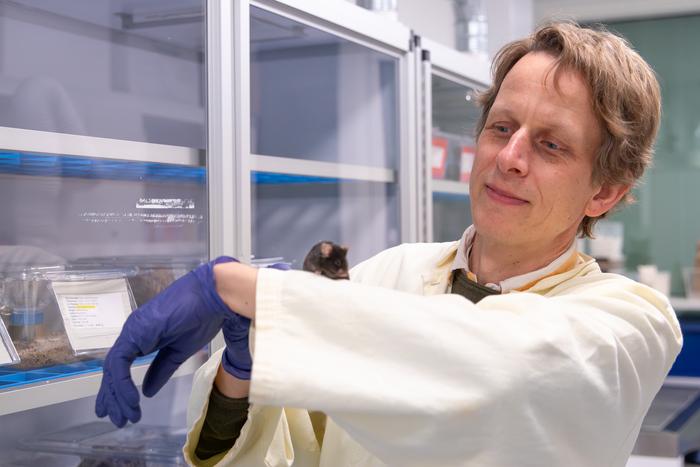

Credit: Photo: Simon Byrial Fischel/Aarhus University
Researchers identify important gene in the fight against prostate cancer
A new study from Aarhus University finds that men with mutations in a particular gene are at greater risk of developing metastases after prostate cancer.
Finding out that cancer has spread is always unwelcome news. A study from Aarhus University has identified a gene that determines whether patients with prostate cancer develop metastases elsewhere in the body.
“We’ve identified gene KMT2C, which is very important to the spread of prostate cancer. Loss of the KMT2C gene increases the risk of developing metastases. This can be relevant for both patients in the risk group and for understanding the disease,” says Associate Professor Martin K. Thomsen from the Department of Biomedicine.
Prostate cancer is the second most common cancer in Denmark, and its incidence is continuously increasing. The disease progresses slowly, but metastatic prostate cancer is difficult to treat and has high mortality rates.
“This gene is a smoking gun in the development of the disease, and it could form the basis for screening patients in the future. If the gene mutates, then there’s a risk that the patient will develop metastases. In the long term, we can use this knowledge to operate earlier or to keep an extra close eye on the patient group,” says the researcher.
The results of this study follow in the wake of two recent studies from Spain and the United States, which identified the gene PRMT7 and the gene CITED2, respectively, as critical regulators of prostate cancer metastases.
The method itself is innovative
“We have identified a gene that is often mutated in prostate cancer. The study tells us what genes are important for cancer development, but also how CRISPR can be used in modern cancer research,” says Martin K. Thomsen. Photo: Simon Byrial Fischel
The study, which was recently published in the scientific journal Nature Communications, used mice. By using CRISPR-Cas9, the researchers were able to create genetically engineered mouse models that made it possible to study the complex functions related to the development of prostate cancer.
The method itself is also interesting, says Martin K. Thomsen:
“If you knockout the gene in a cell line, nothing happens. But when we do that in combination with other genes, we can then see how the cancer can migrate from the primary tumour and begin creating metastases. And that’s what we’re interested in because metastases are typically what kill people.”
“While many other CRISPR researchers are working on curing diseases, we’re doing the opposite: We are trying to create a model of the disease so we can study it,” he explains.
Cancer researchers still do not understand the full extent of the molecular change that drives the disease, but animal models can reveal unknown mechanisms. Using CRISPR technology, the researchers were able to create mice with eight mutant genes that are also frequently mutated in prostate cancer in humans. This enabled the researchers to develop a complex model of prostate cancer in mice that can reveal the molecular functions of the genes.
“All the mice developed lung metastases, and further investigation showed that the loss of the gene KMT2C was crucial to the formation of those metastases,” says Martin K. Thomsen.
“The study tells us both what genes are important for cancer development, but also how CRISPR can be used in modern cancer research. CRISPR helps us learn more than traditional animal experiments can. We’re proud that we’ve got the technology up and running, it means we’re able to do things that we couldn’t do five years ago.”
Behind the research results
- The study is basic research.
- Collaboration partners are Nicolai Birkbak, Mikkel H. Vendelbo and Xin Gao.
- Funding: Danish Cancer Society
- Read the scientific article: CRISPR/Cas9 model of prostate cancer identifies Kmt2c deficiency as a metastatic driver by Odam/Cabs1 gene cluster expression | Nature Communications
Contact
Associate Professor Martin K. Thomsen
Aarhus University, Department of Biomedicine
Tel.: +45 23 93 85 53
Email: mkt@biomed.au.dk
Journal
Nature Communications
Method of Research
Experimental study
Subject of Research
Animals
Article Title
CRISPR/Cas9 model of prostate cancer identifies Kmt2c deficiency as a metastatic driver by Odam/Cabs1 gene cluster expression
Article Publication Date
7-Mar-2024
Cite Scienmag News
Juliet Wilcox. (May 16, 2024). Researchers identify important gene in the fight against prostate cancer. Scienmag. https://scienmag.com/researchers-identify-important-gene-in-the-fight-against-prostate-cancer/
Juliet Wilcox. "Researchers identify important gene in the fight against prostate cancer." Scienmag, 16 May 2024, https://scienmag.com/researchers-identify-important-gene-in-the-fight-against-prostate-cancer/. Accessed 4 September 2026.
Juliet Wilcox. "Researchers identify important gene in the fight against prostate cancer." Scienmag. May 16, 2024. https://scienmag.com/researchers-identify-important-gene-in-the-fight-against-prostate-cancer/

