

Thursday, June 18, 2026
Science
No Result
View All Result
  • Login
  • HOME
  • SCIENCE NEWS
  • CONTACT US
  • HOME
  • SCIENCE NEWS
  • CONTACT US
No Result
View All Result
Scienmag
No Result
View All Result
Home Science News Chemistry

A second chance for new antibiotic agent

May 16, 2024
in Chemistry
Reading Time: 2 mins read
0
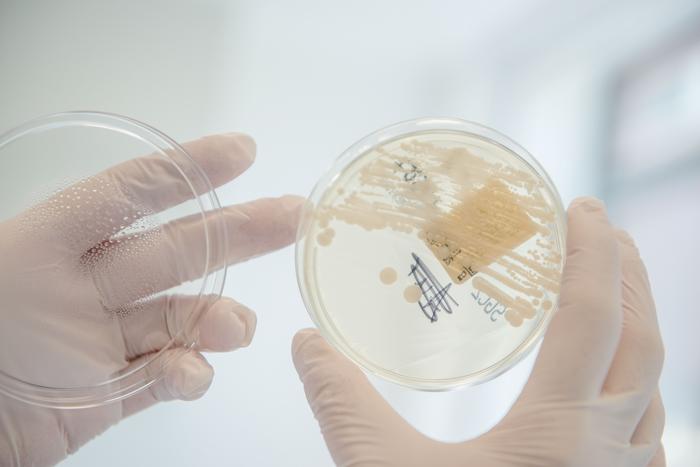
Bacterial culture
67
SHARES
607
VIEWS
Share on FacebookShare on Twitter
ADVERTISEMENT

Significant attempts 20 years ago

Bacterial culture

Credit: © RUB, Marquard

Significant attempts 20 years ago

The study focused on the protein peptide deformylase (PDF). Involved in protein maturation processes in cells, PDF is essential for the survival of bacteria. However, it’s found in both bacteria and human cells. “Some 20 years ago, significant attempts were made to combat PDF with antibiotic agents,” Raphael Stoll points out. “Yet, the original drug candidate, i.e. actinonin, had to be discarded for several reasons. One of the problems faced was the newly discovered human PDF, which was potentially associated with side effects. Still, further research was carried out to generate modified active compounds,” Hendrik Kirschner adds. As part of his doctoral thesis, he examined PDF in detail in the current study and analysed it from the perspective of structural biology using biomolecular nuclear magnetic resonance (NMR) spectroscopy and X-ray crystallography. These techniques enabled him to obtain a 3D structure resolved at the smallest detail. “This is the result of many years of collaborating with our colleague Professor Eckhard Hofmann,” Raphael Stoll says.

Active molecule is adapted and made more selective

“We can use these techniques to visualize surfaces and binding pockets of biomolecules and show that the binding of molecule to this protein is not static, but dynamic,” Hendrik Kirschner explains. The researchers noticed that there are two different binding orientations in the protein for a modified drug molecule: In addition to the orientation that is also present in human PDF, there’s another one that should, in principle, exclusively occur in bacterial PDF. “This prompts us to modify the drug molecule so that it favours the second binding orientation,” Raphael Stoll says. As a result, the antibiotic molecule could be rendered more selective. “It could provide this drug candidate with a second chance,” Hendrik Kirschner concludes.


Journal

Journal of Medicinal Chemistry

DOI

10.1021/acs.jmedchem.3c02382

Method of Research

Experimental study

Subject of Research

Cells

Article Title

Toward More Selective Antibiotic Inhibitors: A Structural View of the Complexed Binding Pocket of E. coli Peptide Deformylase

Article Publication Date

4-Apr-2024

Share27Tweet17
Previous Post

Natural toxins in food: Many people are not aware of the health risks

Next Post

Researchers identify important gene in the fight against prostate cancer

Related Posts

Harnessing Machine Learning to Combat Antibiotic-Resistant Gonorrhea — Chemistry
Chemistry

Harnessing Machine Learning to Combat Antibiotic-Resistant Gonorrhea

June 17, 2026
Innovative Field Study Reveals Effective Method to Reduce Nitrogen Pollution in Tea Plantations — Chemistry
Chemistry

Innovative Field Study Reveals Effective Method to Reduce Nitrogen Pollution in Tea Plantations

June 17, 2026
Scientists Create Modular Nanorobot Inspired by Mini Lunar Rockets — Chemistry
Chemistry

Scientists Create Modular Nanorobot Inspired by Mini Lunar Rockets

June 17, 2026
Creating a Clean Energy Future Using Molecular Sponges — Chemistry
Chemistry

Creating a Clean Energy Future Using Molecular Sponges

June 17, 2026
Routine Chemical Exposures Associated with Preterm Birth and Reduced Birthweight — Chemistry
Chemistry

Routine Chemical Exposures Associated with Preterm Birth and Reduced Birthweight

June 17, 2026
Breakthrough Quantum Experiment Advances Quest for Dark Matter and Gravitational Waves — Chemistry
Chemistry

Breakthrough Quantum Experiment Advances Quest for Dark Matter and Gravitational Waves

June 17, 2026
Next Post
The researcher

Researchers identify important gene in the fight against prostate cancer

  • Mothers who receive childcare support from maternal grandparents show more parental warmth, finds NTU Singapore study

    Mothers who receive childcare support from maternal grandparents show more parental warmth, finds NTU Singapore study

    27656 shares
    Share 11059 Tweet 6912
  • University of Seville Breaks 120-Year-Old Mystery, Revises a Key Einstein Concept

    1060 shares
    Share 424 Tweet 265
  • Bee body mass, pathogens and local climate influence heat tolerance

    682 shares
    Share 273 Tweet 171
  • Researchers record first-ever images and data of a shark experiencing a boat strike

    545 shares
    Share 218 Tweet 136
  • Groundbreaking Clinical Trial Reveals Lubiprostone Enhances Kidney Function

    531 shares
    Share 212 Tweet 133
Science

Embark on a thrilling journey of discovery with Scienmag.com—your ultimate source for cutting-edge breakthroughs. Immerse yourself in a world where curiosity knows no limits and tomorrow’s possibilities become today’s reality!

RECENT NEWS

  • Confined Migration Causes DNA Damage in Neurons
  • Multimodal Multitask AI Transforms Lung Cancer Grading
  • Legalizing Cannabis Boosts Use and Addiction Rates—Tight Regulation Is Essential
  • New Study Seeks to Prolong Immune System Longevity

Categories

  • Agriculture
  • Anthropology
  • Archaeology
  • Athmospheric
  • Biology
  • Biotechnology
  • Blog
  • Bussines
  • Cancer
  • Chemistry
  • Climate
  • Earth Science
  • Editorial Policy
  • Marine
  • Mathematics
  • Medicine
  • Pediatry
  • Policy
  • Psychology & Psychiatry
  • Science Education
  • Social Science
  • Space
  • Technology and Engineering

Subscribe to Blog via Email

Success! An email was just sent to confirm your subscription. Please find the email now and click 'Confirm Follow' to start subscribing.

Join 5,146 other subscribers

© 2025 Scienmag - Science Magazine

Welcome Back!

Login to your account below

Forgotten Password?

Retrieve your password

Please enter your username or email address to reset your password.

Log In
No Result
View All Result
  • HOME
  • SCIENCE NEWS
  • CONTACT US

© 2025 Scienmag - Science Magazine
