


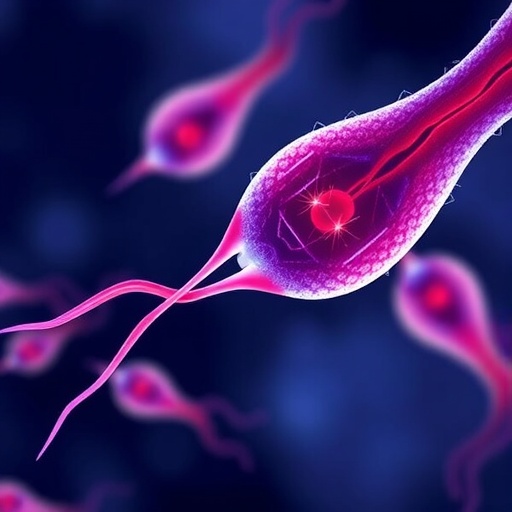
In a pioneering study emerging from The University of Osaka, scientists have unveiled critical insights into the molecular architecture governing male fertility, highlighting how specialized proteins orchestrate the formation and functionality of sperm flagella. These findings, now published in the esteemed journal Nature Communications, illuminate the intricate biological choreography necessary for effective sperm motility, a fundamental determinant of male reproductive capability.
Spermatozoa propulsion, essential for fertilization success, relies on the whip-like action of their flagella—complex organelles whose performance dictates the sperm’s capacity to traverse the female reproductive tract. At the core of this mechanism lies a sophisticated structural arrangement involving radial spokes, protein complexes pivotal in modulating the flagellum’s beating patterns. Disruptions in this architecture often underlie male infertility, a condition affecting millions worldwide but still not fully understood at the molecular level.
Central to this study is the protein CFAP91, a component of the radial spoke apparatus whose precise role had remained elusive despite its noted association with human infertility. The research team utilized advanced genetic engineering techniques to create murine models lacking CFAP91 expression, observing significant aberrations in sperm morphology and impaired motility that culminated in complete male infertility. These phenotypic manifestations underscore CFAP91’s indispensable role in maintaining the structural integrity and dynamic function of sperm flagella.
To deepen their understanding, researchers employed a strategic approach to reintroduce CFAP91 in these knockout models, enabling detailed interrogation of its protein-protein interactions during sperm development. Employing proximity labeling—a cutting-edge biochemical method allowing for the identification of proteins in close physical proximity within complex cellular milieus—they discovered that CFAP91 physically associates with other established radial spoke constituents. This revelation positions CFAP91 not merely as a structural component but as a critical scaffold necessary for the assembly of the radial spoke complex.
Perhaps most intriguingly, the proximity labeling technique identified EFCAB5 as a novel CFAP91-adjacent protein implicated in the regulation of sperm motility. EFCAB5 appears to function as a calcium-binding adaptor, modulating the responsiveness of flagellar movement to intracellular signaling cues. This highlights a previously uncharacterized layer of regulatory control over how sperm generate the precise locomotive forces needed for navigation and fertilization.
The comprehensive analysis elucidates that CFAP91’s absence disrupts the radial spoke’s assembly, precipitating malformed flagella incapable of effective propulsion. Consequently, sperm lacking CFAP91 exhibit erratic or diminished motility, rendering them unable to fulfill their reproductive role. By contrast, the re-expression of CFAP91 restores the structural formation of the radial spokes and reinstates proper motility patterns, firmly establishing the protein’s centrality in sperm function.
Beyond the immediate implications for understanding infertility, these findings provide a compelling model for dissecting the molecular machinery underlying ciliary and flagellar motion—biological phenomena present across diverse cellular systems. Insights gleaned from CFAP91 and its associated proteins could thus inform broader biomedical inquiries into diseases caused by ciliary dysfunction, including respiratory illnesses and developmental disorders.
The Osaka team’s work also underscores the power of combining genetic manipulation with novel proteomic approaches to unravel complex cellular architectures. The deployment of proximity labeling in fully differentiated sperm cells allowed for unprecedented mapping of molecular interactions in situ, a methodological advance that promises to accelerate discoveries in cell biology and reproductive medicine.
From a translational perspective, identifying CFAP91 and EFCAB5 as crucial players opens promising avenues for diagnostic and therapeutic innovation. Molecular assays targeting these proteins or their functional pathways could enhance the precision of male infertility diagnoses, moving beyond gross morphological analysis to detailed molecular profiling. Furthermore, interventions aimed at correcting or compensating for the dysfunction of these proteins may one day underpin novel fertility treatments.
Importantly, this research spotlights the intricate modularity of the sperm flagellum, a marvel of evolutionary bioengineering. The radial spoke complex, with CFAP91 at its core, represents a finely tuned regulatory hub where structural proteins and signaling molecules converge to dictate motility patterns essential for successful reproduction. Such complexity conveys the biological necessity of maintaining fertility and the vulnerability of this system to disruption by molecular defects.
This deeper molecular understanding also lends insight into why certain forms of male infertility have remained refractory to treatment—if the underlying issue stems from molecular scaffolding deficits rather than hormonal or environmental factors, therapeutic strategies must be fundamentally reimagined. The elucidation of CFAP91’s role thus marks a paradigm shift in the approach to male reproductive health.
Moreover, the identification of EFCAB5 as a calcium-regulated modulator accentuates the importance of intracellular signaling dynamics in sperm motility. Given calcium’s central role in cellular function regulation, dissecting how EFCAB5 integrates into motility control pathways may reveal new targets for modulating sperm behavior in both clinical and contraceptive contexts.
In conclusion, this groundbreaking study from The University of Osaka not only deepens the scientific community’s grasp of the molecular determinants of sperm motility and male fertility but also paves the way for translating these insights into clinical practice. As infertility continues to be a global health concern, unraveling the molecular scripts that choreograph sperm function offers a beacon of hope for affected couples worldwide.
News Publication Date: 10-Sep-2025
Web References: https://doi.org/10.1038/s41467-025-63705-7
Cite Scienmag News
Drew Townsend. (September 10, 2025). Unraveling Sperm Movement: Discovery of Two Key Proteins Essential for Male Fertility. Scienmag. https://scienmag.com/unraveling-sperm-movement-discovery-of-two-key-proteins-essential-for-male-fertility/
Drew Townsend. "Unraveling Sperm Movement: Discovery of Two Key Proteins Essential for Male Fertility." Scienmag, 10 September 2025, https://scienmag.com/unraveling-sperm-movement-discovery-of-two-key-proteins-essential-for-male-fertility/. Accessed 1 September 2026.
Drew Townsend. "Unraveling Sperm Movement: Discovery of Two Key Proteins Essential for Male Fertility." Scienmag. September 10, 2025. https://scienmag.com/unraveling-sperm-movement-discovery-of-two-key-proteins-essential-for-male-fertility/


