
Thursday, December 4, 2025
Science
No Result
View All Result
  • Login
  • HOME
  • SCIENCE NEWS
  • CONTACT US
  • HOME
  • SCIENCE NEWS
  • CONTACT US
No Result
View All Result
Scienmag
No Result
View All Result
Home Science News Climate

The origin and long-distance travels of upside down trees

May 15, 2024
in Climate
Reading Time: 3 mins read
0
Photo 1
67
SHARES
605
VIEWS
Share on FacebookShare on Twitter
ADVERTISEMENT

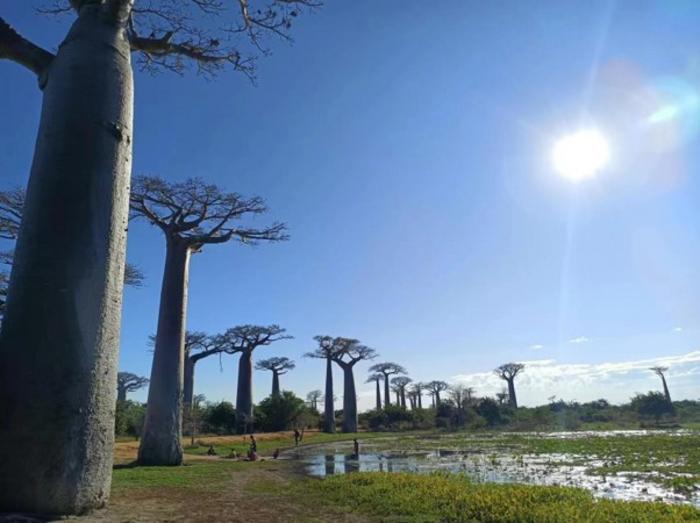
The iconic baobabs, also known as upside-down trees, or the tree of life, have much cultural significance, inspiring innumerable arts, folklore, and traditions. A research published in Nature, involving international collaboration between Wuhan Botanical Garden (China), Royal Botanic Gardens (Kew, UK), University of Antananarivo (Madagascar) and Queen Mary University of London (UK) reveal a remarkable example of species radiation in Madagascar followed by long distance dispersal to Africa and Australia. With speciation, an astonishing divergence of pollination mechanisms evolved, that exploit hawkmoths, bats and lemurs for a simple nectar reward. 

Photo 1

Credit: Alex Antonelli (Royal Botanic Gardens, Kew)

The iconic baobabs, also known as upside-down trees, or the tree of life, have much cultural significance, inspiring innumerable arts, folklore, and traditions. A research published in Nature, involving international collaboration between Wuhan Botanical Garden (China), Royal Botanic Gardens (Kew, UK), University of Antananarivo (Madagascar) and Queen Mary University of London (UK) reveal a remarkable example of species radiation in Madagascar followed by long distance dispersal to Africa and Australia. With speciation, an astonishing divergence of pollination mechanisms evolved, that exploit hawkmoths, bats and lemurs for a simple nectar reward. 

The charismatic baobabs have astonishing growth forms, reaching huge sizes with massive trunks, but apparently diminutive crowns, giving them their iconic appearance as upside-down trees.  The team first assembled the genomes of the eight recognised species and worked out their patterns of speciation. They then analysed the genomes themselves and discovered that the ancestor of all eight species most likely radiated in Madagascar, where they made hybrids, before two species underwent astonishing long-distance travels, one to Africa and another to Australia. In that radiation the species evolved different flower structures to attract hawkmoths, lemurs and bats. 

Quote: Professor Andrew Leitch at Queen Mary University of London said, “We were delighted to be involved in this project uncovering patterns of baobab speciation in Madagascar followed by the astonishing long-distance dispersal of two species, one to Africa and another to Australia. This was accompanied by the evolution of some fascinating pollination syndromes involving hawkmoths, lemurs and bats.” 

Quote: Dr. Ilia Leitch at Royal Botanic Garden Kew said, “This work has uncovered new insights into the patterns of speciation in baobabs and shows how climate change has influenced baobab distribution and speciation patterns over millions of years.” 

Quote: Husband and wife team Andrew and Ilia Leitch at Queen Mary University of London and Royal Botanic Gardens Kew said. ‘We were delighted to be involved in this project uncovering patterns of baobab speciation in Madagascar before the astonishing long-distance dispersal of two species, one to Africa and another to Australia. The work also provides new insights into how climate change has influenced baobab distribution and speciation patterns over millions of years’.  


Journal

Nature

DOI

10.1038/s41586-024-07447-4

Article Title

The rise of baobab trees in Madagascar

Article Publication Date

15-May-2024

Share27Tweet17
Previous Post

All wound up: A clearer look at electric guitar pickups #ASA186

Next Post

American Academy of Sleep Medicine announces 2024 award recipients

Related Posts

blank
Climate

Microclimates Slow, Shift Climate Speeds in Tropical Forests

November 27, 2025
blank
Climate

Major US Corporations Revise Emissions Data Significantly

November 26, 2025
blank
Climate

60 Years of Massive, Deep Ocean Changes Observed

November 25, 2025
blank
Climate

Higher Water Use Efficiency Fails to Boost Tree Growth

November 24, 2025
blank
Climate

Warming Amplifies Carbon Source-Sink Mismatch in Conifers

November 21, 2025
blank
Climate

Global Bias in Documenting Latitudinal Range Shifts

November 21, 2025
Next Post
American Academy of Sleep Medicine announces 2024 award recipients

American Academy of Sleep Medicine announces 2024 award recipients

  • Mothers who receive childcare support from maternal grandparents show more parental warmth, finds NTU Singapore study

    Mothers who receive childcare support from maternal grandparents show more parental warmth, finds NTU Singapore study

    27587 shares
    Share 11032 Tweet 6895
  • University of Seville Breaks 120-Year-Old Mystery, Revises a Key Einstein Concept

    995 shares
    Share 398 Tweet 249
  • Bee body mass, pathogens and local climate influence heat tolerance

    652 shares
    Share 261 Tweet 163
  • Researchers record first-ever images and data of a shark experiencing a boat strike

    522 shares
    Share 209 Tweet 131
  • Groundbreaking Clinical Trial Reveals Lubiprostone Enhances Kidney Function

    490 shares
    Share 196 Tweet 123
Science

Embark on a thrilling journey of discovery with Scienmag.com—your ultimate source for cutting-edge breakthroughs. Immerse yourself in a world where curiosity knows no limits and tomorrow’s possibilities become today’s reality!

RECENT NEWS

  • Boosting Cancer Immunotherapy by Targeting DNA Repair
  • Addressing Dumpsite Risks: A Action Framework for LMICs
  • Evaluating eGFR Equations in Chinese Children
  • Global Guidelines for Shared Decision-Making in Valvular Heart Disease

Categories

  • Agriculture
  • Anthropology
  • Archaeology
  • Athmospheric
  • Biology
  • Blog
  • Bussines
  • Cancer
  • Chemistry
  • Climate
  • Earth Science
  • Marine
  • Mathematics
  • Medicine
  • Pediatry
  • Policy
  • Psychology & Psychiatry
  • Science Education
  • Social Science
  • Space
  • Technology and Engineering

Subscribe to Blog via Email

Enter your email address to subscribe to this blog and receive notifications of new posts by email.

Join 5,191 other subscribers

© 2025 Scienmag - Science Magazine

Welcome Back!

Login to your account below

Forgotten Password?

Retrieve your password

Please enter your username or email address to reset your password.

Log In
No Result
View All Result
  • HOME
  • SCIENCE NEWS
  • CONTACT US

© 2025 Scienmag - Science Magazine

Discover more from Science

Subscribe now to keep reading and get access to the full archive.

Continue reading