
Friday, September 4, 2026
Science
No Result
View All Result
  • Login
  • HOME
  • SCIENCE NEWS
  • CONTACT US
  • HOME
  • SCIENCE NEWS
  • CONTACT US
No Result
View All Result
Scienmag
No Result
View All Result
Home Science News Technology and Engineering

Next-generation sustainable electronics are doped with air

May 15, 2024
in Technology and Engineering
Denise Maddox
By Denise Maddox Scienmag Editorial Profile - Mechanical Engineering
Reading Time: 3 mins read
0
Next-generation sustainable electronics are doped with air
66
SHARES
600
VIEWS
Share on FacebookShare on Twitter
ADVERTISEMENT

Semiconductors are the foundation of all modern electronics. Now, researchers at Linköping University, Sweden, have developed a new method where organic semiconductors can become more conductive with the help of air as a dopant. The study, published in the journal Nature, is a significant step towards future cheap and sustainable organic semiconductors.

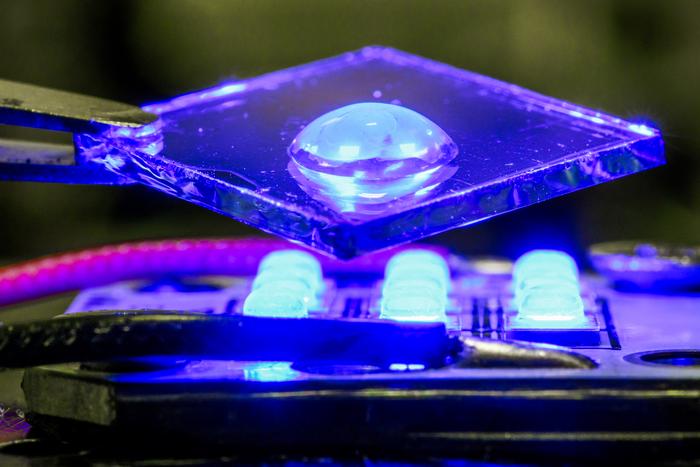
Photocatalytic doping of organic semiconductors

Credit: Thor Balkhed

Semiconductors are the foundation of all modern electronics. Now, researchers at Linköping University, Sweden, have developed a new method where organic semiconductors can become more conductive with the help of air as a dopant. The study, published in the journal Nature, is a significant step towards future cheap and sustainable organic semiconductors.

“We believe this method could significantly influence the way we dope organic semiconductors. All components are affordable, easily accessible, and potentially environmentally friendly, which is a prerequisite for future sustainable electronics,” says Simone Fabiano, associate professor at Linköping University.

Semiconductors based on conductive plastics instead of silicon have many potential applications. Among other things, organic semiconductors can be used in digital displays, solar cells, LEDs, sensors, implants, and for energy storage.

To enhance conductivity and modify semiconductor properties, so-called dopants are typically introduced. These additives facilitate the movement of electrical charges within the semiconductor material and can be tailored to induce positive (p-doping) or negative (n-doping) charges. The most common dopants used today are often either very reactive (unstable), expensive, challenging to manufacture, or all three.

Now, researchers at Linköping University have developed a doping method that can be performed at room temperature, where inefficient dopants such as oxygen are the primary dopant, and light activates the doping process.

“Our approach was inspired by nature, as it shares many analogies with photosynthesis, for example. In our method, light activates a photocatalyst, which then facilitates electron transfer from a typically inefficient dopant to the organic semiconductor material,” says Simone Fabiano.

The new method involves dipping the conductive plastic into a special salt solution – a photocatalyst – and then illuminating it with light for a short time. The duration of illumination determines the degree to which the material is doped. Afterwards, the solution is recovered for future use, leaving behind a p-doped conductive plastic in which the only consumed substance is oxygen in the air.

This is possible because the photocatalyst acts as an “electron shuttle”, taking electrons or donating them to material in the presence of sacrificial weak oxidants or reductants. This is common in chemistry but has not been used in organic electronics before.

“It’s also possible to combine p-doping and n-doping in the same reaction, which is quite unique. This simplifies the production of electronic devices, particularly those where both p-doped and n-doped semiconductors are required, such as thermoelectric generators. All parts can be manufactured at once and doped simultaneously instead of one by one, making the process more scalable,” says Simone Fabiano.

The doped organic semiconductor has better conductivity than traditional semiconductors, and the process can be scaled up. Simone Fabiano and his research group at the Laboratory of Organic Electronics showed earlier in 2024 how conductive plastics could be processed from environmentally friendly solvents like water; this is their next step.

“We are at the beginning of trying to fully understand the mechanism behind it and what other potential application areas exist. But it’s a very promising approach showing that photocatalytic doping is a new cornerstone in organic electronics,” says Simone Fabiano, a Wallenberg Academy Fellow.


Journal

Nature

DOI

10.1038/s41586-024-07400-5

Article Title

Photocatalytic doping of organic semiconductors

Article Publication Date

15-May-2024

COI Statement

Wenlong Jin, Chi-Yuan Yang, and Simone Fabiano have applied for patents based on the work in the study, and the latter two are founders of n-Ink AB, a spinout of Linköping University.

Subject of Research: Technology and Engineering

Article Title: Next-generation sustainable electronics are doped with air

Article References: Original research article

Image Credits: AI Generated

DOI: Not provided

Keywords: Not provided

Cite Scienmag News

Denise Maddox. (May 15, 2024). Next-generation sustainable electronics are doped with air. Scienmag. https://scienmag.com/next-generation-sustainable-electronics-are-doped-with-air/

Denise Maddox. "Next-generation sustainable electronics are doped with air." Scienmag, 15 May 2024, https://scienmag.com/next-generation-sustainable-electronics-are-doped-with-air/. Accessed 4 September 2026.

Denise Maddox. "Next-generation sustainable electronics are doped with air." Scienmag. May 15, 2024. https://scienmag.com/next-generation-sustainable-electronics-are-doped-with-air/

Share26Tweet17
Previous Post

Bio-based resins could offer recyclable future for 3D printing

Next Post

Unwrapping the origin story of the baobab

Related Posts

Open-source tool automates volcanic cone analysis on Mars and Earth
Technology and Engineering

Open-source tool automates volcanic cone analysis on Mars and Earth

September 4, 2026
New Fusion-Based Method Detects Drones at Long Range in Cluttered Backgrounds
Technology and Engineering

New Fusion-Based Method Detects Drones at Long Range in Cluttered Backgrounds

September 4, 2026
Defending federated learning from backdoors with semantic filters and geometry
Technology and Engineering

Defending federated learning from backdoors with semantic filters and geometry

September 4, 2026
Real-time multimedia CPR training feedback using pose estimation and action recognition
Technology and Engineering

Real-time multimedia CPR training feedback using pose estimation and action recognition

September 4, 2026
Researchers build GPU-based distributed computing framework
Technology and Engineering

Researchers build GPU-based distributed computing framework

September 4, 2026
AI Disclosure and Emotional Support in Chatbot Talks with International Students
Technology and Engineering

AI Disclosure and Emotional Support in Chatbot Talks with International Students

September 4, 2026
Next Post
Unwrapping the origin story of the baobab

Unwrapping the origin story of the baobab

  • Mothers who receive childcare support from maternal grandparents show more optimized

    Mothers who receive childcare support from maternal grandparents show more parental warmth, finds NTU Singapore study

    27656 shares
    Share 11059 Tweet 6912
  • University of Seville Breaks 120-Year-Old Mystery, Revises a Key Einstein Concept

    1061 shares
    Share 424 Tweet 265
  • Bee body mass, pathogens and local climate influence heat tolerance

    682 shares
    Share 273 Tweet 171
  • Researchers record first-ever images and data of a shark experiencing a boat strike

    546 shares
    Share 218 Tweet 137
  • Groundbreaking Clinical Trial Reveals Lubiprostone Enhances Kidney Function

    531 shares
    Share 212 Tweet 133
Science

Embark on a thrilling journey of discovery with Scienmag.com—your ultimate source for cutting-edge breakthroughs. Immerse yourself in a world where curiosity knows no limits and tomorrow’s possibilities become today’s reality!

RECENT NEWS

  • Extensive SARS-CoV-2 spread in Sierra Leone despite few reported cases and illness
  • Nurses’ Work Engagement Linked to Work Capital Through Decent Work
  • TAK-003 dengue vaccine protects adolescents during São Paulo’s 2024–2025 outbreak
  • Survey links doctors’ and nurses’ working conditions to mental health across Europe

Categories

  • Agriculture
  • Anthropology
  • Archaeology
  • Athmospheric
  • Biology
  • Biotechnology
  • Blog
  • Bussines
  • Cancer
  • Chemistry
  • Climate
  • Earth Science
  • Editorial Policy
  • Marine
  • Mathematics
  • Medicine
  • Pediatry
  • Policy
  • Psychology & Psychiatry
  • Science Education
  • Social Science
  • Space
  • Technology and Engineering

Subscribe to Blog via Email

Enter your email address to subscribe to this blog and receive notifications of new posts by email.

Join 5,151 other subscribers

© 2025 Scienmag - Science Magazine

Welcome Back!

Login to your account below

Forgotten Password?

Retrieve your password

Please enter your username or email address to reset your password.

Log In
No Result
View All Result
  • HOME
  • SCIENCE NEWS
  • CONTACT US

© 2025 Scienmag - Science Magazine

Discover more from Science

Subscribe now to keep reading and get access to the full archive.

Continue reading