


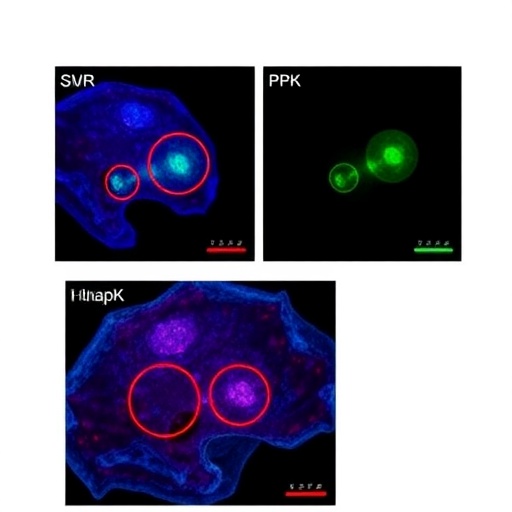
The dynamic world of ovarian folliculogenesis has garnered substantial attention in the last few decades, and the modulation of this intricate process is largely dictated by various signaling pathways. A recent study led by Zhao et al. delves profoundly into one such critical pathway: the MAPK (Mitogen-Activated Protein Kinase) signaling pathway. This research opens new avenues for understanding the molecular mechanisms underpinning ovarian development and its implications for fertility.
MAPK signaling is a pivotal pathway known to influence cellular responses such as proliferation, differentiation, and survival. In the context of ovarian physiology, the MAPK pathway orchestrates the development of ovarian follicles, balancing hormonal signals that govern adulthood and reproductive cycles. This regulatory finesse underscores the pathway’s significance in reproductive health and disease, revealing exciting potential for therapeutic interventions aimed at infertility and related conditions.
Zhao and colleagues embarked upon this transformative journey with a meticulous analysis that integrates existing literature with novel experimental data. They set the stage by elucidating the role of the MAPK pathway in general cellular mechanisms, particularly how extracellular signals are transduced into specific cellular responses. This foundational understanding is critical as it contextualizes the role of MAPKs in ovarian function and development.
The study highlights the distinct MAPK family members—ERK, JNK, and p38 MAPK—each playing unique roles in ovarian follicular development. The ERK pathway is notably emphasized for promoting granulosa cell proliferation and differentiation in response to follicle-stimulating hormone (FSH). Such insights not only clarify the biological implications of these pathways but also underline their potential impact on therapeutic strategies aimed at enhancing ovarian function.
Folliculogenesis is a highly regulated process that involves multiple stages of development, starting from primordial follicles and transitioning through primary, secondary, and antral stages. The orchestration of these stages is mediated by various hormones, with FSH and luteinizing hormone (LH) being central players. The active engagement of the MAPK pathway during these phases suggests that any dysregulation could disrupt normal ovarian function, leading to conditions such as polycystic ovary syndrome (PCOS) and premature ovarian insufficiency.
One of the standout aspects of this research is its exploration of how external factors such as environmental toxins, stress, and nutrition can influence MAPK signaling pathways. The researchers point out that understanding these interactions is critical since modern lifestyles expose individuals to numerous factors that could alter hormonal balances and, consequently, reproductive health.
Moreover, the team draws attention to experimental illustrations where modulation of MAPK pathways directly influenced follicular health. This experimental data underscores the potential for targeted therapies based on MAPK manipulation, signaling a potential revolution in infertility treatment modalities. For instance, pharmacological agents capable of enhancing or inhibiting MAPK signaling could pave the way for novel interventions in women facing fertility challenges.
While the study lays an important theoretical groundwork, it does not shy away from addressing the clinical implications of their findings. The future of reproductive medicine may well hinge on how effectively the MAPK pathway is understood and leveraged in clinical settings. By fine-tuning drugs to selectively target these pathways, healthcare professionals might improve the outcomes of assisted reproductive technologies and tackle related disorders more effectively.
The intersection of the MAPK signaling pathway with genetic predispositions to ovarian dysfunction offers another fascinating dimension. Through genomic analyses, Zhao and his team speculate on future research initiatives that could investigate gene-environment interactions further. Understanding how genetic variations influence MAPK signaling could lead to a predictive framework for assessing ovarian reserve and function.
Furthermore, there is a pronounced emphasis on the importance of interdisciplinary research in this domain. By combining insights from molecular biology, genetics, and even bioinformatics, the understanding of ovarian folliculogenesis is bound to increase tenfold. Collaboration among scientists, clinicians, and data analysts will likely yield transformative breakthroughs that merge basic science with clinical application.
The innovative methodologies employed in this research, including cutting-edge imaging techniques and in vitro models of follicular development, reinforce the study’s findings. Such approaches not only validate the role of MAPK signaling but also demonstrate the feasibility of studying these complex processes in a controlled environment.
Zhao et al.’s study serves as a clarion call for increased research funding directed at reproductive health, particularly focusing on the molecular underpinnings of ovarian function. As the global population continues to grow, and as reproductive disorders become more prevalent, the urgency for innovative solutions becomes paramount. This study stands as a significant contribution to that imperative, advocating for a deeper understanding of the intricate interplay between cellular signaling pathways and reproductive health.
In conclusion, the MAPK signaling pathway’s roles in ovarian folliculogenesis offer profound insights into the complexities of female reproductive health. Zhao and his team adeptly illuminate how these pathways not only govern normal follicular development but also represent promising targets for therapeutic intervention in reproductive challenges. As the field evolves, the collaborative efforts of scientists investigating the MAPK pathway’s potential may well lead to groundbreaking advancements in how reproductive issues are navigated and treated.
Engagement with this critical research is essential for scientists and healthcare professionals alike, emphasizing that significant advancements in reproductive health are not only possible but within reach. With increasing awareness and technological advancements, the future of fertility treatments may become more effective, attuned to the intricate signaling pathways that govern ovarian function.
Cite Scienmag News
Arden W. (September 2, 2025). MAPK Pathway’s Key Role in Ovarian Follicle Development. Scienmag. https://scienmag.com/mapk-pathways-key-role-in-ovarian-follicle-development/
Arden W. "MAPK Pathway’s Key Role in Ovarian Follicle Development." Scienmag, 2 September 2025, https://scienmag.com/mapk-pathways-key-role-in-ovarian-follicle-development/. Accessed 28 August 2026.
Arden W. "MAPK Pathway’s Key Role in Ovarian Follicle Development." Scienmag. September 2, 2025. https://scienmag.com/mapk-pathways-key-role-in-ovarian-follicle-development/


