


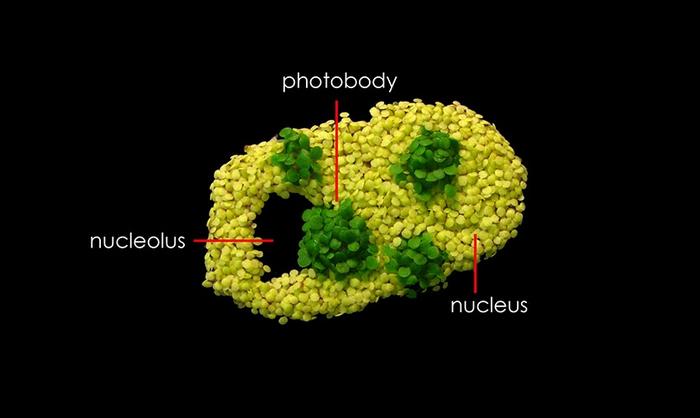
Plants’ ability to sense light and temperature, and their ability to adapt to climate change, hinges on free-forming structures in their cells whose function was, until now, a mystery.

Credit: Meng Chen/UCR
Plants’ ability to sense light and temperature, and their ability to adapt to climate change, hinges on free-forming structures in their cells whose function was, until now, a mystery.
For the first time, UC Riverside researchers have determined how these structures work on a molecular level, as well as where and how they form. This information is described in two Nature Communications papers published this week.
Scientists have long studied membrane-bound compartments, called organelles, in plant cells, such as the Golgi apparatus, mitochondria, and most significantly, the nucleus, where DNA gets copied and transcribed into RNA.
However, much less is known about the membrane-free organelles that can dynamically assemble and disassemble inside the nucleus, such as the photobodies that help to sense light and temperature in plants.
“At one time, people called these photobodies ‘garbage cans,’ because they didn’t understand them. When people don’t understand something, they call it useless. But they aren’t useless at all,” said UCR botany professor Meng Chen, senior author of both papers. “They are a new frontier in science.”
Part of the challenge in studying photobodies, or membrane-less organelles in general, is that molecules are moving in and out of them constantly. This makes it difficult to distinguish the function of the components inside the organelles versus those outside. Additionally, these photobodies only form in the light.
Chen spent two decades working on this problem before his lab found a method that helped unlock the mystery of the organelles’ function.
In the past, he would remove a gene in a laboratory plant and try to observe any changes in the photobodies and the plants’ light or temperature responses. This approach yielded partial success.
His laboratory identified a gene that made it impossible for the membrane-less organelles to assemble. Knocking out this gene made the plants partially blind to light. “We saw that these organelles are involved in light sensing, but we realized this was a correlation, not causation,” Chen said.
To learn more, the researchers tried enhancing the size of the organelles, rather than eliminating them. This strategy, detailed in one of the new papers, proved successful. With bigger organelles, it was possible to see the function.
“What we saw, ultimately, is that the membrane-less organelles help plants distinguish a whole range of different light intensities. Without them, plants would not be able to ‘see’ changes in light intensity,” Chen said.
In a related set of experiments, described in the second Nature Communications paper, the researchers tested the relationship between these organelles and temperature. Previously, the group had shown that if temperature increases, the number of these organelles decreases.
The group theorized that temperature-sensitivity would be a function of where in the cell the organelles formed. Other researchers proposed that the formation of the organelles is random, but Chen suspected this was not the case.
“There is not much in nature that is completely random,” Chen said. “At the airport, do people get together in the middle of nowhere, or are they usually in the waiting areas and at airline counters? Anything that has an important function is not usually random.”
The formation of photobodies, it turns out, is not random, either. More than half of them are near centromeres, the region of a chromosome harboring silenced genes.
At 16 degrees, there were nine types of membrane-less organelles in the cells. At 27 degrees, the number dropped to only five types. Though all of them contain the temperature-sensing protein phytochrome B, some of these organelles are sensitive to temperature, and others aren’t.
Going forward, the researchers are hoping to show that it is possible to change the plants’ sensitivity to light and temperature by manipulating where the organelles form. This is particularly important if people want to continue growing food crops in a hotter, brighter world.
California grows half of the country’s fruits and vegetables. But scientists estimate that without mitigation of greenhouse gas emissions, the average temperatures in the state could increase by 11 degrees by the end of the century, which would seriously impact crop growth.
“To predict and mitigate climate change, we need to understand how plants sense and respond to their environment, especially temperature,” Chen said. “Temperature is not related only to growth and size. It’s related to everything: flowering time, fruit development, pathogen response, and immunity.”
Journal
Nature Communications
Article Title
Distinguishing individual photobodies using Oligopaints reveals thermo-sensitive and -insensitive phytochrome B condensation at distinct subnuclear locations
Article Publication Date
29-Apr-2024
Cite Scienmag News
Sloane Callahan. (May 7, 2024). Free-forming organelles help plants adapt to climate change. Scienmag. https://scienmag.com/free-forming-organelles-help-plants-adapt-to-climate-change/
Sloane Callahan. "Free-forming organelles help plants adapt to climate change." Scienmag, 7 May 2024, https://scienmag.com/free-forming-organelles-help-plants-adapt-to-climate-change/. Accessed 4 September 2026.
Sloane Callahan. "Free-forming organelles help plants adapt to climate change." Scienmag. May 7, 2024. https://scienmag.com/free-forming-organelles-help-plants-adapt-to-climate-change/

