


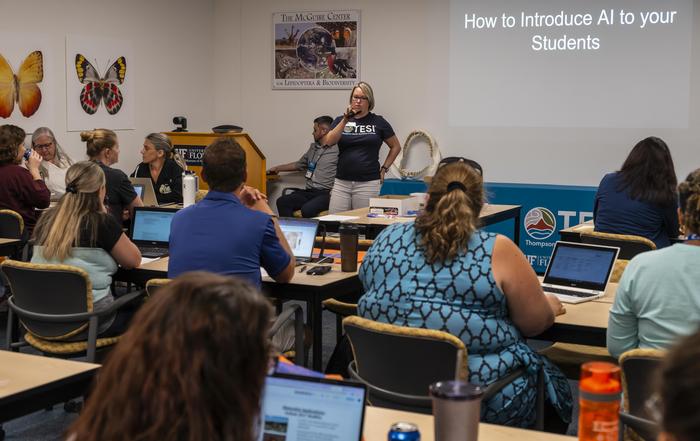
The results of an in-depth review of published research on scientists conducting K-12 science, technology, engineering and mathematics (STEM) outreach suggest that increased collaboration with K-12 educators could improve such projects. The study authors identified the need for more rigorous peer-reviewed research on scientist-teacher outreach projects and existing barriers to scientist and teacher participation. Pulling all this information together, they outline the best ways to integrate teachers into successful outreach projects.

Credit: Florida Museum photo by Jeff Gage
The results of an in-depth review of published research on scientists conducting K-12 science, technology, engineering and mathematics (STEM) outreach suggest that increased collaboration with K-12 educators could improve such projects. The study authors identified the need for more rigorous peer-reviewed research on scientist-teacher outreach projects and existing barriers to scientist and teacher participation. Pulling all this information together, they outline the best ways to integrate teachers into successful outreach projects.
“Although there is work being done in K-12 STEM outreach, there needs to be more of a focus on all aspects of that outreach, as opposed to, ‘We went in; we did this activity; here’s what we found,’” said lead author Brian Abramowitz, the K-12 education and outreach coordinator at the Florida Museum of Natural History’s Thompson Earth Systems Institute.
Instead, the researchers recommend that publications clearly outline the planning of outreach events between the science expert and teacher, which will allow other outreach facilitators to replicate the process. This could include things like details on how scientists found and connected with the teachers and how they planned their visits with teachers.
“The more we can share how we do this kind of work, the more I think it will increase the number of people who feel comfortable engaging in K-12 outreach, because they have a better idea of what works and what doesn’t,” said co-author Megan Ennes, assistant curator of museum education at the Florida Museum and director of the Thompson Earth Systems Institute.
There are innumerable barriers to both scientists and teachers attempting to plan and implement these programs. But the biggest hindrance, Abramowitz said, is time.
“Similar to scientists who have so much on their plate, teachers also are overwhelmed largely with tasks that they’re asked to do, and they might not feel like they have time to participate in a scientist-teacher partnership.”
But the benefits outweigh the challenges. According to the study, teachers and scientists able to successfully surmount the various obstacles in their path mutually benefited, and their students also benefited in various ways. For teachers, that included increased content knowledge, science skills and practices, self-efficacy, interest in the science content of their curriculum and their motivation to teach science content. Scientists improved their teaching strategies and communication skills. They also added significantly to their knowledge of the content being taught, new technologies that help aid or improve teaching performance, and an increased awareness of alternative career opportunities.
The authors also recommend involving teachers in the planning process as early as possible, which helps ensure that the science content is accessible and presented appropriately.
“Although scientists typically have an idea of how they would like to work with teachers, be open and flexible to potentially other options. Teachers know very well what activities will be successful in their classrooms,” said Abramowitz.
Abramowitz also coordinates the Thompson Earth Systems Institute’s Scientist in Every Florida School program. This statewide initiative creates partnerships between scientists and K-12 teachers in public and Title I Florida schools by connecting students with scientist role models and providing professional development for teachers. Abramowitz will put the information and guidelines developed in this study to good use by incorporating them in future outreach programs.
The authors published their study in the International Journal of Science and Mathematics Education.
Brittany Kester and Pavlo Antonenko of the University of Florida are also authors of the paper.
Journal
International Journal of Science and Mathematics Education
Article Publication Date
3-Feb-2024
Cite Scienmag News
Violet Maxwell. (May 2, 2024). When scientists and K-12 teachers team up, the results can be spectacular or lackluster. Scienmag. https://scienmag.com/when-scientists-and-k-12-teachers-team-up-the-results-can-be-spectacular-or-lackluster/
Violet Maxwell. "When scientists and K-12 teachers team up, the results can be spectacular or lackluster." Scienmag, 2 May 2024, https://scienmag.com/when-scientists-and-k-12-teachers-team-up-the-results-can-be-spectacular-or-lackluster/. Accessed 5 September 2026.
Violet Maxwell. "When scientists and K-12 teachers team up, the results can be spectacular or lackluster." Scienmag. May 2, 2024. https://scienmag.com/when-scientists-and-k-12-teachers-team-up-the-results-can-be-spectacular-or-lackluster/

