


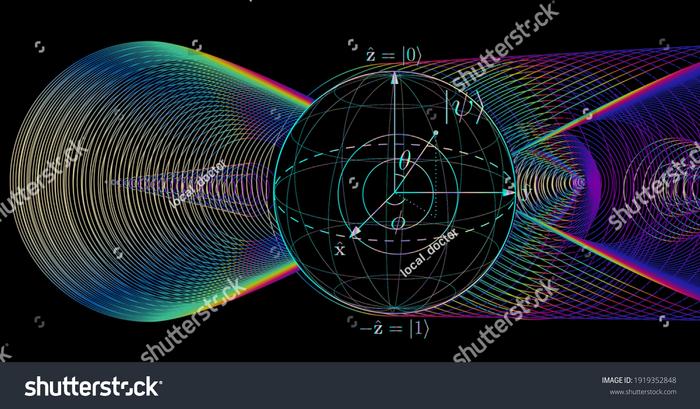
The fragile qubits that make up quantum computers offer a powerful computational tool, yet also present a conundrum: How can engineers create practical, workable quantum systems out of bits that are so easily disturbed — and wiped of data — by tiny changes in their environment?

Credit: Shutterstock
The fragile qubits that make up quantum computers offer a powerful computational tool, yet also present a conundrum: How can engineers create practical, workable quantum systems out of bits that are so easily disturbed — and wiped of data — by tiny changes in their environment?
Engineers have long struggled with how to make quantum computers less error-prone, often by developing ways to detect and correct errors rather than prevent them in the first place. However, many such error-correction schemes involve duplicating information across hundreds or thousands of physical qubits at once, which quickly becomes hard to scale up in an efficient way.
Now, a team of scientists led by researchers at the Pritzker School of Molecular Engineering (PME) at the University of Chicago have developed the blueprint for a quantum computer that can more efficiently correct errors. The system uses a new framework, based around quantum low-density party-check (qLDPC) codes — which can detect errors by looking at the relationship between bits — as well as a new hardware involving reconfigurable atom arrays, which allow qubits to communicate with more neighbors and therefore let the qLDPC data be encoded in fewer qubits.
“With this proposed blueprint, we’ve reduced the overhead required for quantum error correction, which opens new avenues for scaling up quantum computers,” said Liang Jiang, professor of molecular engineering and senior author of the new work, published in Nature Physics.
Intrinsic noise
While standard computers rely on digital bits — in an on or off position — to encode data, qubits can exist in states of superposition, giving them the ability to tackle new computational problems. However, qubits’ unique properties also make them incredibly sensitive to their environment; they change states based on the surrounding temperature and electromagnetism.
“Quantum systems are intrinsically noisy. There’s really no way to build a quantum machine that won’t have error,” said Qian Xu, a PME graduate student who led the new work. “You need to have a way of doing active error correction if you want to scale up your quantum system and make it useful for practical tasks.”
For the last few decades, scientists have mostly turned to one type of error correction, called surface codes, for quantum systems. In these systems, you simultaneously encode the same logical information into many physical bits, arranged in a large two-dimensional grid. Errors can be deduced by comparing qubits to their direct neighbors. A mismatch suggests that one qubit has misfired.
“The problem with this is that you need a huge resource overhead,” said Xu. “In some of these systems, you need one thousand physical qubits for every logical qubit, so in the long run we don’t think we can scale this up to very large computers.”
Lowering redundancy
In their new system, Jiang, Xu, and colleagues at Harvard University, Caltech, University of Arizona, and QuEra Computing aimed to instead use qLDPC codes to correct errors. This type of error-correction had long been considered, but not implemented into a realistic blueprint.
With qLDPC codes, the data in qubits is not only compared to direct neighbors but also to more far-flung qubits. It allows a smaller grid of qubits to be used to achieve the same number of comparisons for error correction. However, this kind of long-distance communication between qubits had always been the sticking point in implementing qLDPC.
The researchers came up with a solution in the form of new hardware: reconfigurable atoms that can be moved with lasers to allow qubits to talk to new partners.
“With today’s reconfigurable atom array systems, we can control and manipulate more than a thousand physical qubits with high fidelity and connect qubits separated by a large distance,” said Harry Zhou of Harvard University and QuEra Computing. “By matching the structure of quantum codes and these hardware capabilities, we can implement these more advanced qLDPC codes with only a few control lines, putting the realization of them within reach with today’s experimental systems.”
When they combined qLDPC codes with reconfigurable neutral-atom arrays, the team was able to achieve a better error rate than using surface codes with only a few hundred physical qubits. When scaling up, quantum algorithms involving thousands of logical qubits could be accomplished with less than 100,000 physical qubits — far more efficient than the gold-standard surface codes.
“There’s still redundancy in terms of encoding the data in multiple physical qubits, but the idea is that we’ve reduced that redundancy by a lot,” said Xu.
The framework is still theoretical, although scientists are rapidly developing atom-array platforms that move toward the practical use of error-corrected quantum computation. The PME team is now working to further fine-tune their blueprint and ensure that the logical qubits relying on qLDPC codes and reconfigurable atom arrays can be used in computation.
“We think in the long run this will allow us to build very large quantum computers with lower error rates,” said Xu.
Cite Scienmag News
Katie Riggs. (April 29, 2024). New system boosts efficiency of quantum error correction. Scienmag. https://scienmag.com/new-system-boosts-efficiency-of-quantum-error-correction/
Katie Riggs. "New system boosts efficiency of quantum error correction." Scienmag, 29 April 2024, https://scienmag.com/new-system-boosts-efficiency-of-quantum-error-correction/. Accessed 3 September 2026.
Katie Riggs. "New system boosts efficiency of quantum error correction." Scienmag. April 29, 2024. https://scienmag.com/new-system-boosts-efficiency-of-quantum-error-correction/

