


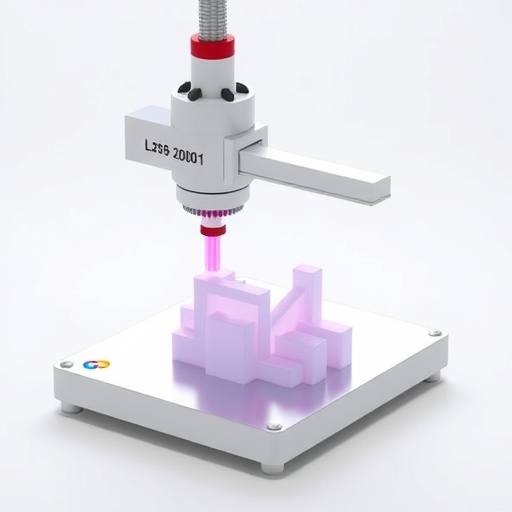
A groundbreaking study from researchers B. Karaş and A. Shokrani has introduced an innovative approach to understanding the costs associated with laser powder-bed additive manufacturing (LPBFAM), a leading-edge technology revolutionizing the production landscape. Published in the esteemed journal npj Advanced Manufacturing, this research combines the financial rigor of activity-based costing (ABC) with the dynamic insights of discrete event simulation (DES) to deliver an unprecedented analytical framework. This intersection of cost accounting and operational modeling could herald a new era of efficiency and transparency in additive manufacturing industries worldwide.
Laser powder-bed fusion additive manufacturing stands as a pillar of modern industrial innovation, allowing the creation of complex geometries and bespoke components with unparalleled precision. However, despite its transformative potential, the method’s cost structure has remained notoriously opaque due to the myriad factors influencing production: from powder material characteristics and machine parameters to post-processing requirements and machine downtime. Until now, attempts to quantify these costs have struggled with oversimplified models lacking the ability to simulate the actual production process dynamically. The novel methodology introduced by Karaş and Shokrani addresses these gaps by embedding discrete event simulation within activity-based costing frameworks.
Activity-based costing, a well-established managerial accounting technique, enables the allocation of overhead and indirect costs to specific activities, ultimately attributing expenses more accurately to products based on their consumption of resources. When integrated with discrete event simulation—a method used to model the operation of a system as a sequence of events occurring at discrete points in time—the combined approach provides an unparalleled lens through which the true drivers of cost in laser powder-bed additive manufacturing can be observed and analyzed in a virtual environment. This synergy allows for scenario testing, process optimization, and strategic decision-making, all grounded in empirical modeling rather than static estimates.
The study delves deeply into the laser powder-bed additive manufacturing process, addressing key steps including powder spreading, layer melting, build plate movement, and post-build thermal treatments. Each activity is meticulously modeled within the discrete event simulation environment, accounting for machine cycle times, material usage, maintenance scheduling, and operator interventions. This detailed granularity empowers the activity-based costing model to attribute specific costs to these discrete events, thereby illuminating inefficiencies and potential areas for cost reduction.
Delving further into discrete event simulation’s role, the researchers underscore the significance of capturing variability inherent to LPBFAM processes. Factors such as varying build geometries, stochastic machine downtimes, and fluctuating environmental conditions can all influence process outcomes and cycle times. By simulating these events with probabilistic distributions and real-world data inputs, the model transcends traditional deterministic costing approaches, allowing manufacturers to anticipate fluctuations and prepare for contingencies more effectively.
One of the pivotal outcomes of this research is the capacity to conduct ‘what-if’ analyses to explore how alterations in process parameters or operational strategies impact overall production costs. For instance, the model can simulate the financial consequences of changing laser power settings, modifying bed preheat temperatures, or adjusting layer thicknesses—variables that directly affect build time, material consolidation, and defect rates. These insights equip both engineers and financial planners with actionable intelligence capable of guiding process optimization towards more cost-effective configurations.
Moreover, the integration of ABC and DES opens pathways to benchmarking different machine models, alloys, or production layouts. Manufacturers contemplating investments in new equipment or process modifications can leverage this model to project the associated financial ramifications before capital is committed. This proactive capacity represents a compelling strategic tool amid rising competition and the continual pressure to streamline additive manufacturing operations.
Beyond the operational and financial spheres, the approach posited by Karaş and Shokrani could have ripple effects across supply chains and product development lifecycles. By clarifying production cost drivers with unprecedented fidelity, firms can better negotiate pricing, manage supplier relationships, and develop more accurate cost models for pricing and forecasting. Additionally, early-stage design decisions can incorporate cost considerations with greater precision, fostering designs that balance technical performance with economic feasibility—a crucial advantage in the agile, innovation-driven world of additive manufacturing.
The researchers support their model with case studies and validation exercises, utilizing empirical data gathered from commercial LPBFAM systems. Performance metrics such as cycle times, energy consumption, material usage, and failure rates are carefully benchmarked against simulated outcomes, lending credence to the model’s predictive fidelity. These validations underscore the practical applicability of the methodology and signal its potential integration into industrial practice without prohibitive calibration or customization requirements.
Importantly, this work also provides a foundation for extending cost modeling beyond the immediate build environment. Considerations of downstream processes—such as support removal, surface finishing, and quality inspections—though outside the direct scope of LPBFAM itself, could be incorporated in future model iterations. This holistic view would further empower manufacturers to evaluate full product lifecycle costs, an essential factor in enterprises striving for sustainability and economic resilience.
A noteworthy technological facet of the model is its scalability and adaptability across different additive manufacturing platforms. Although developed specifically around laser powder-bed fusion, the underlying approach of combining activity-based costing with discrete event simulation could be extrapolated to other additive processes, such as electron beam melting or binder jetting. This flexibility broadens the research impact, laying groundwork for comprehensive cost management frameworks across a spectrum of cutting-edge manufacturing technologies.
The implications of Karaş and Shokrani’s research ripple across academia, industry, and policy realms. For academia, it presents a fertile area of exploration, inviting further refinements in modeling techniques and integration with emerging data analytics and machine learning approaches. For industry, the practical benefits of better cost visibility and optimization could accelerate the adoption curve for additive manufacturing, helping companies navigate the transition from prototyping to mass production with greater financial confidence. Policymakers tasked with fostering advanced manufacturing competitiveness may also find value in promoting such analytical frameworks as part of broader industrial modernization efforts.
As additive manufacturing increasingly permeates sectors ranging from aerospace and automotive to healthcare and consumer products, understanding and managing production costs with precision becomes paramount. The heralded approach presented in this study brings the community a step closer to demystifying the complex economics of LPBFAM, providing a methodological breakthrough whose effects could translate directly into improved profitability and innovation capacity.
This research exemplifies the burgeoning trend of converging disciplinary tools—accounting theory, process engineering, and simulation modeling—to tackle contemporary industrial challenges. By tying together theoretical rigor with practical application, Karaş and Shokrani’s work not only advances additive manufacturing scholarship but also emerges as an essential reference point for practitioners seeking to harness these transformative technologies fully.
In conclusion, the integration of activity-based costing with discrete event simulation offers a paradigm-shifting vantage point on laser powder-bed additive manufacturing. Beyond traditional cost estimation, this approach captures the fluidity, complexity, and operational nuances of the manufacturing process, enabling stakeholders to make more informed, data-driven decisions. As the additive manufacturing sector marches toward more mature, scaled production, methodologies like this will be indispensable in unlocking its full economic and technological potential.
Karaş, B., Shokrani, A. Activity-based costing of laser powder-bed additive manufacturing incorporating discrete event simulation.
npj Adv. Manuf. 2, 24 (2025). https://doi.org/10.1038/s44334-025-00036-x
Cite Scienmag News
Denise Maddox. (June 16, 2025). Activity-Based Costing Meets Simulation in Laser 3D Printing. Scienmag. https://scienmag.com/activity-based-costing-meets-simulation-in-laser-3d-printing/
Denise Maddox. "Activity-Based Costing Meets Simulation in Laser 3D Printing." Scienmag, 16 June 2025, https://scienmag.com/activity-based-costing-meets-simulation-in-laser-3d-printing/. Accessed 3 September 2026.
Denise Maddox. "Activity-Based Costing Meets Simulation in Laser 3D Printing." Scienmag. June 16, 2025. https://scienmag.com/activity-based-costing-meets-simulation-in-laser-3d-printing/


