


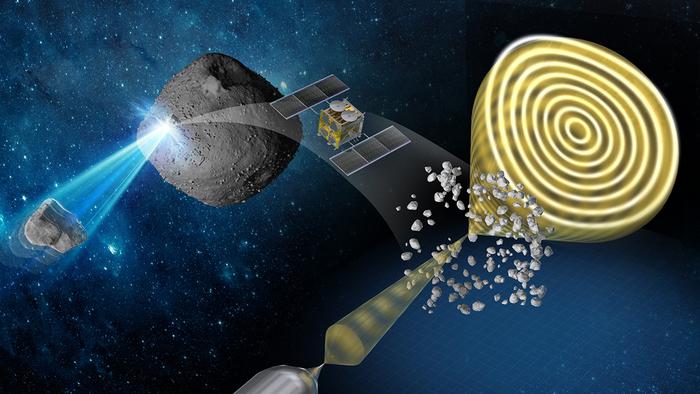
Samples reveal evidence of changes experienced by the surface of asteroid Ryugu, some probably due to micrometeoroid bombardment.

Credit: Yuki Kimura
Samples reveal evidence of changes experienced by the surface of asteroid Ryugu, some probably due to micrometeoroid bombardment.
Analyzing samples retrieved from the asteroid Ryugu by the Japanese Space Agency’s Hayabusa2 spacecraft has revealed new insights into the magnetic and physical bombardment environment of interplanetary space. The results of the study, carried out by Professor Yuki Kimura at Hokkaido University and co-workers at 13 other institutions in Japan, are published in the journal Nature Communications.
The investigations used electron waves penetrating the samples to reveal details of their structure and magnetic and electric properties, a technique called electron holography.
Hayabusa2 reached asteroid Ryugu on 27 June 2018, collected samples during two delicate touchdowns, and then returned the jettisoned samples to Earth in December 2020. The spacecraft is now continuing its journey through space, with plans for it to observe two other asteroids in 2029 and 2031.
One advantage of collecting samples directly from an asteroid is that it allows researchers to examine long-term effects of its exposure to the environment of space. The ‘solar wind’ of high energy particles from the sun and bombardment by micrometeoroids cause changes known as space-weathering. It is impossible to study these changes precisely using most of the meteorite samples that land naturally on Earth, partly due to their origin from the internal parts of an asteroid, and also due to the effects of their fiery descent through the atmosphere.
“The signatures of space weathering we have detected directly will give us a better understanding of some of the phenomena occurring in the Solar System,” says Kimura. He explains that the strength of the magnetic field in the early solar system decreased as planets formed, and measuring the remnant magnetization on asteroids can reveal information about the magnetic field in the very early stages of the solar system.
Kimura adds, “In future work, our results could also help to reveal the relative ages of surfaces on airless bodies and assist in the accurate interpretation of remote sensing data obtained from these bodies.”
One particularly interesting finding was that small mineral grains called framboids, composed of magnetite, a form of iron oxide, had completely lost their normal magnetic properties. The researchers suggest this was due to collision with high velocity micrometeoroids between 2 and 20 micrometers in diameter. The framboids were surrounded by thousands of metallic iron nanoparticles. Future studies of these nanoparticles will hopefully reveal insights into the magnetic field that the asteroid has experienced over long periods of time.
“Although our study is primarily for fundamental scientific interest and understanding, it could also help estimate the degree of degradation likely to be caused by space dust impacting robotic or manned spacecraft at high velocity,” Kimura concludes.
Journal
Nature Communications
Method of Research
Experimental study
Subject of Research
Not applicable
Article Title
Nonmagnetic framboid and associated iron nanoparticles with a space-weathered feature from asteroid Ryugu
Article Publication Date
29-Apr-2024
Cite Scienmag News
Grant Pearson. (April 29, 2024). Probing the effects of interplanetary space on asteroid Ryugu. Scienmag. https://scienmag.com/probing-the-effects-of-interplanetary-space-on-asteroid-ryugu/
Grant Pearson. "Probing the effects of interplanetary space on asteroid Ryugu." Scienmag, 29 April 2024, https://scienmag.com/probing-the-effects-of-interplanetary-space-on-asteroid-ryugu/. Accessed 3 September 2026.
Grant Pearson. "Probing the effects of interplanetary space on asteroid Ryugu." Scienmag. April 29, 2024. https://scienmag.com/probing-the-effects-of-interplanetary-space-on-asteroid-ryugu/

