


Professor Yong-Young Noh from the Department of Chemical Engineering at Pohang University of Science and Technology (POSTECH), along with Dr. Ao Liu and Dr. Huihui Zhu, postdoctoral researchers from the Department of Chemical Engineering at POSTECH and now professors at the University of Electronic Science and Technology of China, Dr. Yong-Sung Kim from Korea Research Institute of Standards and Science, and Dr. Min Gyu Kim from the Pohang Accelerator Laboratory, collaborated on the development of a tellurium-selenium composite oxide semiconductor material. Their efforts led to the successful creation of a high-performance and highly stable p-type thin-film transistor (TFT). This research has been published online in Nature, a premier international scientific journal.

Credit: POSTECH
Professor Yong-Young Noh from the Department of Chemical Engineering at Pohang University of Science and Technology (POSTECH), along with Dr. Ao Liu and Dr. Huihui Zhu, postdoctoral researchers from the Department of Chemical Engineering at POSTECH and now professors at the University of Electronic Science and Technology of China, Dr. Yong-Sung Kim from Korea Research Institute of Standards and Science, and Dr. Min Gyu Kim from the Pohang Accelerator Laboratory, collaborated on the development of a tellurium-selenium composite oxide semiconductor material. Their efforts led to the successful creation of a high-performance and highly stable p-type thin-film transistor (TFT). This research has been published online in Nature, a premier international scientific journal.
Semiconductors are used in almost every electronic device that people use such as cell phones, PCs, and automobiles. They can be classified into two main categories: crystalline and amorphous semiconductors. Crystalline semiconductors possess a well-ordered atomic or molecular structure while amorphous semiconductors lack such regularity. Consequently, amorphous semiconductors offer simpler fabrication methods and reduced costs compared to their crystalline counterparts. However, they typically exhibit inferior electrical performance.
Research progress on p-type amorphous semiconductors has been notably sluggish. Despite the widespread adoption of n-type amorphous oxide semiconductors, particularly those based on indium gallium zinc oxide (IGZO) in OLED displays and memory devices, the advancement of p-type oxide materials has been impeded by numerous inherent defects. This setback has hindered the development of n-p-type complementary bipolar semiconductors (CMOS), which serve as the cornerstone of electronic devices and integrated circuits. Achieving high-performance amorphous p-type oxide semiconductor devices has long been regarded as a near-impossible challenge, with academia facing two decades of unsuccessful attempts.
Nevertheless, a team of researchers led by POSTECH Professor Yong-Young Noh, has transformed the seemingly “impossible” into the “possible”.
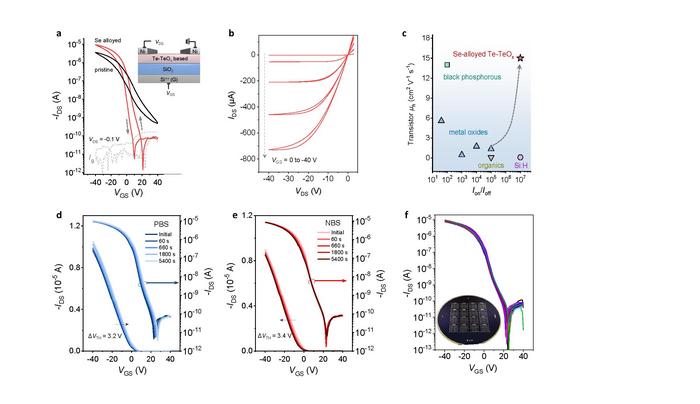
Through their investigation, the team discovered that the charge of tellurium oxide, a rare earth metal, increases in oxygen-deficient environments. This phenomenon arises from the creation of an acceptor level capable of accommodating electrons in the absence of sufficient oxygen, thereby enabling the material to function as a p-type semiconductor. Building upon this insight, the team successfully engineered high-performance and exceptionally stable amorphous p-type oxide Thin-Film Transistors (TFTs) utilizing partially oxidized tellurium thin films and a tellurium-selenium composite oxide (Se:TeOx) incorporating selenium.
Experimental findings reveal that the team’s TFTs exhibit the most impressive hole mobility (15 cm2V-1s-1) and on/off current ratio (106-107) ever reported for a p-type amorphous oxide TFT. These achievements nearly match the performance levels of conventional n-type oxide semiconductors (such as IGZOs), which have been extensively studied.
Furthermore, the team’s TFTs demonstrated exceptional stability under varying external conditions including fluctuations in voltage, current, air, and humidity. Notably, uniform performance across all TFT components was observed when fabricated on wafers, affirming their suitability for reliable semiconductor devices applicable in industrial settings.
Professor Yong-Young Noh of POSTECH expressed optimism by saying, “This milestone holds significant implications for next-generation display technologies such as OLED TVs, VR, and AR devices as well as for research on low-power CMOS and DRAM memory.” He added, “We anticipate its potential to drive substantial value creation across diverse industries.”
The research was conducted with support from the National Semiconductor Laboratory Program and the Mid-Career Researcher Program of the National Research Foundation of Korea, and Samsung Display.
Journal
Nature
Article Title
Selenium alloyed tellurium oxide for amorphous p-channel transistors
Article Publication Date
10-Apr-2024
Cite Scienmag News
Denise Maddox. (April 26, 2024). POSTECH Professor Yong-Young Noh resolves two decades of oxide semiconductor challenges, which Is published in prestigious journal Nature. Scienmag. https://scienmag.com/postech-professor-yong-young-noh-resolves-two-decades-of-oxide-semiconductor-challenges-which-is-published-in-prestigious-journal-nature/
Denise Maddox. "POSTECH Professor Yong-Young Noh resolves two decades of oxide semiconductor challenges, which Is published in prestigious journal Nature." Scienmag, 26 April 2024, https://scienmag.com/postech-professor-yong-young-noh-resolves-two-decades-of-oxide-semiconductor-challenges-which-is-published-in-prestigious-journal-nature/. Accessed 4 September 2026.
Denise Maddox. "POSTECH Professor Yong-Young Noh resolves two decades of oxide semiconductor challenges, which Is published in prestigious journal Nature." Scienmag. April 26, 2024. https://scienmag.com/postech-professor-yong-young-noh-resolves-two-decades-of-oxide-semiconductor-challenges-which-is-published-in-prestigious-journal-nature/

