

Wednesday, November 11, 2026
Science
No Result
View All Result
  • Login
  • HOME
  • SCIENCE NEWS
  • CONTACT US
  • HOME
  • SCIENCE NEWS
  • CONTACT US
No Result
View All Result
Scienmag
No Result
View All Result
Home Science News Technology and Engineering

New Centroid-Based Algorithm Improves Community Detection in Complex Networks

November 11, 2026
in Technology and Engineering
Denise Maddox
By Denise Maddox Scienmag Editorial Profile - Mechanical Engineering
Reading Time: 2 mins read
0
New Centroid-Based Algorithm Improves Community Detection in Complex Networks

New Centroid-Based Algorithm Improves Community Detection in Complex Networks

65
SHARES
587
VIEWS
Share on FacebookShare on Twitter
ADVERTISEMENT

Researchers have developed a degree–distance centroid community detection technique, designated as DDC–CD, that enhances the identification of structural organization schemes within complex networks. By uniquely combining node degree metrics with shortest-path distance measurements, the computational method selects optimal centroids to guide the formation of balanced, well-separated community structures across social, biological, and communication systems.

The investigation, conducted by Srinivas Amedapu and R. Leela Velusamy and published in Applied Network Science, evaluated the newly proposed algorithm alongside four established community detection strategies. The comparative assessment benchmarked DDC–CD against the random node head technique, the highest-degree node head technique, the Louvain community detection technique, and the max–min technique across multiple network environments.

To assess structural quality and operational performance, the authors conducted empirical experiments across four real-world datasets: Facebook, Power-Grid, Wiki-Vote, and Gnutella. The evaluation focused on three primary performance metrics: average fitness values to gauge intercommunity connectivity, modularity scores to evaluate partition quality, and overall execution runtime.

In experimental evaluations, the DDC–CD method consistently produced the lowest average fitness values among the tested approaches, recording 0.240 on Facebook, 0.340 on Power-Grid, 0.190 on Wiki-Vote, and 0.280 on Gnutella, reflecting minimal connectivity between distinct communities. The approach also achieved higher modularity values across most datasets, scoring 0.531 for Facebook, 0.731 for Power-Grid, 0.141 for Wiki-Vote, and 0.227 for Gnutella, demonstrating superior structural cohesion in the detected clusters.

Regarding computational speed, the runtime of DDC–CD was marginally higher than the execution times recorded for the random node head technique and the highest-degree node head technique. However, the authors observed that the algorithm remained computationally efficient while offering a more balanced operational trade-off than the Louvain and max–min techniques, surpassing existing methods by producing compact, cohesive, and stable network communities.

The documented findings represent peer-reviewed, accepted research published under open-access terms to ensure rapid availability for researchers studying complex network systems. Issued in advance of the final Version of Record, this citable contribution provides verified access to the comparative framework, operating under standard legal disclaimers while remaining subject to final editorial modifications.

Subject of Research: Community detection in complex networks using degree-distance centroids

Article Title: Detecting communities in complex networks using a degree–distance centroid-based method (DDC–CD)

Article References: Amedapu, S., & Velusamy, R. L. (2026). Detecting communities in complex networks using a degree–distance centroid-based method (DDC–CD). Applied Network Science, 11(1), Article 66. https://doi.org/10.1007/s41109-026-00811-5

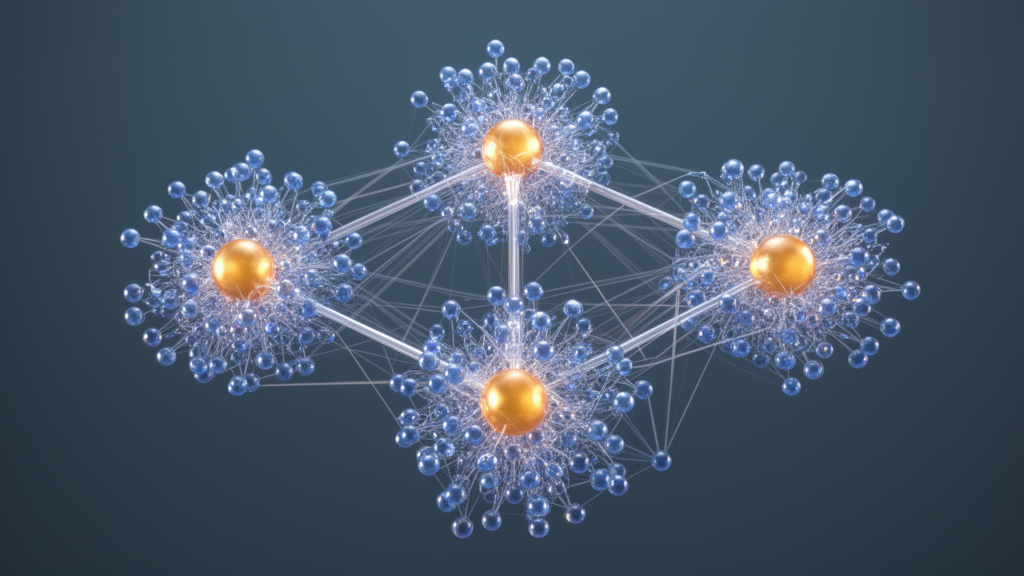
Image Credits: AI Generated

DOI: 10.1007/s41109-026-00811-5

Keywords: community detection, complex networks, degree-distance centroid, network analysis, modularity, social networks, graph algorithms, applied network science, Detecting, communities, complex, networks

Cite Scienmag News

Denise Maddox. (November 11, 2026). New Centroid-Based Algorithm Improves Community Detection in Complex Networks. Scienmag. https://scienmag.com/new-centroid-based-algorithm-improves-community-detection-in-complex-networks/

Denise Maddox. "New Centroid-Based Algorithm Improves Community Detection in Complex Networks." Scienmag, 11 November 2026, https://scienmag.com/new-centroid-based-algorithm-improves-community-detection-in-complex-networks/. Accessed 11 November 2026.

Denise Maddox. "New Centroid-Based Algorithm Improves Community Detection in Complex Networks." Scienmag. November 11, 2026. https://scienmag.com/new-centroid-based-algorithm-improves-community-detection-in-complex-networks/

Tags: Applied Network Sciencecommunitiescommunity detectioncomplexcomplex networksdegree-distance centroidDetectinggraph algorithmsmodularitynetwork analysisnetworkssocial networks
Share26Tweet16
Previous Post

Advanced Local Climate Mapping Pinpoints Urban Heat Disparities in Midwestern Cities

Next Post

Hybrid AI Model Detects Mild Cognitive Impairment from EEG

Related Posts

Global Review Uncovers Stark Methodological Divides in Electricity Demand Forecasting
Technology and Engineering

Global Review Uncovers Stark Methodological Divides in Electricity Demand Forecasting

November 11, 2026
Biologgers and Machine Learning Classify European Seabass Welfare States in Sea-Cages
Biology

Biologgers and Machine Learning Classify European Seabass Welfare States in Sea-Cages

November 11, 2026
Machine Learning Model Predicts Antimicrobial Peptide Synergy With High Test Accuracy
Biotechnology

Machine Learning Model Predicts Antimicrobial Peptide Synergy With High Test Accuracy

November 11, 2026
Virtual Semantic Knowledge Graphs and Negative Feedback Enhance Recommender System Accuracy
Technology and Engineering

Virtual Semantic Knowledge Graphs and Negative Feedback Enhance Recommender System Accuracy

November 11, 2026
Localized Neural Network Cuts PET Image Blurring and Shortens Scan Times
Medicine

Localized Neural Network Cuts PET Image Blurring and Shortens Scan Times

November 11, 2026
Review Evaluates Construction Noise Risks for Endangered Baltic Harbour Porpoises
Technology and Engineering

Review Evaluates Construction Noise Risks for Endangered Baltic Harbour Porpoises

November 11, 2026
Next Post
Hybrid AI Model Detects Mild Cognitive Impairment from EEG

Hybrid AI Model Detects Mild Cognitive Impairment from EEG

  • Mothers who receive childcare support from maternal grandparents show more optimized

    Mothers who receive childcare support from maternal grandparents show more parental warmth, finds NTU Singapore study

    27656 shares
    Share 11059 Tweet 6912
  • University of Seville Breaks 120-Year-Old Mystery, Revises a Key Einstein Concept

    1061 shares
    Share 424 Tweet 265
  • Bee body mass, pathogens and local climate influence heat tolerance

    682 shares
    Share 273 Tweet 171
  • Researchers record first-ever images and data of a shark experiencing a boat strike

    546 shares
    Share 218 Tweet 137
  • Groundbreaking Clinical Trial Reveals Lubiprostone Enhances Kidney Function

    531 shares
    Share 212 Tweet 133
Science

Embark on a thrilling journey of discovery with Scienmag.com—your ultimate source for cutting-edge breakthroughs. Immerse yourself in a world where curiosity knows no limits and tomorrow’s possibilities become today’s reality!

RECENT NEWS

  • Gelatin and Tea Polyphenol Complexes Protect Frozen Surimi From Ice Damage
  • Quantitative PCR Measures Fungal Biomass in Diverse Biogenic Waste Composites
  • Green Spectrophotometric Method Quantifies Piroxicam and Venlafaxine Using Chemometric Modeling
  • Global Review Uncovers Stark Methodological Divides in Electricity Demand Forecasting

Categories

  • Agriculture
  • Anthropology
  • Archaeology
  • Athmospheric
  • Biology
  • Biotechnology
  • Blog
  • Bussines
  • Cancer
  • Chemistry
  • Climate
  • Earth Science
  • Editorial Policy
  • Marine
  • Mathematics
  • Medicine
  • Pediatry
  • Policy
  • Psychology & Psychiatry
  • Science Education
  • Science News
  • Social Science
  • Space
  • Technology and Engineering

Subscribe to Blog via Email

Enter your email address to subscribe to this blog and receive notifications of new posts by email.

Join 5,150 other subscribers

© 2026 Scienmag - Science Magazine

Welcome Back!

Login to your account below

Forgotten Password?

Retrieve your password

Please enter your username or email address to reset your password.

Log In
No Result
View All Result
  • HOME
  • SCIENCE NEWS
  • CONTACT US

© 2026 Scienmag - Science Magazine

Discover more from Science

Subscribe now to keep reading and get access to the full archive.

Continue reading

