


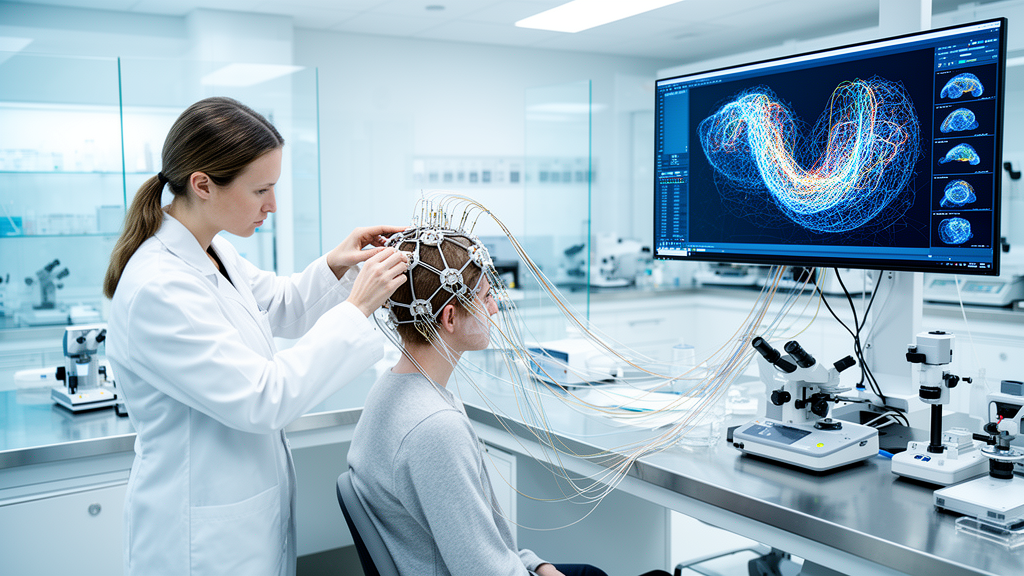
A review published in BMC Biomedical Engineering in May 2024 examines the emerging role of generative artificial intelligence in advancing the development of brain-computer interfaces. The study, authored by Seif Eldawlatly, highlights how generative AI techniques are being employed to address longstanding challenges that have hindered the widespread practical use of these systems. Since their inception more than 50 years ago, brain-computer interfaces have held promise for compensating for lost functions in people with disabilities by enabling direct communication between the brain and external devices. However, the transition from laboratory feasibility to widespread real-world application has been stalled by issues such as limited data availability, low spatiotemporal resolution of non-invasive brain signals, and significant variability between different users.
The review identifies four primary areas where generative AI has been recently adopted to overcome these barriers. These include the augmentation of limited electroencephalogram data, the enhancement of the spatiotemporal resolution of recorded signals, the improvement of cross-subject performance to reduce calibration time, and the development of end-to-end applications that transform brain signals into other media. By leveraging deep learning models with large numbers of tunable parameters, researchers are using these techniques to generate synthetic brain activity that resembles real recorded data, thereby providing more material for machine learning algorithms to process and learn from.
One of the most significant applications of generative AI in this field is data augmentation for specific brain patterns. The P300 pattern, a positive peak appearing approximately 300 milliseconds after a rare anticipated stimulus, is central to many speller systems. Traditionally, achieving accurate classification for P300-based systems requires a large number of trials, which is inconvenient for users. The review notes that various generative adversarial network architectures, including Deep Convolutional GANs and Conditional GANs, have been used to generate synthetic P300 data. When this synthetic data is added to real recordings, it has led to an increase in P300 recognition accuracy by 10 to 18 percent, allowing for shorter calibration times and less user inconvenience.
Similar benefits have been observed in systems utilizing the Steady-state Visual Evoked Potential, or SSVEP, which relies on the frequency spectrum of flickering visual stimuli. Generative AI models such as Variational Autoencoders and StarGAN have been employed to generate synthetic data in both the time and frequency domains. This approach has improved SSVEP recognition accuracy by 2 to 20 percent. Furthermore, using Long Short-term Memory-based GANs to generate signals of longer duration has increased SSVEP recognition accuracy by approximately 30 percent, helping to obtain better spectrum estimation while reducing the amount of data that needs to be recorded from users.
Motor Imagery, which involves recognizing spectral patterns corresponding to imagined movements, is another key paradigm where generative AI has shown utility. Studies have used Variational Autoencoders and conditional Wasserstein GANs to augment time-domain EEG signals, resulting in classification accuracy enhancements of 1 to 18 percent depending on the dataset and architecture. Another approach involves transforming EEG signals into the frequency domain using the Short-time Fourier Transform and representing them as images. Generative AI is then used to create synthetic images of these spectra, which has enhanced overall Motor Imagery classification accuracy by 2.5 to 12 percent. These methods collectively suggest that generative AI can significantly reduce the amount of training data required for effective BCI operation.
Beyond data augmentation, generative AI is being applied to enhance the spatial and temporal resolution of EEG signals. High spatial resolution typically requires expensive equipment with many electrodes, which is impractical for daily use. Deep Convolutional Neural Networks have been used to estimate signals from electrodes not present in a headset, effectively synthesizing signals from as few as 4 input electrodes to produce outputs from up to 60 electrodes. In one study, using only 25 percent of the channels to generate the remaining 75 percent resulted in a minimal reduction of only 9 percent in mental imagery classification accuracy compared to ground-truth data, demonstrating the efficacy of this approach for practical applications.
The review also details efforts to map EEG signals to underlying neural activity, such as mesoscale neural activity or intracranial EEG. Deep neural networks comprising ResNet and LSTM architectures have achieved a mean correlation of 0.83 when mapping EEG to mesoscale neural activity. Additionally, GANs have been used to detect interictal epileptiform discharges with an accuracy reaching 76 percent, outperforming previous approaches. These findings indicate that generative AI can not only improve BCI performance but also aid in understanding how single-neuron activity maps to scalp-recorded EEG signals.
Temporal resolution enhancement is another area of focus, where generative AI can generate high temporal resolution EEG signals from lower resolution recordings. Vanilla GANs and WGANs have been used to double the sampling rate of recorded EEG, leading to an enhancement in classification accuracy for Motor Imagery datasets by approximately 4 percent. While this area has not been as thoroughly examined as spatial resolution enhancement, it offers a promising path to reducing the cost and complexity of EEG recording devices by augmenting the capabilities of lower-resolution hardware.
Cross-subject performance is a critical challenge for the scalability of BCI systems, as inter-subject variability typically requires extensive calibration data for each user. Generative AI techniques are being explored to generate subject-independent data that can train classifiers without the need for target-specific data. For P300-based BCIs, a hybrid CNN-LSTM GAN increased cross-subject accuracy by 10 percent. In SSVEP-based systems, various GAN and VAE models resulted in performance improvements ranging from 3 to 35 percent. For Motor Imagery BCIs, transformer models with attention mechanisms enhanced cross-subject performance by 0.88 to 2.11 percent, while a CNN-based GAN using common spatial pattern filtering improved overall cross-subject accuracy by 15.85 percent.
The review also explores the use of generative AI in developing end-to-end BCI applications that go beyond standard classification tasks. One such application is the generation of speech from recorded EEG signals, a task of particular interest for individuals with reduced communication abilities. A dual GAN architecture achieved a similarity of 78.5 percent between actual and generated speech for both single words and long sentences. Denoising diffusion probabilistic models have also been used, exceeding the accuracy of other models in generating speech by 14.5 percent. These advancements suggest that generative AI could provide a framework for successful speech synthesis from brain signals.
In the realm of visual generation, pre-trained stable diffusion models, VAEs, and GANs have been demonstrated to generate images from EEG signals. Stable diffusion models outperformed other techniques, achieving a similarity of 45.8 percent between actual and generated images. Another diffusion-based model that extracts multi-level semantics from EEG signals achieved an accuracy of 85.6 percent when evaluated using semantic classifiers. A dual autoencoder based on a CNN architecture also achieved an accuracy of 85 percent in classifying generated images using both inter-subject and intra-subject data. These results highlight the potential for generative AI to create complex visual content directly from brain activity.
Despite these promising results, the review outlines several challenges that must be addressed for the full realization of generative AI in BCI development. Generative AI models require extensive training data to produce reliable outputs, and training with limited data can lead to overfitting. The convergence and stability of these models often require extensive hyperparameter tuning, which is computationally expensive and may not be feasible for individual subject calibration. Furthermore, generative AI techniques are characterized by high computational complexity, which poses challenges for real-time application. The risk of hallucination in generative models is also a significant concern in critical BCI applications, such as controlling a wheelchair or robotic arm, where errors could have life-threatening consequences.
The review concludes that while generative AI is predominantly GAN-based in current BCI applications, the utilization of other techniques such as large language models and diffusion models remains under-explored. Future directions include using generative AI to augment test data during online use, potentially reducing the time needed to type using P300 speller systems. The integration of generative AI and BCI is seen as a bi-directional benefit, where BCI data could also help train AI models to better mimic human cognitive processes. Addressing the current limitations in data availability, computational cost, and model stability will be key to transforming BCI into a prevalent assistive technology for general use.
Subject of Research: The application of generative artificial intelligence techniques to overcome data scarcity, resolution, and variability challenges in brain-computer interface development.
Article Title: On the role of generative artificial intelligence in the development of brain-computer interfaces
Article References: Eldawlatly, S. (2024). On the role of generative artificial intelligence in the development of brain-computer interfaces. BMC Biomedical Engineering, 6(1), Article 4. https://doi.org/10.1186/s42490-024-00080-2
Image Credits: AI Generated
DOI: 10.1186/s42490-024-00080-2
Keywords: brain-computer interfaces, generative AI, EEG, data augmentation, spatiotemporal resolution, cross-subject performance, speech synthesis, image generation, assistive technology, BMC Biomedical Engineering, role, generative
Cite Scienmag News
Cassandra Pierce. (November 10, 2026). Generative AI Enhances Brain-Computer Interface Accuracy and Resolution. Scienmag. https://scienmag.com/generative-ai-enhances-brain-computer-interface-accuracy-and-resolution/
Cassandra Pierce. "Generative AI Enhances Brain-Computer Interface Accuracy and Resolution." Scienmag, 10 November 2026, https://scienmag.com/generative-ai-enhances-brain-computer-interface-accuracy-and-resolution/. Accessed 10 November 2026.
Cassandra Pierce. "Generative AI Enhances Brain-Computer Interface Accuracy and Resolution." Scienmag. November 10, 2026. https://scienmag.com/generative-ai-enhances-brain-computer-interface-accuracy-and-resolution/




