


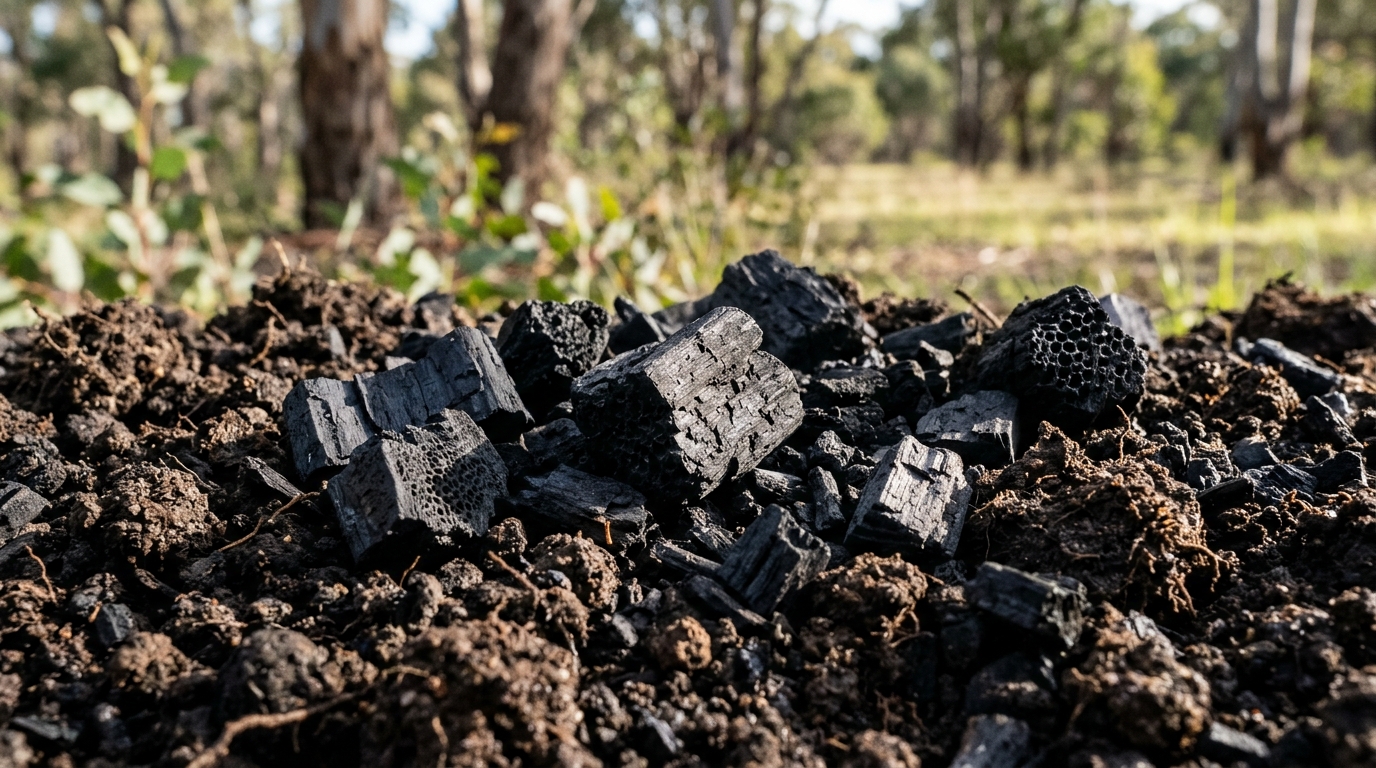
A pilot-scale study published in Carbon Neutral Systems demonstrates that a continuous horizontal reactor can produce biochar from eucalyptus wood chips with properties suitable for long-term carbon storage. The research, led by Cinthia Oliveira de Souza Nogueira and colleagues, evaluated the yield, physicochemical stability, and environmental safety of the material produced under industrial conditions. The study aimed to address the scarcity of data regarding biochar production outside of controlled laboratory settings, providing evidence for the technical feasibility of this negative emission technology at a larger scale.
The production process utilized a continuous horizontal reactor with an operational capacity of 20 to 25 tons per month, located in Dores do Indaiá, Brazil. Approximately 620 kg of eucalyptus wood chips, obtained from plantation-grown Eucalyptus sp., were processed through the system. The reactor integrated drying, pyrolysis, combustion of generated gases, and cooling of the solid product. Pyrolysis was conducted via indirect heating, with the process stabilizing at approximately 430 °C. This temperature was selected based on thermogravimetric analysis, which indicated that the highest release of volatiles occurs near 400 °C, making 430 °C a suitable condition for optimizing both yield and quality.
The resulting biochar exhibited a gravimetric yield of 28% by weight, a figure consistent with the 20–32% range typically reported for woody biomass. Proximate analysis revealed a composition of 78.7% fixed carbon, 15.5% volatile matter, and 5.8% ash. These values indicate efficient pyrolysis and a high degree of carbonization. The material’s thermal stability was further confirmed by thermogravimetric analysis of the biochar itself, which showed no peaks associated with hemicellulose or cellulose degradation, confirming that these components had been fully decomposed during the pyrolysis process. At 1000 °C, 76.5% of the mass was retained, highlighting the predominance of fixed carbon and minerals.
Chemical characterization indicated a high level of aromaticity and recalcitrance, with molar H/Corg and O/Corg ratios of 0.41 and 0.31, respectively. Both ratios fall below the thresholds proposed by the European Biochar Certificate, suggesting a stable chemical structure with low reactivity and resistance to degradation in soil. Fourier transform infrared spectroscopy supported this interpretation, identifying bands associated with aromatic structures and substituted aromatics. The biochar also possessed a specific surface area of 67.75 m² g⁻¹, determined via the Brunauer–Emmett–Teller method. While moderate, this surface area is associated with the creation of interaction sites and microhabitats for soil microorganisms, complementing the porous architecture observed in scanning electron microscopy images.
Environmental safety assessments confirmed that the biochar is free from significant toxic contaminants. Concentrations of heavy metals such as cadmium, mercury, arsenic, and lead were found to be below the limits established by the European Biochar Certificate. Similarly, polycyclic aromatic hydrocarbons, polychlorinated biphenyls, and dioxins were detected at concentrations below the limit of quantification. The material’s pH of 7.8 and electrical conductivity of 329.7 µS cm⁻¹ support its potential for agricultural use, as these properties can contribute to the correction of soil acidity and balanced ion supply. The presence of nutrients like phosphorus, calcium, and zinc further reinforces its agronomic potential.
The carbon sequestration potential of the biochar was estimated using a model adapted from Woolf et al. (2021), which considers the mass fraction of organic carbon and its permanence in soil over a 100-year horizon. The estimated potential was 1.67 tonnes of CO2 equivalent per tonne of biochar. This calculation assumes an average soil temperature of 25 °C and relies on the H/Corg ratio to determine the fraction of carbon that remains stable. The thermostable fraction, calculated from proximate analysis data, was found to be 83%, indicating that a significant portion of the material is highly resistant to both thermal and biological degradation. This value surpasses those reported for biochars obtained from the gasification of other wood species, such as Pinus patula.
The study highlights the suitability of continuous horizontal pyrolysis for industrial deployment, as it offers operational advantages such as stable operation and homogeneous product quality. Unlike laboratory studies, which are often limited to small-scale, controlled conditions, this pilot-scale investigation provides insights into the performance of pyrolysis in practical scenarios. The findings suggest that the technology can produce a stable, low-toxicity biochar with potential for long-term carbon storage. However, the researchers note that the net impact of carbon sequestration may vary depending on emissions associated with the biochar’s life cycle, including production, transport, and application stages.
Limitations of the study include the absence of direct field trials to validate carbon stability and agronomic performance over time. The carbon sequestration estimate is derived from literature-based parameters and should be confirmed through long-term experimental studies. Additionally, while the biochar showed promising properties for soil application, its effects on soil biological dynamics and crop yields have not been directly measured in this work. The researchers emphasize the need for future research to focus on field-scale validation and comprehensive life cycle assessments to fully consolidate biochar as a tool for sustainable agro-industrial systems.
The preservation of a porous structure with interconnected pores, as observed in scanning electron microscopy, suggests that the biochar may promote colonization by microbial communities. These internal structures provide physical niches and favorable conditions for microbial adhesion, growth, and activity, which can contribute to soil biological dynamics. The energy-dispersive X-ray spectroscopy analysis indicated that carbon is the predominant element, followed by oxygen, calcium, potassium, magnesium, silicon, aluminum, and iron. The retention of these minerals during pyrolysis may contribute to soil fertility when the biochar is applied, offering an additional benefit beyond carbon sequestration.
In conclusion, the production of biochar from eucalyptus wood chips in a pilot-scale continuous horizontal reactor resulted in a material with characteristics suitable for soil application. The estimated carbon sequestration potential of 1.67 t CO2e t⁻¹ and the projected stability of over 100 years under typical field conditions suggest that this technology has significant potential for climate mitigation. The absence of contaminants and the presence of properties potentially beneficial to soil indicate promising use as an agricultural input. As the demand for negative emission technologies grows, this study provides a critical step toward the commercial adoption of biochar as a sustainable solution for carbon removal and soil quality enhancement.
Before thermochemical processing, the plantation-harvested eucalyptus chips presented an irregular particle size, an average bulk density of 300 ± 18 kg m⁻³, and an initial moisture content of 39 ± 2% on a wet basis. Managing this high moisture level required an integrated pre-treatment stage within the pilot system. The biomass was routed through a rotary drum dryer coupled directly to the reactor, using the facility’s exhaust gases as a recycled heat source. Operating with an inlet gas temperature of 375 °C and an exit temperature of 110 °C over a 10-minute residence time, the dryer successfully lowered moisture below 20% by weight. Achieving this threshold was essential, as processing wood below 20% moisture improves operational productivity and strengthens the overall economic viability of continuous biochar systems.
The thermal execution of the pilot trial provided specific operational data on continuous conversion over an eight-hour run. Indirect heating utilized auxiliary eucalyptus woodchips as combustion fuel, generating heating gases that entered the system at 825 °C and exited at 375 °C. Inside the horizontal chamber, temperatures initiated at 200 °C before stabilizing at approximately 430 °C, while woodchips maintained a biomass residence time of 40 minutes. This operational design addresses specific engineering challenges associated with continuous processing. Indirectly heated rotary kilns often suffer from limited gas-solid contact and low heat transfer efficiency that hinder process optimization, whereas continuous screw reactors consume large amounts of energy due to constant mechanical operation. The horizontal configuration demonstrates technical feasibility by combining continuous conveyance, effective heat integration, and uniform thermal processing.
Thermogravimetric profiling of the raw wood chips detailed the three-stage mass loss progression leading up to 1000 °C. The initial stage between 30 °C and 120 °C produced a 5.6% mass reduction attributed to the release of moisture and physically adsorbed water. The secondary stage from 200 °C to 400 °C drove the primary decomposition event, causing a 73.7% weight loss dominated by hemicellulose and cellulose degradation with a sharp differential peak at 360 °C. Above 400 °C, mass loss slowed to 8.1%, corresponding to lignin degradation and residual carbonization. In addition, nitrogen adsorption-desorption measurements revealed an open hysteresis loop typical of narrow slit-like pores. This pore geometry restricts cryogenic nitrogen diffusion as a result of micropore deformation and steric constraints at opening points.
The methodology for estimating long-term carbon sequestration relies on empirical mathematical relationships tying elemental ratios to soil persistence. The 100-year permanence factor was calculated using an established formula where retention decreases linearly as a function of the molar H/Corg ratio. Furthermore, the observed molar O/Corg ratio falls within the 0.2 to 0.6 range that scientific literature associates with environmental half-lives between 100 and 1,000 years. Regarding field implementation, the authors identify practical considerations for soil application, noting that fine particles can be vulnerable to wind and erosion losses, for which pelletization serves as a mitigation approach. Lastly, comprehensive carbon accounting must weigh manufacturing and transport emissions against indirect climate gains, such as suppressing agricultural nitrous oxide emissions.
Subject of Research: Pilot-scale production and characterization of biochar from eucalyptus wood chips for carbon sequestration
Article Title: Pilot-scale production of biochar from eucalyptus wood chips for carbon sequestration
Article References: Nogueira, C. O. D. S., de Almeida Pereira, V., Latorre, F. L., de Jesus Paula, R., Dutra Junior, A. T., de Almeida, I. A., Ferreira, O. E., Lima, E. N., da Silva Bezerra, A. C., & Machado, A. R. T. (2025). Pilot-scale production of biochar from eucalyptus wood chips for carbon sequestration. Carbon Neutral Systems, 1(1), Article 15. https://doi.org/10.1007/s44438-025-00015-x
Image Credits: AI Generated
DOI: 10.1007/s44438-025-00015-x
Keywords: biochar, carbon sequestration, pyrolysis, eucalyptus, negative emissions, soil amendment, pilot-scale, renewable energy, production, wood, chips, carbon
Cite Scienmag News
Denise Maddox. (November 8, 2026). Eucalyptus Biochar Pilot Study Shows Stable Carbon Sequestration Potential. Scienmag. https://scienmag.com/eucalyptus-biochar-pilot-study-shows-stable-carbon-sequestration-potential/
Denise Maddox. "Eucalyptus Biochar Pilot Study Shows Stable Carbon Sequestration Potential." Scienmag, 8 November 2026, https://scienmag.com/eucalyptus-biochar-pilot-study-shows-stable-carbon-sequestration-potential/. Accessed 17 November 2026.
Denise Maddox. "Eucalyptus Biochar Pilot Study Shows Stable Carbon Sequestration Potential." Scienmag. November 8, 2026. https://scienmag.com/eucalyptus-biochar-pilot-study-shows-stable-carbon-sequestration-potential/




