


A research team comprising Md Samdani Azad, Minji Choi, and Tae-Hyung Lee has developed an explainable multi-target machine learning framework based on Extreme Gradient Boosting to simultaneously predict two key engineering demand parameters in nuclear power plant reactor containment buildings: peak floor acceleration and peak floor displacement. Seismic fragility and reliability assessments represent fundamental components of probabilistic safety evaluations for nuclear infrastructure, where reactor containment buildings function as the final physical barrier preventing radioactive release during extreme seismic events. Past engineering evaluations have consistently emphasized the necessity of quantifying both aleatory uncertainties stemming from ground motion characteristics and epistemic uncertainties arising from variable structural and material properties. While comprehensive nonlinear time-history analysis yields realistic structural responses under earthquake loading, its prohibitive computational demands have historically created a severe bottleneck for large-scale probabilistic risk assessments. To overcome these computational constraints, the researchers demonstrated that a regularized, multi-output gradient boosting architecture can deliver rapid, highly accurate, and transparent demand forecasts across hundreds of simulated earthquake scenarios.
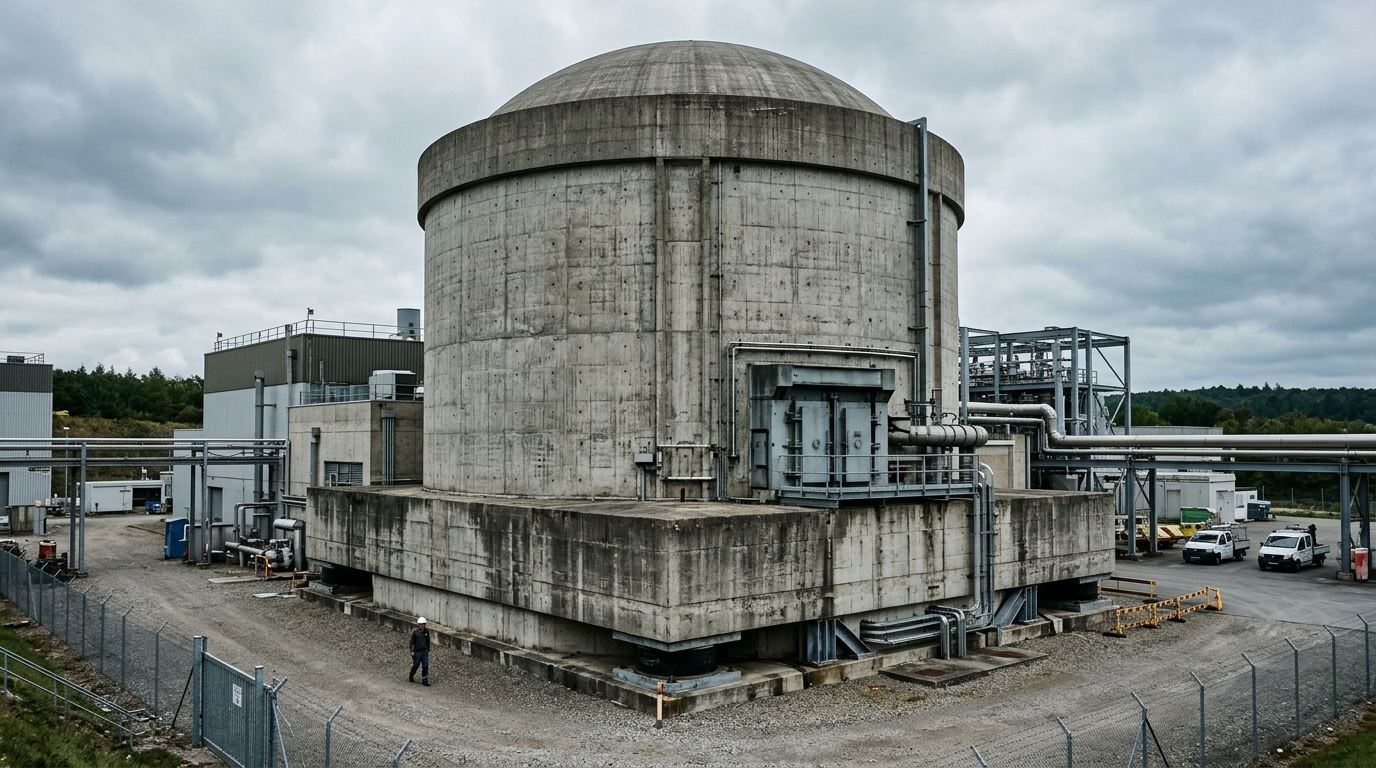
The physical structure investigated in this investigation represents a typical nuclear power plant reactor containment building consisting of a cylindrical reinforced concrete shear wall capped by an upper dome. The main cylindrical wall features an outer radius of 23.5 meters, an overall height of 54 meters, and a continuous wall thickness of 1.22 meters, while the spherical dome portion possesses a radius of 23.2 meters and an average thickness of 1.07 meters. Accurately tracking both parameters simultaneously is therefore essential for establishing holistic safety margins under extreme environmental excitation.
To simulate structural responses without incurring the overwhelming processing costs of full three-dimensional continuum finite element models, the investigators implemented a beam-truss model developed within the OpenSees software platform. A mesh discretization of 3 meters by 3 meters was established after conducting rigorous mesh convergence and sensitivity tests against a refined 1 meter by 1 meter model and three-dimensional multilayer shell representations. The sensitivity testing confirmed that the 3-meter mesh preserved the fundamental frequency of the containment structure within a three percent margin of the finer model while substantially reducing computational runtimes. Material behavior within the OpenSees environment was governed by the Concrete02 model for concrete and the Steel02 model for reinforcement steel, with model validity corroborated by comparing floor response spectra against previously established finite element benchmarks.
Generating a diverse simulation dataset required systematically propagating uncertainties across five governing structural and material properties identified from prior engineering literature: concrete compressive strength, concrete tensile strength, reinforcement steel yield strength, total structural mass, and the structural damping ratio. Using Latin Hypercube Sampling, the researchers generated 200 distinct parameter combinations covering the probabilistic distributions of these five random variables. Each generated parameter set was subsequently subjected to ten different horizontal ground motion records selected from the PEER database and scaled to match the United States Nuclear Regulatory Commission 1.60 design response spectrum. This generated a total dataset of 2,000 nonlinear time-history analyses. For each of the 200 sampled parameter configurations, the resulting peak floor acceleration and peak floor displacement responses were calculated as the mathematical average across the ten earthquake records, limiting individual record-to-record fluctuations and establishing a stable demand baseline for machine learning model training.
Initial correlation analyses across the generated dataset uncovered notable distinctions in how random material and structural variations govern seismic responses at the dome node. The structural damping ratio demonstrated the single strongest negative correlation with peak floor acceleration at negative 0.84, confirming that enhanced energy dissipation substantially suppresses acceleration responses during dynamic shaking. Concrete tensile strength exhibited a moderate negative correlation with displacement at negative 0.31 and a weak positive correlation with acceleration at 0.13, while structural mass displayed a mild positive correlation with displacement at 0.39. Steel yield strength displayed negligible correlation with either demand metric, demonstrating its minimal influence on global elastic and near-elastic containment demands.
To build a predictive system capable of mapping these uncertain structural parameters to structural demands, the authors implemented Extreme Gradient Boosting, an ensemble learning algorithm that sequentially constructs decision trees to minimize residual errors through gradient descent. Because standard XGBoost natively handles only single-target outputs, the researchers coupled the gradient boosted trees with the MultiOutputRegressor wrapper from SciKit-Learn. This architectural configuration trains dedicated regression trees for each target parameter while executing within a unified computational pipeline capable of capturing response relationships. Hyperparameter tuning was executed using RandomizedSearchCV guided by a custom cross-validated mean absolute percentage error metric. Model generalization was validated through 100 repeated random train-test splits using an eighty-twenty data partition without stratification, thereby establishing an empirical distribution of prediction errors rather than relying on a single favorable data split.
A hyperparameter sensitivity analysis evaluating eight distinct structural settings revealed that model accuracy was overwhelmingly dictated by three specific parameters: L1 regularization strength, minimum child weight, and the learning rate. Rank-based Spearman correlation against cross-validated error indicated that L1 regularization alpha had the strongest effect with a correlation magnitude near 0.75, showing that small deviations from optimal regularization produced sharp increases in percentage error. Minimum child weight ranked as the second most influential parameter with a correlation of approximately 0.45, demonstrating an optimal performance threshold around a value of 5. The learning rate registered a correlation of about 0.25, with lower rates near 0.05 consistently enhancing predictive accuracy by balancing convergence speed against generalization. In contrast, other parameters including the subsample ratio, column sample by tree, and maximum tree depth showed moderate effects, while the total number of estimators and L2 regularization lambda exhibited negligible correlations below 0.02.
Performance evaluations over 100 random data splits proved that the multi-target XGBoost framework delivers dependable and consistent demand predictions, achieving mean absolute percentage errors centered between 3.0 percent and 5.0 percent for peak floor acceleration, with a mean near 4.0 percent. Predicted peak floor displacements yielded percentage errors largely concentrated between 5.0 percent and 8.0 percent, averaging roughly 6.0 percent. When benchmarked against Gaussian Process Regression, the comparison revealed a distinct engineering trade-off between mean accuracy and prediction consistency. While Gaussian Process Regression attained lower mean percentage errors of 2.6 percent for acceleration and 3.2 percent for displacement, its performance exhibited substantial dispersion and wide error swings across random data splits, particularly for displacement estimates. The XGBoost model produced tightly bounded root mean squared errors typically between 0.015 and 0.030 for acceleration and 0.5 to 0.9 for displacement, demonstrating superior robustness across variable training partitions while cutting tuning wall-clock time by roughly 13 percent compared to independent single-output tuning pipelines.
To make the complex gradient boosting ensembles transparent and suitable for nuclear regulatory reviews, the researchers implemented Shapley Additive Explanations, rooted in cooperative game theory, to calculate the marginal contribution of each structural parameter to final demand outputs. For peak floor acceleration, SHAP violin plots identified the structural damping ratio as the overwhelmingly dominant feature, displaying the widest attribution spread and greatest deviation from zero, while concrete strength and structural mass exerted only secondary contributions, reflecting the reality that acceleration demands are largely governed by global dynamic vibrational characteristics. For peak floor displacement, however, the attribution profile shifted markedly. While damping remained dominant, concrete compressive strength and structural mass exhibited pronounced contributions, with lower compressive strength driving large positive SHAP displacement values due to stiffness degradation and higher mass amplifying inertial forces. Concrete tensile strength and steel yield strength also showed measurable contributions to displacement predictions through their roles in concrete cracking and inelastic deformations.
The authors outlined important structural boundaries and research limitations that contextualize the operational deployment of their machine learning metamodel. Because the predictive framework was constructed and validated using a specific reactor containment building geometry and material baseline, direct application to alternative structural systems requires retraining or structural transfer. Furthermore, because demand parameters were averaged across ten ground motion records for each Latin Hypercube parameter set to limit individual record variability, the current model predicts mean structural demands under material and structural uncertainties rather than serving as a direct probabilistic fragility or risk assessment tool. The authors emphasized that future research should integrate record-to-record dispersion directly into the predictive architecture, incorporate soil-structure interaction effects, and expand the multi-target framework across diverse containment structural topologies while focusing optimization efforts on the identified primary hyperparameters.
Subject of Research: Seismic demand prediction for nuclear reactor containment buildings using explainable multi-target machine learning
Article Title: Explainable Multi-Target XGBoost Models for Seismic Demand Prediction of NPP Reactor Containment Building
Article References: Azad, M. S., Choi, M., & Lee, T.-H. (2026). Explainable Multi-Target XGBoost Models for Seismic Demand Prediction of NPP Reactor Containment Building. Architectural Research, 28(1), Article 5. https://doi.org/10.1007/s44515-026-00004-2
Image Credits: AI Generated
DOI: 10.1007/s44515-026-00004-2
Keywords: nuclear engineering, seismic demand, containment building, XGBoost, machine learning, SHAP analysis, structural reliability, earthquake engineering, Explainable, Multi-Target, Models, Seismic
Cite Scienmag News
Teresa Odom. (November 7, 2026). Machine Learning Predicts Nuclear Reactor Containment Seismic Demands With Explainable Models. Scienmag. https://scienmag.com/machine-learning-predicts-nuclear-reactor-containment-seismic-demands-with-explainable-models/
Teresa Odom. "Machine Learning Predicts Nuclear Reactor Containment Seismic Demands With Explainable Models." Scienmag, 7 November 2026, https://scienmag.com/machine-learning-predicts-nuclear-reactor-containment-seismic-demands-with-explainable-models/. Accessed 16 November 2026.
Teresa Odom. "Machine Learning Predicts Nuclear Reactor Containment Seismic Demands With Explainable Models." Scienmag. November 7, 2026. https://scienmag.com/machine-learning-predicts-nuclear-reactor-containment-seismic-demands-with-explainable-models/




