


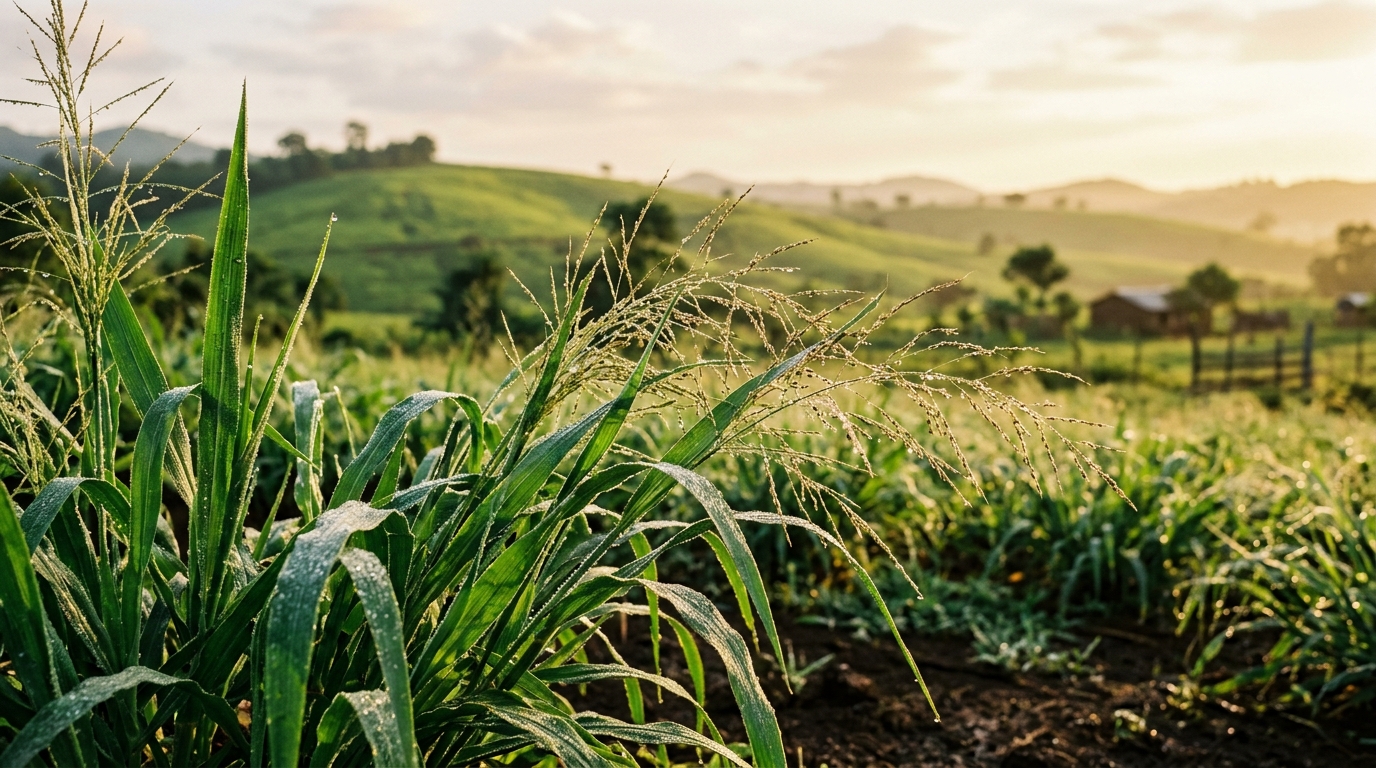
Researchers analyzed the use of statistical and artificial intelligence models to estimate in vitro ruminal methane production of tropical forage groups. The study, published in Frontiers in Agronomy, screened 395 forage accessions from two major plant families and found that models combining fermentation data with a few chemical traits could predict methane output with useful accuracy, particularly for certain forage groups such as grasses, climbers and shrub-tree species.
The work addresses a practical bottleneck in livestock climate research. Ruminant animals emit methane as part of their digestion, and identifying forages that reduce this emission is a stated goal of global mitigation efforts such as the Global Methane Pledge. In vitro fermentation systems offer a practical alternative to in vivo measurements. Even so, evaluating large numbers of forage samples this way remains resource-intensive, because gas production, methane concentration, digestibility and chemical composition must each be measured. The research team, led by Mauricio Vélez-Terranova of Universidad Nacional de Colombia together with colleagues from the Alliance of Bioversity International and International Center for Tropical Agriculture and an independent consultant, tested whether statistical and AI methods could ease that burden.
The experimental material consisted of 395 tropical forage accessions, divided into 238 Fabaceae and 157 Poaceae. Each sample was incubated for 24 hours in an in vitro fermentation system to measure gas production, methane in the gas production, true dry matter digestibility and the partition factor. Chemical analyses determined organic matter, crude protein, neutral detergent fiber, acid detergent fiber and ash, and hemicellulose was calculated from the two fiber fractions. These fermentation and composition variables then served as predictors of in vitro methane production.
Models were built at several levels of organization: separately for the two botanical families, Fabaceae and Poaceae; for functional groups defined as climbers, herbaceous legumes and shrub-tree species; and for the full dataset. Performance was assessed using repeated 5-fold cross-validation with five repetitions.
The results showed that predictive accuracy differed among forage groups. Across the evaluated groups, the root mean square error ranged from 1.61 to 5.03 and the coefficient of determination ranged from 0.76 to 0.88. The best performance came from multivariate models tailored to specific forage groups that integrated fermentation characteristics with selected chemical composition variables, notably gas production, true dry matter digestibility and crude protein. Among the algorithms tested, support vector regression with a linear kernel achieved the strongest predictions, followed by multiple regression.
The authors note that in some groups, including Poaceae, climbers and shrub-tree species, the models perform satisfactorily for analytical purposes, although further validation with independent datasets is needed before broader application.
The study’s authors describe these models as a complementary tool for situations where direct methane measurement is not feasible because of cost or limitations in analytical infrastructure. In regions where specialized gas analysis equipment is scarce, such models could expand the number of forage accessions that receive at least an estimated methane assessment, supporting screening programs that would otherwise be limited to a much smaller number of samples.
The models were developed and evaluated on the same 395 accessions through cross-validation, and the authors explicitly state that further validation with independent datasets is needed. Performance varied by forage group, so a model fitted to one family or functional group cannot be assumed to transfer to another without testing. The estimates concern in vitro methane production under a 24-hour incubation protocol, not methane emissions from living animals on specific diets. Within those limits, the study provides a documented, quantified baseline: group-specific models combining gas production, dry matter digestibility and crude protein, implemented with support vector regression or multiple regression, predicted in vitro methane with R-squared values between 0.76 and 0.88, a level the authors consider satisfactory for analytical use in several groups.
Subject of Research: Statistical and artificial intelligence models for estimating in vitro ruminal methane production of tropical forage groups
Article Title: Application of statistical and artificial intelligence models to estimate in vitro ruminal methane production in tropical forage groups
Article References: Vélez-Terranova, M., Marín Gómez, A., Wenzl, P., Gonzalez Guzman, J. J., Jauregui, R. N., Barbosa, N., Cardoso, J. A., Mazabel, J., Molina-Botero, I. C., Makkar, H. P. S., & Arango, J. (2026). Application of statistical and artificial intelligence models to estimate in vitro ruminal methane production in tropical forage groups. Frontiers in Agronomy, 8, Article 1901565. https://doi.org/10.3389/fagro.2026.1901565
Image Credits: AI Generated
DOI: 10.3389/fagro.2026.1901565
Keywords: methane, tropical forages, in vitro fermentation, support vector regression, machine learning, Fabaceae, Poaceae, cross-validation, livestock emissions, forage screening, Global Methane Pledge, rumen fermentation
Cite Scienmag News
Alan Morgan. (November 5, 2026). AI Models Predict Methane From Tropical Forages in Lab Tests. Scienmag. https://scienmag.com/ai-models-predict-methane-from-tropical-forages-in-lab-tests/
Alan Morgan. "AI Models Predict Methane From Tropical Forages in Lab Tests." Scienmag, 5 November 2026, https://scienmag.com/ai-models-predict-methane-from-tropical-forages-in-lab-tests/. Accessed 21 November 2026.
Alan Morgan. "AI Models Predict Methane From Tropical Forages in Lab Tests." Scienmag. November 5, 2026. https://scienmag.com/ai-models-predict-methane-from-tropical-forages-in-lab-tests/




