Friday, October 30, 2026
Science
No Result
View All Result
  • Login
  • HOME
  • SCIENCE NEWS
  • CONTACT US
  • HOME
  • SCIENCE NEWS
  • CONTACT US
No Result
View All Result
Scienmag
No Result
View All Result
Home Science News Space

Models compared for how solar plasma structures grow and rotate

October 29, 2026
in Space
Grant Pearson
By Grant Pearson Scienmag Editorial Profile - Observational Astronomy
Reading Time: 3 mins read
0
Models compared for how solar plasma structures grow and rotate

Models compared for how solar plasma structures grow and rotate

65
SHARES
587
VIEWS
Share on FacebookShare on Twitter
ADVERTISEMENT

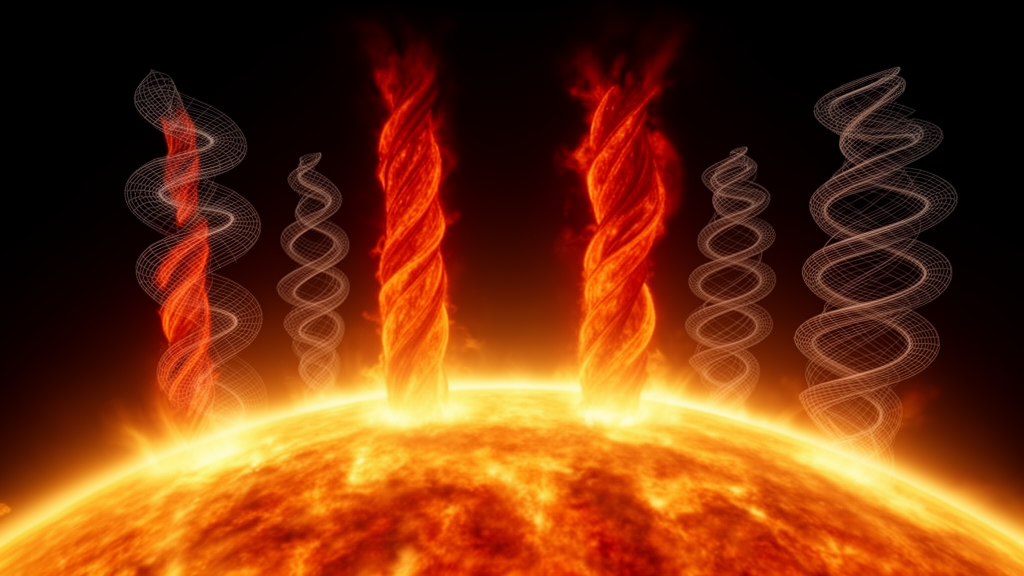
A new theoretical study published in Astrophysics and Space Science compares a family of mathematical models that describe how dynamical plasma structures arise in the Sun. The work, by Sergey N. Artekha and appearing in volume 371 of the journal, lays out a hierarchy of models of increasing complexity, from a minimal ideal-hydrodynamics description to a full magnetohydrodynamic (MHD) treatment, and traces how the resulting flow patterns develop from the first moments of structure generation to their most mature stage.

The starting point of the analysis is the physical mechanism behind structure formation. According to the abstract, two processes are central: the Schwarzschild criterion for convective instability, under which a superadiabatic temperature gradient makes overheated plasma begin to rise, and the presence of excess energy in the form of heat or magnetic fields. In the simplest framework, ideal hydrodynamics, the model applies to the initial stage of generation of plasma structures, and the author constructs rigorous analytical solutions assembled from building blocks. An intermediate, refined model then considers rotating plasma at the growth stage, in which a unidirectional differential rotation emerges.

The most complete model in the comparison solves the full system of Navier-Stokes MHD equations for an axisymmetric plasma. It includes equations for the stream function, the azimuthal velocity component, the density change, the flow function of the poloidal magnetic field, and the azimuthal component of the magnetic field. This full model follows the development of structures in rotating plasma from the very beginning to the highest development stage. The velocity field is adjusted to satisfy boundary conditions, and the velocity components change in a coordinated manner as the structure evolves.

A key result concerns the role of magnetism. The study reports that a stationary axisymmetric ambient magnetic field and its gradients have little effect on the plasma structure and the velocity field in the configurations examined. Despite the differences in complexity among the models, the movement structures they produce are similar: radial flows converge towards the axis at the bottom of the structure, while near the top there is an outflow towards the periphery. The maximum vertical velocity component is reached at the center of the axis, on the symmetry axis of the structure.

The paper also discusses applications of these models to solar structures, including jets. Because the work is a modeling comparison, its findings concern the behavior of the mathematical solutions themselves rather than direct observations of specific solar events. The abstract notes that the models are intended to capture mechanisms of generation of dynamical plasma structures driven by convection and excess thermal or magnetic energy, with the full MHD formulation providing the most complete description of the coupled velocity and magnetic field evolution in rotating plasma.

Subject of Research: Mathematical modeling of dynamical plasma structure generation in the solar atmosphere using ideal hydrodynamic and magnetohydrodynamic frameworks.

Article Title: Comparison of models for dynamical structures of solar plasma

Article References: Artekha, S. N. (2026). Comparison of models for dynamical structures of solar plasma. Astrophysics and Space Science, 371(10), Article 129. https://doi.org/10.1007/s10509-026-04660-7

Image Credits: AI Generated

DOI: 10.1007/s10509-026-04660-7

Keywords: solar plasma, magnetohydrodynamics, Navier-Stokes equations, convective instability, Schwarzschild criterion, differential rotation, plasma structures, solar jets, axisymmetric models, Astrophysics and Space Science, Comparison, models

Cite Scienmag News

Grant Pearson. (October 29, 2026). Models compared for how solar plasma structures grow and rotate. Scienmag. https://scienmag.com/models-compared-for-how-solar-plasma-structures-grow-and-rotate/

Grant Pearson. "Models compared for how solar plasma structures grow and rotate." Scienmag, 29 October 2026, https://scienmag.com/models-compared-for-how-solar-plasma-structures-grow-and-rotate/. Accessed 30 October 2026.

Grant Pearson. "Models compared for how solar plasma structures grow and rotate." Scienmag. October 29, 2026. https://scienmag.com/models-compared-for-how-solar-plasma-structures-grow-and-rotate/

Tags: Astrophysics and Space Scienceaxisymmetric modelsComparisoncomparison of plasma growth modelsconvective instabilityconvective instability in the Sundifferential rotationdifferential rotation in solar plasmaevolution of solar plasma structureshierarchical modeling of solar plasmaideal hydrodynamics in solar physicsmagnetohydrodynamic modeling of solar plasmamagnetohydrodynamicsmodelsNavier-Stokes MHD equations for solar plasmaNavier–Stokes equationsplasma flow patterns in the Sunplasma structuresSchwarzschild criterionsolar jetssolar plasmasolar plasma rotation dynamicssolar plasma structure formationsuperadiabatic temperature gradient effects
Share26Tweet16
Previous Post

Neural Network Model Links Obesity, Metabolism and Alzheimer’s Progression

Next Post

Cursor Movements Reveal How Skilled Soccer Players Prepare Before They Respond

Related Posts

Physicists Pin Down the Hidden Voltage Source Behind Geomagnetically Induced Currents
Space

Physicists Pin Down the Hidden Voltage Source Behind Geomagnetically Induced Currents

October 30, 2026
Moon’s mightiest mountain revealed as a three-sided pyramid taller than Everest’s base-to-peak height
Space

Moon’s mightiest mountain revealed as a three-sided pyramid taller than Everest’s base-to-peak height

October 30, 2026
CubeSat Deorbit Method Targets Re-Entry Longitude by Accounting for Earth’s Rotation
Space

CubeSat Deorbit Method Targets Re-Entry Longitude by Accounting for Earth’s Rotation

October 30, 2026
SETI Institute Adds Three Artists-in-Residence Probing Life, Intelligence and Consciousness
Space

SETI Institute Adds Three Artists-in-Residence Probing Life, Intelligence and Consciousness

October 30, 2026
Genetic Algorithm Tracks Relay of Three Dissipation Channels in Warm Higgs Inflation
Space

Genetic Algorithm Tracks Relay of Three Dissipation Channels in Warm Higgs Inflation

October 30, 2026
Tidal forces may have concentrated deep lunar heat near the core-mantle boundary, model suggests
Space

Tidal forces may have concentrated deep lunar heat near the core-mantle boundary, model suggests

October 30, 2026
Next Post
Cursor Movements Reveal How Skilled Soccer Players Prepare Before They Respond

Cursor Movements Reveal How Skilled Soccer Players Prepare Before They Respond

  • Mothers who receive childcare support from maternal grandparents show more optimized

    Mothers who receive childcare support from maternal grandparents show more parental warmth, finds NTU Singapore study

    27656 shares
    Share 11059 Tweet 6912
  • University of Seville Breaks 120-Year-Old Mystery, Revises a Key Einstein Concept

    1061 shares
    Share 424 Tweet 265
  • Bee body mass, pathogens and local climate influence heat tolerance

    682 shares
    Share 273 Tweet 171
  • Researchers record first-ever images and data of a shark experiencing a boat strike

    546 shares
    Share 218 Tweet 137
  • Groundbreaking Clinical Trial Reveals Lubiprostone Enhances Kidney Function

    531 shares
    Share 212 Tweet 133
Science

Embark on a thrilling journey of discovery with Scienmag.com—your ultimate source for cutting-edge breakthroughs. Immerse yourself in a world where curiosity knows no limits and tomorrow’s possibilities become today’s reality!

RECENT NEWS

  • Trademarks Meet Patents in New Method to Spot Technology Opportunities
  • Reddit self-declarations offer auditable labels for demographic inference
  • Scots pine needles map trace element pollution in Polish industrial town
  • Dual-blockchain scheme secures vehicle handovers without pre-shared keys

Categories

  • Agriculture
  • Anthropology
  • Archaeology
  • Athmospheric
  • Biology
  • Biotechnology
  • Blog
  • Bussines
  • Cancer
  • Chemistry
  • Climate
  • Earth Science
  • Editorial Policy
  • Marine
  • Mathematics
  • Medicine
  • Pediatry
  • Policy
  • Psychology & Psychiatry
  • Science Education
  • Science News
  • Social Science
  • Space
  • Technology and Engineering

Subscribe to Blog via Email

Enter your email address to subscribe to this blog and receive notifications of new posts by email.

Join 5,150 other subscribers

© 2025 Scienmag - Science Magazine

Welcome Back!

Login to your account below

Forgotten Password?

Retrieve your password

Please enter your username or email address to reset your password.

Log In
No Result
View All Result
  • HOME
  • SCIENCE NEWS
  • CONTACT US

© 2025 Scienmag - Science Magazine

Discover more from Science

Subscribe now to keep reading and get access to the full archive.

Continue reading