Neanderthal bones found at two Paleolithic sites appear to have been used as ordinary flint-knapping tools rather than as objects of special symbolic treatment, according to a new study published in Archaeological and Anthropological Sciences.
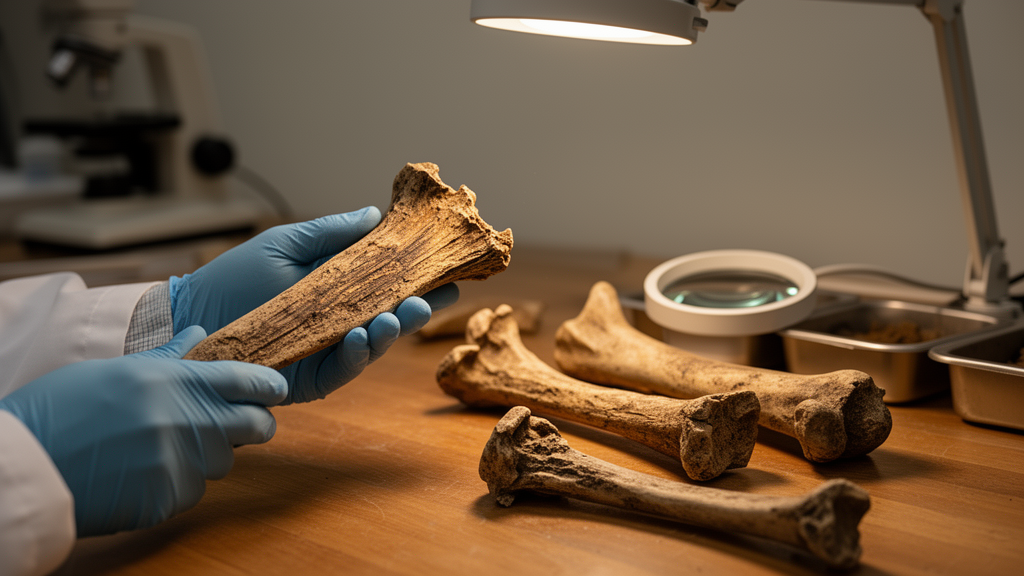
Bone retouchers are stone-age implements made from bone fragments that were pressed against sharp stone edges to reshape and refine lithic tools. Archaeologists value them because they preserve traces of technological behavior, including how raw materials were selected, the state of the bone when it was used, the kinds of stone being worked, and even the handedness of the toolmaker.
The discovery of retouchers made from human bones has long provoked debate. Some researchers suggested that using the remains of dead Neanderthals in this way might indicate symbolic behavior, treating human bone differently from the bones of animals. The new study set out to test that idea directly.
An international research team led by Kelly-Ann Desjardins developed a conceptual framework to evaluate whether the use of human bones as unmodified tools reflects symbolic intent, and to distinguish such objects from purely utilitarian ones. The framework was then applied by comparing blank selection and tool use between retouchers made on human bones and those made on other animal bones from Mousterian contexts.
The retouchers came from the Tourtoirac rock shelter in France and the Cavernes de Goyet in Belgium. To compare them, the researchers combined traditional qualitative use-wear analysis with quantitative surface texture analysis performed using confocal microscopy, an approach that measures microscopic roughness and texture on the tool surfaces objectively.
The results showed only a limited number of significant differences in how the retouchers were used. This, the authors conclude, suggests a non-differentiated processing of Neanderthal remains used as tools compared with remains of other faunal species. In other words, human bones appear to have entered the same technological system as animal bones, without evidence of distinctive handling that would signal symbolic particularism.
Beyond the two assemblages, the team carried out a critical review of European Middle Paleolithic evidence bearing on the question. This broader review, they report, encourages further reflection on the social dimensions of material reuse and on the ways Neanderthals may have negotiated relationships between the living, the dead, and material culture.
The study does not claim that Neanderthals lacked any relationship with their dead. Rather, it shifts the interpretive burden: where human-bone tools show the same use patterns as animal-bone tools, a utilitarian explanation requires no additional symbolic layer. The framework offered in the paper is intended as a reusable tool for assessing symbolic intent in future discoveries, rather than a verdict on a single site.
The work illustrates how quantitative microscopy can now address long-standing archaeological questions that once rested on qualitative judgment alone. By measuring surface textures on retouchers made from different skeletal sources, the method provides a repeatable basis for comparing how Neanderthals treated bone as a raw material, whatever its origin.
The article, published on 29 October 2026 as volume 18, article number 224 of the journal, was authored by a team including researchers from multiple institutions, with contributions from specialists in archaeology, anthropology, and ancient human remains. Its central finding is deliberately measured: on current evidence, Mousterian retouchers made on human bones do not stand apart technologically from those made on other faunal remains, leaving open the question of what, if anything, their use meant to the Neanderthals who made them.
Subject of Research: Analysis of Mousterian bone retouchers made on human and animal bones to test for symbolic treatment of Neanderthal remains
Article Title: Retouchers made on human bones in Mousterian contexts: symbolic particularism or undifferentiated processing compared to other faunal remains?
Article References: Desjardins, K.-A., Beauval, C., Crevecoeur, I., Abrams, G., Mateo-Lomba, P., Cosnefroy, Q., Semal, P., Rougier, H., Rigaud, S., & Doyon, L. (2026). Retouchers made on human bones in Mousterian contexts: symbolic particularism or undifferentiated processing compared to other faunal remains?. Archaeological and Anthropological Sciences, 18(11), Article 224. https://doi.org/10.1007/s12520-026-02587-2
Image Credits: AI Generated
DOI: 10.1007/s12520-026-02587-2
Keywords: Neanderthals, bone retouchers, Mousterian, symbolic behavior, use-wear analysis, confocal microscopy, Middle Paleolithic, Tourtoirac, Goyet, faunal remains, archaeology, Retouchers
Cite Scienmag News
Courtney Benton. (October 29, 2026). Neanderthal Bones Used as Everyday Tools, Not Symbolic Objects. Scienmag. https://scienmag.com/neanderthal-bones-used-as-everyday-tools-not-symbolic-objects/
Courtney Benton. "Neanderthal Bones Used as Everyday Tools, Not Symbolic Objects." Scienmag, 29 October 2026, https://scienmag.com/neanderthal-bones-used-as-everyday-tools-not-symbolic-objects/. Accessed 31 October 2026.
Courtney Benton. "Neanderthal Bones Used as Everyday Tools, Not Symbolic Objects." Scienmag. October 29, 2026. https://scienmag.com/neanderthal-bones-used-as-everyday-tools-not-symbolic-objects/