


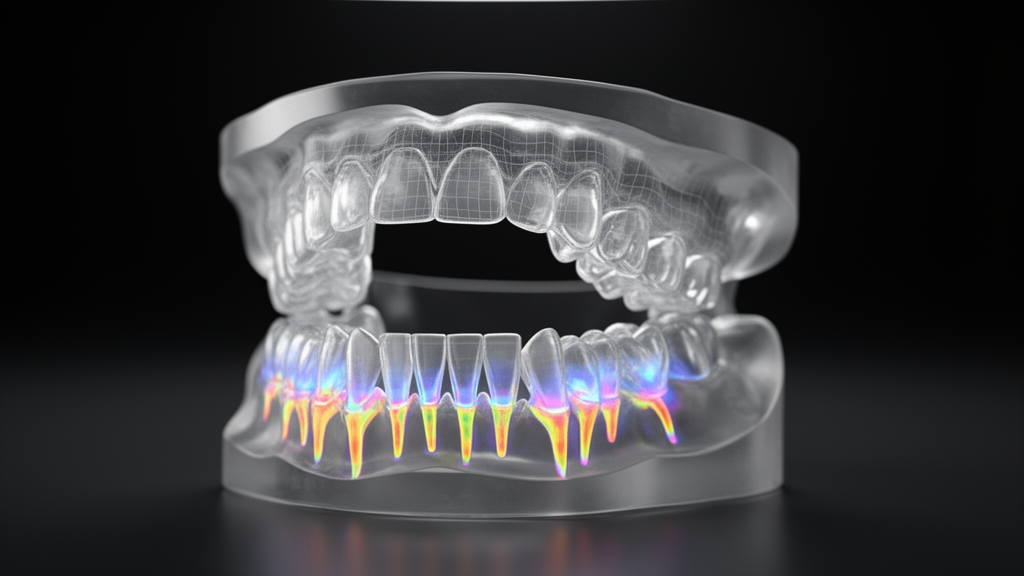
Clear aligners have become one of the fastest-growing tools in orthodontics, yet the invisible forces that decide whether a tooth glides bodily into place or simply tips at the crown have remained surprisingly murky. A new scoping review, published in Digital and Aligner Orthodontics, has now mapped five years of computational research to answer a deceptively simple question: which design variables—attachments, auxiliary mechanics, activation vectors and staging—most consistently influence whether a simulated tooth tips or translates? The answer, drawn from 51 finite element analysis (FEA) studies published between January 2020 and December 2025, is that aligners alone almost always produce crown tipping and reciprocal movements, while predictable translation demands engineered force couples built into the appliance.
The review, led by T. Castroflorio, G. Rossini, S. Parrini, M. Migliorati and S. Abu Arqub, followed the PRISMA-ScR reporting framework for scoping reviews. Two reviewers independently screened records from PubMed, Scopus, Web of Science and Google Scholar against predefined eligibility criteria, extracting data on study design and modelling parameters. The search initially yielded 181 records, of which 130 were excluded; the remaining 51 studies were synthesised descriptively, organised by movement category, because the heterogeneity of models made quantitative meta-analysis impossible. The protocol was registered in advance on the Open Science Framework, and the authors deliberately framed their goal as mapping simulation outputs and modelling choices rather than ranking clinical evidence.
FEA works by discretising complex anatomical geometries—teeth, alveolar bone and the periodontal ligament (PDL)—into thousands of small elements, allowing researchers to compute stress distributions, strain patterns and force magnitudes under different treatment scenarios. Even minor changes in aligner thickness, material properties or attachment placement can substantially alter force transmission. But the method rests on simplifying assumptions: the PDL is typically modelled as a linearly elastic sleeve, polymers as perfectly elastic, and bone as immobile. Simulated forces therefore tend to overestimate initial peaks and underestimate decay, and effects such as thermoforming deformation, water sorption and creep are rarely captured.
The review’s most sobering finding concerns model credibility. Applying an evidence-mapping framework across six credibility domains, the authors found that only 3 of the 51 studies (5.9%) reached high credibility, addressing five or six domains. Eighteen studies (35.3%) were of moderate credibility with three to four domains, while 30 studies (58.8%) scored low, covering zero to two domains. Reporting was strikingly uneven: boundary conditions appeared in 98.0% of studies and sensitivity or parametric analyses in 94.1%, yet validation against experimental or clinical comparators was present in just 15.7%, material property definitions in 11.8%, and temporal modelling in only 13.7%. Mesh or discretisation reporting appeared in 35.3% of the studies.
Material properties, which the authors describe as critical for mechanistic realism, were reported in only six studies, four of which incorporated some form of comparative validation against in vitro or clinical data. Forty-five studies—88.2%—omitted any validation procedure. Temporal modelling through staged, sequential or dynamic analysis appeared in just seven studies; the remaining 44 relied solely on static snapshots that cannot represent progressive force relaxation, viscoelastic effects or incremental tooth movement over time. Credibility tracked these domains closely: validation was present in 66.7% of high-credibility studies but only 3.3% of low-credibility ones, and material property reporting and temporal modelling were each implemented in 100% of high-credibility studies versus 0% of low-credibility studies.
Within the movement-specific synthesis, distalisation emerged as a case study in tipping. Across the reviewed simulations, distal translation was commonly coupled with distal and buccal tipping of the moving tooth and reciprocal mesial tipping and proclination of the anchorage unit. In an upper second-molar model, the presence of a third molar reduced maximum distal displacement by about 17% and crown displacement by 10–22%, while increasing distopalatal rotation. Attachment orientation mattered: a 90° rectangular orientation on the second molar yielded the greatest pure distalisation in a full-arch maxillary model, while a 135° orientation combined with an intrusive vector produced the maximum distal movement. Intrusive components facilitated molar distalisation, whereas extrusive forces impeded it. Class II elastics enhanced distalisation and mitigated anterior anchorage loss, with precision-cut configurations outperforming button-based traction.
Torque and buccal movements told a similar story of engineered compensation. Aligners alone produced limited or uncontrolled buccal translation: in an aligned maxillary arch without attachments, crowns tended to tip buccally and mesially during a 0.25-mm expansion step. Horizontal rectangular attachments consistently improved force coupling, and when the same tooth received both buccal and palatal attachments, bodily movement was superior to single-sided placement. Power ridges outperformed cylinders and semi-ellipsoid attachments for pure labio-lingual torque on incisors. The simulations also pointed to tooth-specific overtreatment thresholds: roughly 1.2° of programmed buccal root torque sufficed for bodily movement of maxillary central incisors, while lateral incisors required about 2.7°. All studies agreed that maxillary teeth are more prone to uncontrolled buccal tipping than mandibular teeth for the same activation, possibly because of thinner buccal cortical bone and longer clinical crowns.
Extraction mechanics and vertical movements revealed further design sensitivities. In maxillary first-premolar extraction models, a canine step of approximately 0.25 mm produced near-bodily lingual root movement of the incisors, whereas larger activations of 0.30 mm or more promoted labial incisor inclination and accentuated posterior mesial tipping. In mandibular first-premolar extraction cases, creating controlled anterior inter-incisal spacing of 0.20–0.80 mm before a 0.20-mm intrusion step increased true intrusive displacement, with the most favourable pattern at 0.60 mm spacing. For posterior intrusion, a bilateral buccal-plus-palatal attachment configuration on the maxillary second molar generated near-parallel intrusion with tipping below 1° and roughly a 31% reduction in peak PDL stress. Mandibular incisor intrusion proved highly sensitive to initial incisor inclination, with increasing proclination reducing the magnitude of pure intrusion.
Expansion emerged as the least predictable movement category. Increasing the programmed expansion step from 0.1 to 0.3 mm progressively increased buccal-crown tipping and reduced root translation of posterior teeth, and pre-set lingual-crown torque counteracted these side effects only at smaller steps—a 0.5° compensation paired with a 0.1-mm step and a 1.5° compensation with a 0.2-mm step restored bodily movement, while at 0.3 mm further torque offered little extra control. An alternating-movement strategy, expanding the right and left arch segments in sequence, delivered the highest target-tooth displacement efficiency at approximately 21% while limiting anchorage loss to about 30%. Cylindrical embossments were more efficient than cuboid or ball shapes at equivalent interference depths.
The authors are explicit that these convergent, movement-specific trends remain biomechanical hypotheses generated under idealised modelling assumptions, not prescriptive clinical guidance. Given the near-absence of validation, material property reporting and time-dependent modelling across the included literature, they conclude that the FEA evidence provides robust parametric guidance on design variables but lacks sufficient empirical validation and mechanistic realism for direct clinical translation without independent verification. Their research agenda calls for time-dependent aligner material characterisation, patient-specific PDL models capturing biological variability, clinical studies tracking three-dimensional tooth displacement at standardised intervals, open-access benchmark datasets, and standardised FEA reporting requirements—steps they argue are needed to elevate clear aligner biomechanics from exploratory simulation to prescriptive evidence.
Subject of Research: Finite element analysis of clear aligner biomechanics across different types of orthodontic tooth movement
Article Title: What finite element models teach us about clear aligners: a PRISMA-ScR-aligned scoping review of biomechanics across different types of tooth movements (2020–2025)
Article References: Castroflorio, T., Rossini, G., Parrini, S., Migliorati, M., & Arqub, S. A. (2026). What finite element models teach us about clear aligners: a PRISMA-ScR-aligned scoping review of biomechanics across different types of tooth movements (2020–2025). Digital and Aligner Orthodontics, 1(1), Article 8. https://doi.org/10.1007/s44525-026-00002-8
Image Credits: AI Generated
DOI: 10.1007/s44525-026-00002-8
Keywords: clear aligners, finite element analysis, orthodontics, biomechanics, scoping review, tooth movement, attachments, anchorage, torque control, dental expansion, periodontal ligament, PRISMA-ScR
Cite Scienmag News
Ophelia Keating. (October 29, 2026). Finite element models map clear aligner biomechanics across tooth movements. Scienmag. https://scienmag.com/finite-element-models-map-clear-aligner-biomechanics-across-tooth-movements/
Ophelia Keating. "Finite element models map clear aligner biomechanics across tooth movements." Scienmag, 29 October 2026, https://scienmag.com/finite-element-models-map-clear-aligner-biomechanics-across-tooth-movements/. Accessed 30 October 2026.
Ophelia Keating. "Finite element models map clear aligner biomechanics across tooth movements." Scienmag. October 29, 2026. https://scienmag.com/finite-element-models-map-clear-aligner-biomechanics-across-tooth-movements/









