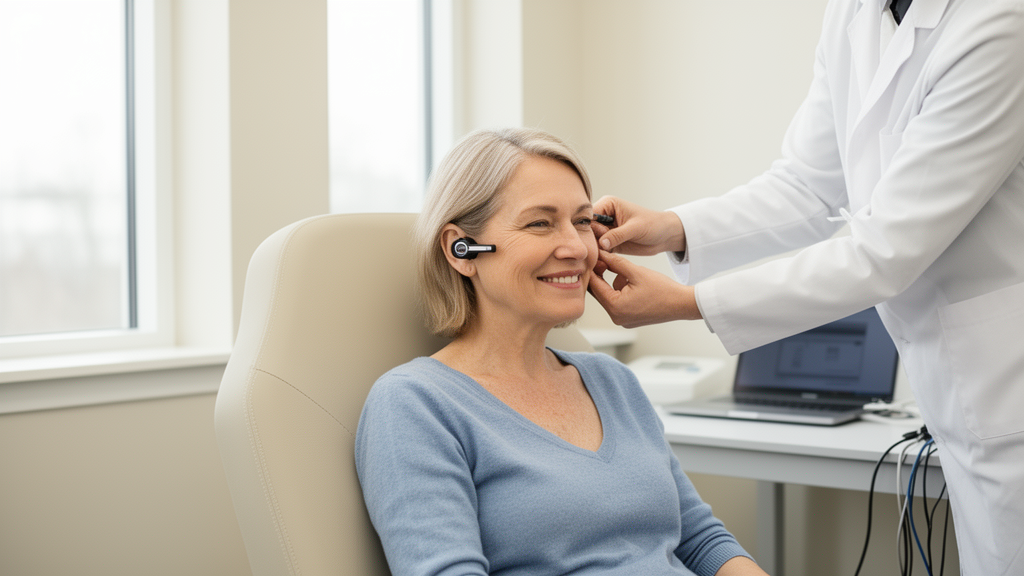
Transcutaneous auricular vagus nerve stimulation, or taVNS, delivers tiny electrical pulses to the tragus and cymba concha of the outer ear, regions supplied by the auricular branch of the vagus nerve. A new pair of randomized crossover trials in healthy adults, published in Bioelectronic Medicine, set out to answer a question that most stimulation studies skip: not just whether the technique is safe, but whether people actually find it comfortable enough to keep using. The answer, across four different stimulation configurations, was a consistent yes, with mild tingling rather than pain dominating the participant experience.
The research team, based in Miami, Florida, ran two consecutive studies, each with a crossover design in which every participant experienced both experimental conditions in randomized order, separated by at least a week of washout. Study 1, conducted between April and September 2024, enrolled 31 healthy adults and compared two monophasic duty cycles: 30 seconds of stimulation followed by 30 seconds of rest, versus 10 seconds on and 10 seconds off. Both used a square monophasic waveform, a 500-microsecond pulse width, 25 Hz frequency, 2 mA intensity, and 60-minute sessions. Twenty-nine participants completed both visits.
Study 2, run from December 2024 to May 2025 with 30 participants, all of whom completed both visits, shifted the comparison to waveform shape. The monophasic condition used a 50% duty cycle (30 seconds on, 30 off), while the biphasic condition ran continuously at a 100% duty cycle, since alternating polarity prevents the ion accumulation that makes continuous monophasic delivery risky for the skin. Both waveforms shared a 500-microsecond pulse width, 25 Hz frequency, 2.5 mA intensity, and 60-minute duration. In both studies, stimulation was delivered through self-adhesive 9 by 12 mm hydrogel electrodes, with the anode over the cymba concha and the cathode on the anterior tragus to minimize off-target activation.
Tolerability was the primary outcome, and the researchers deliberately widened its definition. Immediately after each session, participants completed a questionnaire rating ear pain, irritation, discomfort, and any sensations felt during or after stimulation on a 0 to 10 scale, where 10 represented the worst imaginable. Semi-structured interviews then probed how sensations changed over the session, how comfortable participants felt, and which condition they preferred. The interviews were transcribed and analyzed using rapid qualitative analysis, with structured templates and matrices allowing systematic comparison across participants.
The quantitative tolerability results were strikingly uniform. In study 1, seven participants reported ear pain during the 30/30 condition and eight during the 10/10 condition, with median numerical pain ratings of 2.00 and 3.00 respectively. Tingling, tickling, or pricking was by far the most common sensation, reported by 26 participants in one condition and 25 in the other, yet the median irritation rating attached to those sensations was a low 2.00 in both. At the second session, no one reported pain after the first condition, and only one participant reported pain after the other, scoring it 3 out of 10.
Study 2 mirrored this pattern. Five participants reported ear pain under each waveform, with median ratings of 2.00 in both cases. Tingling, tickling, or pricking was again the dominant sensation, reported by 26 participants under monophasic and 24 under biphasic stimulation, with low median irritation ratings. One participant reported pain after monophasic stimulation with a rating of 6, and two reported pain after biphasic with a median rating of 1.50. Notably, no adverse events or side effects were reported during or after either waveform condition in study 2. In study 1, one participant withdrew after reporting headache and anxiety following the first visit that may or may not have been related to the stimulation, and eight others reported mild side effects such as itching, headache, changes in hunger, or sleepiness.
The qualitative interviews revealed genuine, nuanced preferences that a pure adverse-event count would have missed entirely. Formal preference tests, however, showed no statistically significant departure from an even split in either study. In study 1, those who favored the longer 30-second cycles described the stimulation as less intense and less scratchy, reported a meditative benefit, and appreciated the clear sensation as evidence that the device was working. Those who preferred the shorter 10-second cycles found it more relaxing, less painful, and easier to adjust to quickly. One participant said the pins-and-needles feeling gave them confidence the device was doing something; another described the shorter cycles as having a background-noise quality they barely noticed after the first minutes.
In study 2, preferences split along similar experiential lines. Fans of the pulsed monophasic stimulation said the on-off rhythm gave them breaks from the prickling sensation and made it easier to concentrate on tasks or conversations. Those who preferred continuous biphasic stimulation described it as initially more comfortable, with a fading sensation that was easy to tune out and forget. One participant reported feeling the pinprick only at the start and never again. The authors caution that the two waveforms in study 2 also differed in total stimulation dose: because of the 50% duty cycle, monophasic sessions delivered half the stimulation of the continuous biphasic sessions, a confound readers should keep in mind.
Beyond tolerability, the studies explored secondary physiological outcomes in subgroups of 12 participants per study: heart rate variability measured with a chest strap before and after stimulation, quantitative sensory testing of thermal and mechanical pain sensitivity on the left forearm, and paired-pulse transcranial magnetic stimulation measures of corticospinal inhibition and facilitation. All four conditions were associated with decreased heart rate and increased heart rate variability after stimulation, consistent with prior work in healthy volunteers, but none of the between-condition comparisons reached significance, and all carried negligible effect sizes. The researchers note that their young, healthy sample had relatively high baseline heart rate variability, which may have produced a ceiling effect that smaller responses in clinical populations would not share.
Pain sensitivity and cortical measures told a more mixed story. Quantitative sensory testing changes were small to negligible, with one exception: in study 2, wind-up, a measure of nociceptive temporal summation, decreased significantly more under biphasic stimulation, a medium-sized effect that the authors say justifies further study of dynamic rather than static pain measures. TMS results were inconsistent across conditions and differed from earlier studies reporting increased intracortical inhibition after taVNS; the team attributes this partly to being underpowered and to their small, non-clinical samples. The overarching conclusion is that taVNS was well tolerated in healthy adults regardless of duty cycle or waveform when tolerability includes comfort and subjective experience, and that incorporating these dimensions may improve protocol optimization and adherence. The authors stress that their findings apply only to the parameters tested, mostly young healthy volunteers, and may not generalize to clinical populations, where further research is warranted.
Subject of Research: Tolerability and participant experience of transcutaneous auricular vagus nerve stimulation across duty cycles and waveforms in healthy adults
Article Title: Participant-centered tolerability of transcutaneous auricular vagus nerve stimulation: insights from two crossover studies
Article References: Gonzalez, G., O’Malley, M., Bolanos, J., Taylor, D., McTeague, L. M., Canepa, A., & Wong, M. L. (2026). Participant-centered tolerability of transcutaneous auricular vagus nerve stimulation: insights from two crossover studies. Bioelectronic Medicine, 12(1), Article 12. https://doi.org/10.1186/s42234-026-00206-y
Image Credits: AI Generated
DOI: 10.1186/s42234-026-00206-y
Keywords: taVNS, vagus nerve stimulation, tolerability, crossover trial, heart rate variability, quantitative sensory testing, transcranial magnetic stimulation, neuromodulation, participant preference, bioelectronic medicine, healthy adults, duty cycle
Cite Scienmag News
Denise Maddox. (October 29, 2026). Ear nerve stimulation proves comfortable across settings in two crossover trials. Scienmag. https://scienmag.com/ear-nerve-stimulation-proves-comfortable-across-settings-in-two-crossover-trials/
Denise Maddox. "Ear nerve stimulation proves comfortable across settings in two crossover trials." Scienmag, 29 October 2026, https://scienmag.com/ear-nerve-stimulation-proves-comfortable-across-settings-in-two-crossover-trials/. Accessed 29 October 2026.
Denise Maddox. "Ear nerve stimulation proves comfortable across settings in two crossover trials." Scienmag. October 29, 2026. https://scienmag.com/ear-nerve-stimulation-proves-comfortable-across-settings-in-two-crossover-trials/