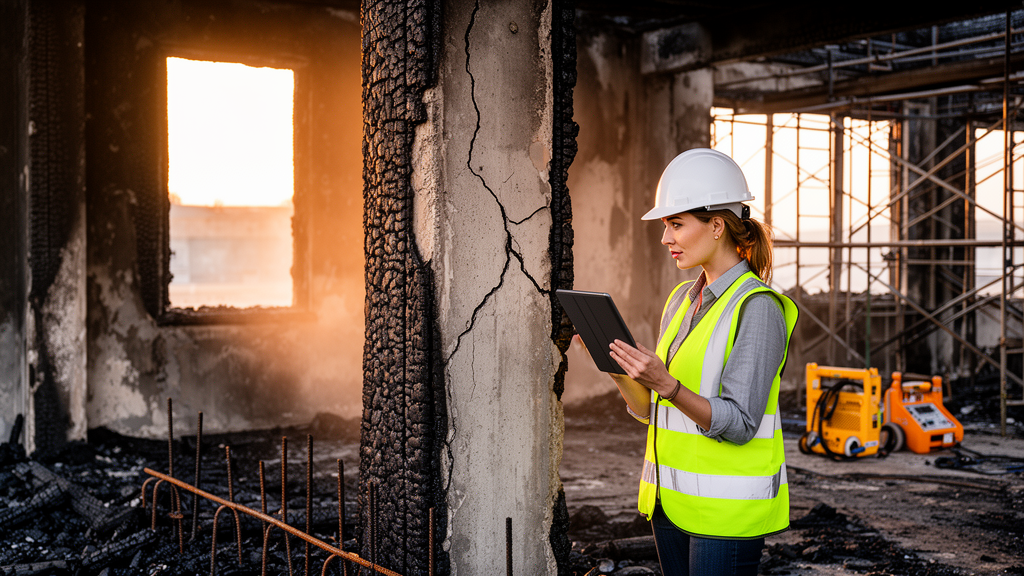
When concrete is exposed to fire, its compressive strength, elastic modulus, and bond strength can degrade severely, and engineers face a difficult question: how much of that lost strength can be recovered if the damaged material is subsequently cured in water or a humid environment? A new open-access study published in AI in Civil Engineering offers one of the most comprehensive answers yet, presenting an empirical model built from 464 experimental datasets that predicts the percentage of compressive strength recovery as a function of four key variables: exposure temperature, re-curing method, re-curing duration, and the water-to-binder (W/B) ratio.
The research, conducted by Muslim Abdul-Ameer Al-Kannoon and Seyed Sina Mousavi, compiled its database from previously published experimental literature, with each observation representing a specific combination of heating and post-fire conditioning conditions. Strength recovery was defined as the compressive strength of the thermally damaged specimen expressed as a percentage of the original intact strength, so a value of 100% means the concrete regained everything it lost, while values above 100% indicate the cured material ended up stronger than before the fire. In the compiled database, recovery outcomes ranged from 2.23% to 202.75%, exposure temperatures spanned 250 to 2,000 degrees Celsius, re-curing durations extended from zero to 273 days, and W/B ratios varied between 0.30 and 0.68.
The mechanism behind recovery is rehydration. At temperatures of roughly 600 to 800 degrees Celsius, concrete suffers microstructural damage through dehydration, cracking, and pore coarsening. Post-fire curing can re-initiate hydration reactions: anhydrous cement particles, decomposed calcium hydroxide, and pozzolanic materials react with newly introduced water to form fresh calcium-silicate-hydrate gel, the binding phase of concrete. This new gel fills cracks and refines the pore structure, which is why wet curing after a fire can restore a meaningful fraction of lost strength, particularly in moderately damaged material.
To identify which factors matter most, the authors applied analysis of variance (ANOVA) with a square root transformation of the recovery output, alongside regression analysis. All four input factors proved statistically significant, with P-values below 0.05, but temperature dominated by a wide margin, registering an F-value of 109.37. Re-curing type ranked second, followed by re-curing duration and W/B ratio. The regression coefficient for temperature was negative, indicating that strength recovery declines as exposure temperature rises. Notably, one caveat in how the data were organized: the “re-curing type” category merges the cooling method used after the fire, such as water quenching or air cooling, with the subsequent curing regime, because the source literature rarely reports these independently.
An optimization analysis then pinpointed the conditions associated with the highest recovery within a target range of 50% to 100%. The favorable window identified was exposure temperatures of 150 to 250 degrees Celsius, hybrid re-curing methods combining different curing approaches, re-curing periods of 94 to 182 days, and W/B ratios between 0.30 and 0.45. Temperatures exceeding roughly 650 degrees Celsius fell outside the optimized range in the analysis, and lower W/B ratios appeared to mitigate the risk associated with high-temperature exposure. The authors caution that interaction effects between parameters, visualized in contour plots, complicate simple one-factor interpretations, with re-curing days becoming more influential at higher temperatures.
From these analyses the team derived polynomial regression models, ultimately favoring a ridge polynomial formulation that applies L2 regularization to suppress overfitting. Inputs were standardized using Z-score normalization, with temperature standardized around a mean of 646.15 degrees Celsius, re-curing days around 31.27 days, and W/B ratio around 0.428. Reliability checks were encouraging: approximately 94.1% of experimental samples fell within the model’s 95% prediction interval. A residual analysis showed a mean residual of +1.76 percentage points and a conservatism parameter of 53.2%, meaning the model mildly underpredicts actual recovery in just over half of the cases, a bias the authors argue is appropriate for design-code applications where conservative estimates are safer.
With that design orientation in mind, the researchers describe a workflow for integrating the conservative model into structural assessment frameworks such as ACI 562. An engineer would estimate the maximum temperature each element experienced, determine the re-curing method, planned duration, and original W/B ratio, apply the prediction equation, and then multiply by an uncertainty factor of 0.85 derived from the residual analysis before using the factored strength in code-based reassessment. The authors emphasize this is a framework for incorporating the model into repair decisions, not a validated prescription for any specific damaged structure.
Alongside the statistical work, six machine learning algorithms were trained on the same four input features: Decision Tree, Artificial Neural Network, XGBoost, K-Nearest Neighbors, Random Forest, and AdaBoost, using an 80/20 train-test split and preprocessing that included missing-data handling, encoding, outlier removal, and normalization. XGBoost performed best, achieving an R-squared of 0.74, a mean absolute error of 8.81 percentage points, and the lowest mean squared error at 126.54. The Decision Tree came second with an R-squared of 0.72, while K-Nearest Neighbors was weakest at 0.67. Feature importance analysis ranked temperature as the predominant predictor in both XGBoost and Random Forest, consistent with the ANOVA findings, while re-curing days carried little predictive weight in either model.
The temperature dominance reflects the underlying materials science. Up to about 300 degrees Celsius, damage stems mainly from free-water evaporation and early dehydration, changes that are largely reversible on rehydration. Between 300 and 600 degrees, calcium hydroxide decomposes into calcium oxide and water, and rehydration of that oxide during curing can both fill microcracks and, in some cases, cause expansive distress. From 600 to 800 degrees, calcium-silicate-hydrate gel decomposes substantially and porosity rises sharply, while beyond 800 degrees, sintering and recrystallization produce permanent degradation that no curing regime can meaningfully reverse. Prior studies reviewed by the authors align with this pattern: blended concretes with fly ash or slag have regained up to 93% of original strength after 56 days of water curing, while specimens heated above 800 degrees typically show negligible recovery.
The authors acknowledge important limitations. The database over-represents plain Portland cement concrete and mixes containing fly ash or slag, while geopolymer concretes and other specialty binder systems are thinly represented, so predictions for those mixtures should be treated with greater caution. The model is also restricted to four inputs because parameters such as cement content, aggregate type, and fiber inclusion were inconsistently reported across source studies. Within those bounds, the study delivers what its authors describe as the most extensive modeling effort to date on post-fire strength recovery, and a quantitative tool for engineers weighing whether curing, rather than replacement, is a defensible option for fire-affected concrete structures.
Subject of Research: Predicting strength recovery of fire-damaged concrete under post-fire curing using statistical and machine learning models
Article Title: An empirical model for predicting time-dependent strength recovery of fire-damaged concrete under post-fire curing regimes: a statistical and machine learning approach
Article References: Al-Kannoon, M. A.-A., & Mousavi, S. S. (2026). An empirical model for predicting time-dependent strength recovery of fire-damaged concrete under post-fire curing regimes: a statistical and machine learning approach. AI in Civil Engineering, 5(1), Article 17. https://doi.org/10.1007/s43503-026-00100-1
Image Credits: AI Generated
DOI: 10.1007/s43503-026-00100-1
Keywords: fire-damaged concrete, post-fire curing, strength recovery, compressive strength, machine learning, XGBoost, ANOVA, regression model, water-to-binder ratio, re-curing duration, structural assessment, rehydration
Cite Scienmag News
Denise Maddox. (October 29, 2026). New Model Predicts How Much Strength Fire-Damaged Concrete Can Regain. Scienmag. https://scienmag.com/new-model-predicts-how-much-strength-fire-damaged-concrete-can-regain/
Denise Maddox. "New Model Predicts How Much Strength Fire-Damaged Concrete Can Regain." Scienmag, 29 October 2026, https://scienmag.com/new-model-predicts-how-much-strength-fire-damaged-concrete-can-regain/. Accessed 29 October 2026.
Denise Maddox. "New Model Predicts How Much Strength Fire-Damaged Concrete Can Regain." Scienmag. October 29, 2026. https://scienmag.com/new-model-predicts-how-much-strength-fire-damaged-concrete-can-regain/