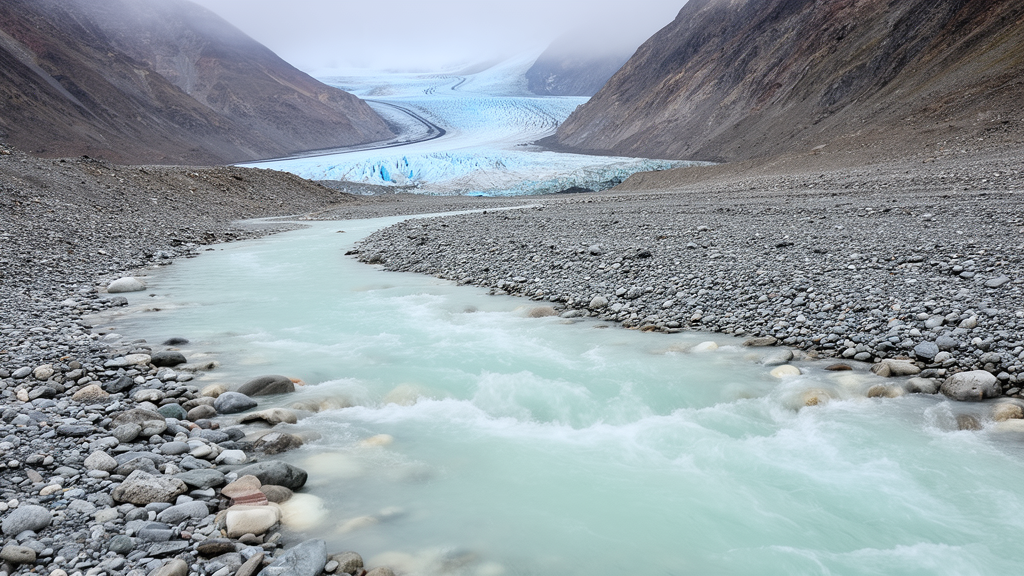
Glacier-fed streams, the turbulent meltwater rivers spilling from the world’s shrinking ice masses, appear to be doing something most rivers do not: absorbing carbon dioxide from the atmosphere rather than releasing it. A global study of 170 glacier-fed streams across 12 mountain ranges and the Greenland periphery found that 69 percent of these waters were undersaturated with carbon dioxide relative to the atmosphere at the time of sampling, meaning their surface waters could draw the gas down from the air. The finding, published in Nature Water, points to a previously underappreciated set of mineral reactions that transfer dissolved inorganic carbon from the water into solid carbonate phases clinging to suspended sediment grains.
The research drew on the Vanishing Glaciers project, an expedition effort between 2019 and 2022 that sampled streams from the European Alps, Caucasus, Himalayas, Andes, Alaska Range, New Zealand’s Southern Alps, Norway, Central Asia and Greenland. At each stream the team sampled an upstream reach close to the glacier snout, at a median distance of just 0.08 kilometres, and a downstream reach within the extent of terminal moraines deposited over roughly the last 2,500 years. Sampling so near the ice minimised confounding influences such as groundwater inputs, tributaries and human activity in developed proglacial areas.
Across all 340 sampled reaches, the median carbon dioxide saturation was 84.3 percent, with an interquartile range of 64.7 to 107.5 percent. Upstream and downstream reaches showed nearly identical saturation states, at 82.6 and 85.6 percent respectively, indicating that the undersaturation is a persistent feature of these waters rather than a local artefact. Dissolved oxygen, by contrast, sat close to atmospheric equilibrium, with a median of 99.9 percent saturation. Because oxygen equilibrates rapidly in these turbulent streams while carbon dioxide does not, the researchers concluded that the carbon dioxide deficit is not simply a consequence of incomplete gas exchange but reflects genuine geochemical removal of dissolved inorganic carbon.
The undersaturation followed a striking latitudinal pattern. Low-latitude streams below 25 degrees showed the strongest deficits, with a median saturation of 65.0 percent, while temperate streams between 25 and 60 degrees averaged 84.6 percent. High-latitude streams above 60 degrees actually showed slight oversaturation, with a median of 104.3 percent. The authors attribute this gradient to variations in chemical weathering intensity: warmer, lower-latitude catchments generate more alkalinity, which buffers dissolved carbon dioxide, whereas cold, rapidly eroding high-latitude catchments have short water residence times and kinetically limited silicate dissolution, reducing their capacity to draw down the gas.
By combining the saturation measurements with estimates of gas exchange through the water surface, the team calculated a median areal carbon dioxide exchange flux of minus 1.53 grams of carbon per square metre per day, where negative values indicate net atmospheric uptake. That drawdown is of the same order of magnitude as the emission fluxes reported from temperate and high-latitude streams and rivers, which typically release 4.5 and 8.0 grams of carbon per square metre per day respectively. The authors caution, however, that newly exposed proglacial terrain can itself emit carbon dioxide, with soil emissions expected to rise from 0.025 to 0.56 grams of carbon per square metre per day within the first century of glacier retreat, and oxidation of rock-bound organic carbon adding a further 0.17 grams per square metre per day in ice-free areas. These terrestrial fluxes could partly or fully offset the aquatic drawdown at the catchment scale.
Explaining the undersaturation proved harder than measuring it. Standard weathering reactions did not fit the observations. Carbonic acid dissolving carbonate and silicate minerals consumes carbon dioxide, but sulfuric acid, generated by sulfide mineral oxidation, drives carbonate weathering that either releases carbon dioxide or retains carbon as bicarbonate without constituting a net atmospheric sink. Secondary calcite precipitation also tends to release the gas. Using the MEANDIR end-member inversion model on solute chemistry, the team showed that sulfuric acid contributes substantially to carbonate dissolution, particularly in carbonaceous catchments, yet most streams remained undersaturated. Subglacial degassing before meltwater emerges could locally explain some deficits, but not the systematic global patterns across lithologies.
The resolution came from a third mechanism: carbonation of silicate and clay mineral surfaces. The researchers propose that carbon dioxide released by sulfuric acid-driven carbonate weathering and secondary calcite precipitation can be consumed by reactions with detrital or authigenic silicate and clay minerals such as chlorite, under the cold, high-pH conditions typical of these streams. This transfers dissolved inorganic carbon into particulate carbonate phases, specifically magnesium-rich carbonates forming on suspended sediment grains. Thermodynamic calculations with PHREEQC showed that calcite supersaturation occurred in 84 percent of streams draining carbonaceous bedrock but in only 9 percent of felsic and none of the mafic systems, and that no analysed water was saturated with respect to crystalline magnesite or hydromagnesite, implying that magnesium carbonate formation happens within transient grain-surface microenvironments rather than in the bulk water.
Direct grain-scale evidence came from scanning electron microscopy with energy-dispersive X-ray spectroscopy on 35 suspended sediment grains from four streams in the Annapurna Range, the Pamirs, the Chilean Andes and the Tien Shan. Of 110 spectra, 108 showed precipitates with distinct microtextures: amorphous calcium carbonate flakes, magnesium-rich amorphous crusts and more crystalline magnesium-calcite agglomerates with minor aluminium and iron enrichments. The grains traced a continuum from low-magnesium amorphous calcium carbonate to progressively magnesium-enriched phases, consistent with experimental work showing that amorphous magnesium-calcite nucleates at aqueous magnesium-to-calcium ratios below 0.167 and incorporates magnesium during crystal growth. Trace metals including copper, manganese, titanium and molybdenum were also scavenged into the coatings, indicating that secondary carbonate precipitation acts as a multication capture process while locking inorganic carbon into solid form.
The quantitative check was encouraging. Scaling the magnesium-rich carbonate coatings to turbidity-derived suspended sediment concentrations of 5 to 60 milligrams per litre, the team estimated a potential particulate inorganic carbon sink of roughly 20 to 190 micromoles of carbon dioxide per litre of streamwater, substantially exceeding the observed dissolved carbon dioxide deficit of 2.5 to 7.3 micromoles per litre in the analysed systems. The authors stress these are first-order estimates that do not constitute a full catchment-scale mass balance, since they omit discharge, sediment fluxes, spatial heterogeneity and reaction kinetics. They also acknowledge that the microscopic analyses were restricted to mixed felsic-carbonaceous and carbonaceous streams where conditions favour coating formation and preservation; the mafic streams showed no mineralogical evidence of secondary carbonate precipitation.
If the mechanism holds more broadly, glacier-fed streams function less as passive conduits carrying weathering products seaward and more as dynamic mineral reactors where dissolved, gaseous and particulate carbon are continuously exchanged. Proglacial floodplains and lakes may then act as temporary reservoirs, storing mineralised carbon over annual to centennial timescales, as suggested by magnesium-rich particulate inorganic carbon preserved in Norwegian glacial tills and sedimentation rates of roughly one millimetre per year of secondary magnesium-calcite in post-glacial lakes of British Columbia. As glacier retreat accelerates and proglacial landscapes expand, the capacity for such temporary storage is likely to grow, though the authors note that growing biological carbon fluxes in warming catchments may ultimately diminish the relevance of these inorganic carbon pathways.
Subject of Research: Carbon dioxide cycling and mineral carbonation in glacier-fed streams
Article Title: Carbonation of silicate minerals contributes to atmospheric CO2 drawdown in glacier-fed streams
Article References: Styllas, M. N., Deluigi, N., Hilton, R. G., Gómez-Gener, L., Yde, J. C., Vanishing Glaciers Field Team, Styllas, M. N., Schön, M., Tolosano, M., de Staercke, V., Kohler, T. J., Peter, H., & Battin, T. J. (2026). Carbonation of silicate minerals contributes to atmospheric CO2 drawdown in glacier-fed streams. Nature Water. https://doi.org/10.1038/s44221-026-00732-8
Image Credits: AI Generated
DOI: 10.1038/s44221-026-00732-8
Keywords: glacier-fed streams, carbon dioxide drawdown, silicate weathering, carbonate precipitation, magnesium carbonate, chemical weathering, sulfuric acid weathering, proglacial landscapes, suspended sediment, inorganic carbon, glacier retreat, Nature Water
Cite Scienmag News
Russell Cooper. (October 28, 2026). Glacier-fed streams quietly pull carbon dioxide from the atmosphere worldwide. Scienmag. https://scienmag.com/glacier-fed-streams-quietly-pull-carbon-dioxide-from-the-atmosphere-worldwide/
Russell Cooper. "Glacier-fed streams quietly pull carbon dioxide from the atmosphere worldwide." Scienmag, 28 October 2026, https://scienmag.com/glacier-fed-streams-quietly-pull-carbon-dioxide-from-the-atmosphere-worldwide/. Accessed 29 October 2026.
Russell Cooper. "Glacier-fed streams quietly pull carbon dioxide from the atmosphere worldwide." Scienmag. October 28, 2026. https://scienmag.com/glacier-fed-streams-quietly-pull-carbon-dioxide-from-the-atmosphere-worldwide/