


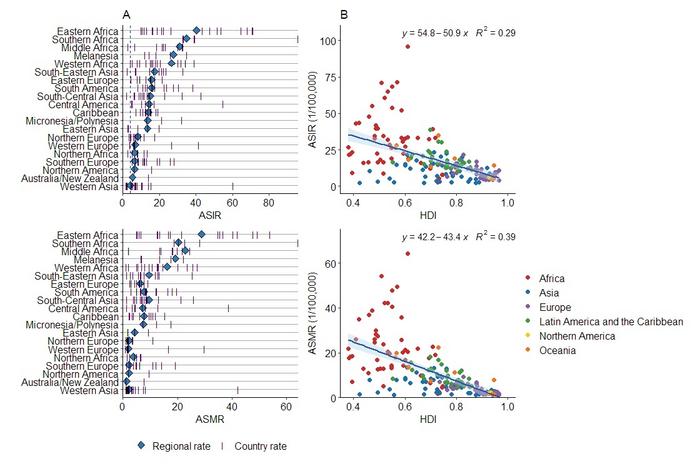
Cervical cancer remains a significant health challenge globally, affecting women’s lives across diverse demographics. As reported in the GLOBOCAN 2022 database, a staggering total of 622,301 new cervical cancer cases were documented worldwide, underscoring the urgent need for improved preventive measures. The findings indicate that the age-standardized incidence rate (ASIR) of cervical cancer stands at 14.1 per 100,000 women. These figures are not just numbers; they represent the realities faced by countless women and their families.
A closer examination reveals geographic disparities in cervical cancer incidence. East Africa leads with the highest ASIR, recorded at 40.4 per 100,000, which starkly contrasts with the 4.2 per 100,000 seen in Western Asia. Such contrasts emphasize the importance of understanding local context and socioeconomic status when addressing health challenges. The Human Development Index (HDI) plays a crucial role in these dynamics; areas with lower HDI frequently observe higher rates of incidence and mortality from cervical cancer.
Mortality data further illustrate the gravity of the situation. In 2022, cervical cancer accounted for 348,874 deaths globally, equating to an age-standardized mortality rate (ASMR) of 7.1 per 100,000. The variations in death rates are alarming; once again, East Africa emerges as the region with the highest mortality rates, followed by Central and South Africa. These statistics not only reflect the severity of the disease but also highlight the systemic health disparities that persist across different regions of the world.
Exploring the correlation between HDI and cervical cancer statistics unveils a troubling trend. Research indicates a negative correlation between HDI and both ASIR and ASMR, suggesting that as HDI decreases, the rates of incidence and mortality increase. This connection is crucial for public health initiatives and calls for targeted interventions in lower-income countries. Educational programs, resource allocation, and systemic improvements in healthcare access are imperative for reducing these disparities.
The trend analysis, which encompasses data from 36 countries between 2003 and 2017, paints a mixed picture. Some countries have seen significant increases in their ASIRs, with average annual percent changes (AAPCs) varying from 0.9% to 5.9%. Conversely, other nations have made strides toward reducing their incidence rates, evidenced by 14 countries reporting significant decreases with AAPCs ranging from -0.8% to -5.9%. This information is vital, as policymakers can leverage these insights for targeted cancer control strategies.
Despite these gains, cervical cancer continues to represent a considerable global health burden, particularly in under-resourced areas. The importance of effective cervical cancer prevention and control frameworks cannot be overstated. By implementing initiatives tailored to specific regional needs, health authorities can significantly impact disease prevention. For instance, prioritizing human papillomavirus (HPV) vaccination campaigns in low-income countries offers a tangible pathway towards achieving the goals set forth by the WHO Global Cervical Cancer Elimination Initiative.
Moreover, comprehensive community education on cervical cancer, its causes, and preventive measures can lead to meaningful improvements in health outcomes. Increasing awareness about regular screenings and HPV vaccinations is essential. Innovative communication strategies, including digital health initiatives that reach women in underserved areas, can amplify the message and inspire action.
The fight against cervical cancer also necessitates collaboration across various stakeholders, including governments, international health organizations, and civil society. A multifaceted approach can harness resources and expertise to address the complexities of this disease. Research partnerships, funding for cervical cancer projects, and the sharing of best practices could streamline efforts to combat this global health issue.
Scientific research also continues to evolve in identifying the determinants of cervical cancer. Recent trends in genetic research and the role of HPV in cancer progression are pivotal areas of exploration. Integrating these scientific advancements into public health policy will be paramount in creating a more responsive healthcare system that addresses the needs of diverse populations.
As the global community progresses towards the WHO’s elimination goals, understanding the intricate links between socioeconomic status, healthcare access, and cervical cancer incidence will be essential. The data underscoring the need for comprehensive, equitable health policies must catalyze action and reform on an international scale.
In conclusion, the pressing reality of cervical cancer requires urgent attention and a renewed commitment from healthcare systems across the globe. With the right strategies, resources, and awareness, the ambitious goals of cervical cancer elimination can become a reality. Collective action, guided by research and centered around community needs, offers hope for a future where cervical cancer becomes an uncommon diagnosis and mortality rates reach unprecedented lows.
Cite Scienmag News
Nathaniel Bowman. (April 14, 2025). Updated Insights on Global Cervical Cancer Trends: Analyzing Incidence and Mortality from 2003 to 2017. Scienmag. https://scienmag.com/updated-insights-on-global-cervical-cancer-trends-analyzing-incidence-and-mortality-from-2003-to-2017/
Nathaniel Bowman. "Updated Insights on Global Cervical Cancer Trends: Analyzing Incidence and Mortality from 2003 to 2017." Scienmag, 14 April 2025, https://scienmag.com/updated-insights-on-global-cervical-cancer-trends-analyzing-incidence-and-mortality-from-2003-to-2017/. Accessed 5 September 2026.
Nathaniel Bowman. "Updated Insights on Global Cervical Cancer Trends: Analyzing Incidence and Mortality from 2003 to 2017." Scienmag. April 14, 2025. https://scienmag.com/updated-insights-on-global-cervical-cancer-trends-analyzing-incidence-and-mortality-from-2003-to-2017/


