Grape growers weighing the financial case for organic or biodynamic farming now have a new long-term cost comparison, which the authors say offers a solid empirical foundation where existing studies have often been difficult to compare. The answer, it turns out, depends heavily on how you measure the money.
The research, published in Agricultural and Food Economics, drew on the INBIODYN field trial at the vineyard site Geisenheimer Mäuerchen, where Riesling vines planted in 1991 have been managed under the three cultivation systems in a four-fold replicated design. The team, led by Dennis Rauhöft with colleagues including Johanna Döring, applied a full cost accounting approach that captured fixed and variable costs across six categories: machinery, labour, materials, vineyard establishment, land, and general and other costs. All prices and indices were referenced to 31 December 2023, and averages were derived from management calculations for each year from 2006 to 2023.
The headline finding is a split verdict. Organic viticulture incurred the lowest costs per hectare, while integrated viticulture offered the lowest costs per kilogram of grapes. For the basic scenario of a 10-hectare winery with mechanical harvesting, costs per hectare were €20,683.10 for organic cultivation, €21,160.47 for integrated and €21,072.61 for biodynamic. The organic advantage came mainly from lower material costs, some 15.26 percent below integrated cultivation, driven by cheaper pesticides and fertilisers. Biodynamic cultivation sat between the two, with higher other costs, including certification, of 6.01 percent relative to organic.
When costs were expressed per kilogram of grapes, the ranking flipped. In the 10-hectare basic scenario, organic cultivation cost €3.23 per kilogram and biodynamic €3.27, which were significantly higher than integrated cultivation at €2.58, by 25.24 percent and 26.98 percent respectively. The pattern held at the larger scale: for a 40-hectare winery, organic (€2.80) and biodynamic (€2.84) systems showed significantly higher costs per kilogram, 24.60 percent and 26.69 percent above integrated cultivation at €2.25. The differences trace back to yields. Integrated management produced higher and more stable average yields over the trial period, so its total costs were divided across a larger output. Biodynamic cultivation averaged 14 percent lower yields than integrated over the entire trial, and organic 17 percent lower.
Labour and machinery dominated the cost structure everywhere the researchers looked. Together they accounted for more than 60 percent of total costs, with labour the largest single driver. In the 40-hectare basic scenario, labour costs for integrated cultivation reached €7,659.12 per hectare, a 41.55 percent share, while machinery costs were €3,673.47, or 19.93 percent. Tractor costs alone made up just over 40 percent of machinery costs, reflecting the tractor’s role as the pulling machine for nearly every field operation. Plant protection application emerged as the single largest item within cultivation equipment, at roughly €7,300 and about 140 labour hours for the 10-hectare basic scenario, around 15 percent of equipment costs.
Manual harvesting was identified as a main driver of production costs. In the manual harvest scenario, costs per hectare rose 11.86 percent for organic, 12.17 percent for biodynamic and 15.21 percent for integrated cultivation compared with the 10-hectare basic scenario. Starting from €800 per hectare for machine harvesting by a contractor, labour costs for integrated cultivation under manual picking were more than four times higher, and those for organic and biodynamic more than three times higher. Even so, integrated production retained the lowest cost per kilogram in this scenario, at €2.93 against €3.50 for organic and €3.54 for biodynamic, again because of its yield advantage.
One of the study’s more striking results concerns mechanisation. The researchers modelled a scenario with a higher degree of mechanisation for the 10-hectare winery, involving increased use of tractors and sprayers, and found no financial advantage. Costs per hectare actually rose to €22,791.97 for organic, €23,299.95 for integrated and €23,181.49 for biodynamic cultivation, with machinery costs about 37 percent higher across all systems. Buying a second tractor doubles the fixed costs while variable costs remain the same and are merely shared. Under the study’s conditions, the authors conclude, greater mechanisation cannot be considered more effective for any cultivation system at this scale, although the results suggest economic benefits improve with winery size. In the comparison between the 10-hectare and 40-hectare basic scenarios, costs per hectare fell by 12.88 percent for integrated, 13.36 percent for organic and 13.01 percent for biodynamic cultivation, largely because fixed costs were spread over more area and equipment was better utilised.
The smallest differences between the cultivation systems appeared in the cost shares for establishing a new vineyard and for land. Planting a new vineyard cost around €45,000 per hectare regardless of cultivation system, depreciated over 25 years at roughly €1,770 per hectare annually, with organic systems incurring about 5 percent more due to more complex care of young vines. Land costs, assumed at €1,116 per hectare based on German lease price surveys, were identical across systems. Material costs told a different story: plant protection products accounted for the largest share at roughly 54 to 62 percent of material costs, followed by cover crops at 22 to 30 percent and tools at 10 to 14 percent, while biodynamic preparations represented only about 2 percent of total material costs. Integrated cultivation had the highest plant protection costs, attributed to the considerably higher purchase prices of the products used.
The authors point to clear optimisation potential in operating resources. Because labour costs can only be reduced through variable labour tied to productivity, and machinery costs are largely fixed, the greatest opportunity lies in the effective use of inputs such as plant protection agents and fertilisers, which could substantially reduce material costs. They also caution that their labour estimates rest on theoretical calculations rather than empirical field monitoring, that irrigation costs were excluded because the trial plot has no irrigation, and that the benefits of better grape quality under manual harvesting, which other work suggests can be substantial, were not part of the cost model.
For growers, the practical message is that system choice interacts with scale, yield expectations and market prices. The higher yield variability observed in organic and biodynamic systems during the trial suggests lower profit margins and reduced economic resilience in difficult years, yet in hot, dry years the organic and biodynamic plots matched or outperformed integrated management in productivity, and grapes produced organically or biodynamically typically command higher market prices. In years when yields converge, the authors note, these alternative systems have the potential to generate higher profits and improve financial stability. Enhancing yield consistency in organic and biodynamic viticulture, they conclude, should be a strategic priority for strengthening its financial viability.
Subject of Research: A full-cost accounting comparison of integrated, organic and biodynamic viticulture based on an eighteen-year field trial in Geisenheim, Germany.
Article Title: Economic comparison of viticultural cultivation systems: evaluating costs across integrated, organic, and biodynamic practices
Article References: Rauhöft, D., Wagner, M., Kurth, A., Friedel, M., & Döring, J. (2026). Economic comparison of viticultural cultivation systems: evaluating costs across integrated, organic, and biodynamic practices. Agricultural and Food Economics, 14(1), Article 74. https://doi.org/10.1186/s40100-026-00513-7
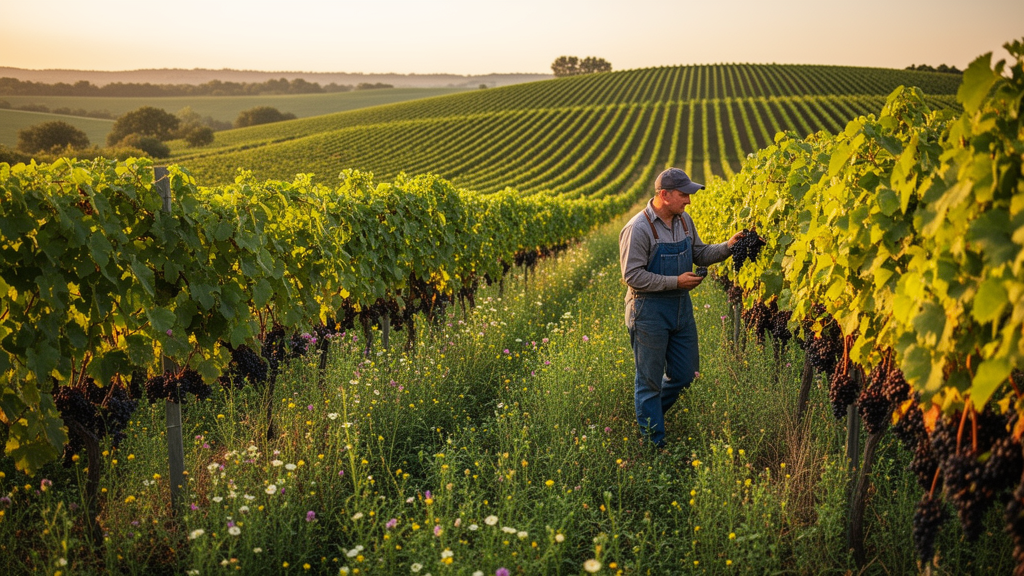
Image Credits: AI Generated
DOI: 10.1186/s40100-026-00513-7
Keywords: viticulture, organic farming, biodynamic viticulture, production costs, wine economics, full cost accounting, grape yield, mechanisation, labour costs, Germany, Riesling, field trial
Cite Scienmag News
Alan Morgan. (October 28, 2026). Organic vineyards cost less per hectare but more per kilogram of grapes. Scienmag. https://scienmag.com/organic-vineyards-cost-less-per-hectare-but-more-per-kilogram-of-grapes/
Alan Morgan. "Organic vineyards cost less per hectare but more per kilogram of grapes." Scienmag, 28 October 2026, https://scienmag.com/organic-vineyards-cost-less-per-hectare-but-more-per-kilogram-of-grapes/. Accessed 28 October 2026.
Alan Morgan. "Organic vineyards cost less per hectare but more per kilogram of grapes." Scienmag. October 28, 2026. https://scienmag.com/organic-vineyards-cost-less-per-hectare-but-more-per-kilogram-of-grapes/