A swarm of earthquakes that shook the region near Ouazzane in northern Morocco between 2009 and 2010 may mark the hidden southwestern tip of one of the Rif belt’s major fault systems, according to a new study published in Frontiers in Earth Science. The research suggests that deformation at the end of the Jebha Fault could be spreading into a network of concealed subsidiary structures within the External Rif, a zone whose seismic hazard potential has until now been underrecognized.
The western-central Rif is characterized by diffuse seismicity, and the 2009–2010 sequence near the city of Ouazzane stands out as a pronounced episode within this pattern. The sequence lies southwest of the Jebha Fault, within the External Rif, a structurally complex domain built from imbricated nappes, thrust sheets, ramps and inherited discontinuities in the basement. Despite its clear seismic footprint, the structural significance of the Ouazzane sequence and its relationship to the regional fault system had remained poorly constrained.
To investigate, the research team analyzed the regional earthquake catalogue, performed double-difference hypocentral relocation, and applied Gardner–Knopoff declustering, a technique that separates mainshocks from their aftershocks. They then integrated the relocated seismicity with regional focal mechanisms and mapped geological structures to assess how the sequence is spatially organized and what it reveals about seismotectonics in the western External Rif.
The relocation results show that the hypocentres are concentrated mainly within the upper 30 kilometers of the crust. Rather than aligning along a single continuous fault plane, the relocated events define several spatially separated and oblique clusters. This fragmented geometry is a key observation: it points to deformation being distributed across multiple structures of different orientations instead of being confined to one through-going active fault surface.
A second important result comes from the declustering analysis. The principal Ouazzane concentration persisted even after aftershocks were removed, indicating that the observed pattern is not produced solely by conventional mainshock–aftershock sequences. In other words, the cluster reflects an underlying spatial organization of seismicity rather than a simple cascade of events triggered around one large shock.
Regional focal mechanisms add a further layer of information. They are dominated by strike-slip faulting, but also include solutions with normal and reverse components. According to the authors, this mixture indicates kinematic partitioning among structures of different orientations, meaning that different faults in the region accommodate different components of the overall deformation field simultaneously.
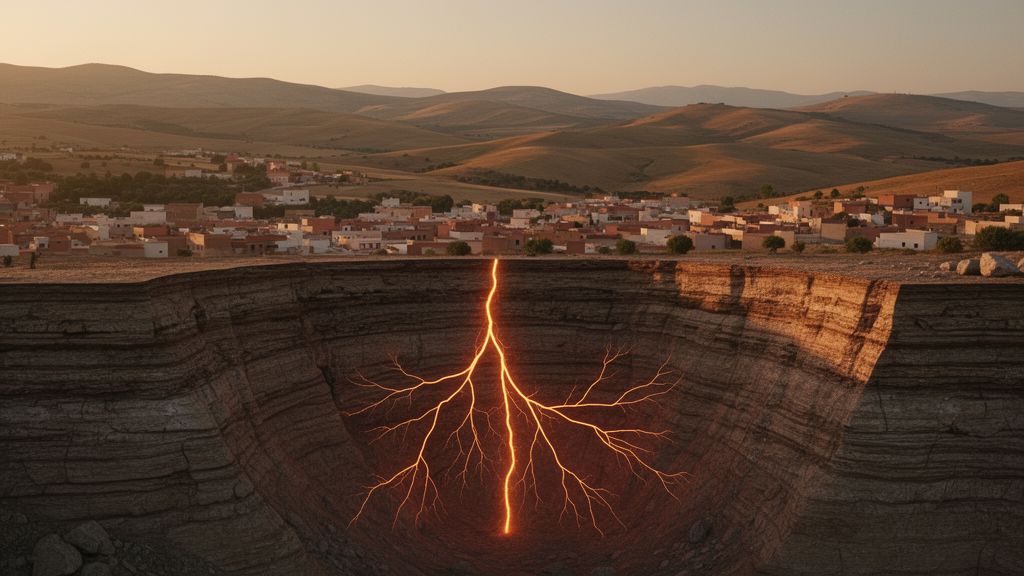
Bringing these lines of evidence together, the researchers propose a structural model in which deformation associated with the southwestern terminal zone of the Jebha Fault may be transferred into a distributed system of concealed subsidiary structures developed within the External Rif nappe stack. The authors are careful to stress the interpretive nature of these inferred branches: they are conceptual structures constrained by the hypocentral distribution and regional fault architecture, not directly mapped active fault surfaces.
On this basis, the team interprets the 2009–2010 Ouazzane sequence as consistent with a possible active horsetail-like termination near the southwestern end of the Jebha system. Crucially, the study does not demonstrate a continuous active fault connection between Jebha and Ouazzane; the interpretation remains a possibility supported by the seismicity pattern rather than a proven fault link.
If the horsetail interpretation is correct, the Ouazzane zone represents a previously underrecognized seismogenic source in the western External Rif, with potential implications for understanding active deformation and seismic hazard in northern Morocco.
Subject of Research: Seismotectonic analysis of the 2009–2010 Ouazzane earthquake sequence and its possible relationship to the Jebha Fault in northern Morocco.
Article Title: The 2009–2010 Ouazzane seismic sequence: evidence for a possible active horsetail-like termination of the Jebha Fault, Rif belt, Northern Morocco
Article References: Akka, H., Ouammou, H., Tahayt, A., & Rigo, A. (2026). The 2009–2010 Ouazzane seismic sequence: evidence for a possible active horsetail-like termination of the Jebha Fault, Rif belt, Northern Morocco. Frontiers in Earth Science, 14, 1962951. https://doi.org/10.3389/feart.2026.1962951
Image Credits: AI Generated
DOI: 10.3389/feart.2026.1962951
Keywords: Ouazzane seismic sequence, Jebha Fault, External Rif, Morocco, hypocentral relocation, declustering, focal mechanisms, strike-slip faulting, horsetail termination, seismic hazard, Ouazzane, seismic
Cite Scienmag News
Violet Maxwell. (October 28, 2026). Hidden Fault Branches May Explain Morocco’s 2009–2010 Ouazzane Earthquake Swarm. Scienmag. https://scienmag.com/hidden-fault-branches-may-explain-moroccos-2009-2010-ouazzane-earthquake-swarm/
Violet Maxwell. "Hidden Fault Branches May Explain Morocco’s 2009–2010 Ouazzane Earthquake Swarm." Scienmag, 28 October 2026, https://scienmag.com/hidden-fault-branches-may-explain-moroccos-2009-2010-ouazzane-earthquake-swarm/. Accessed 28 October 2026.
Violet Maxwell. "Hidden Fault Branches May Explain Morocco’s 2009–2010 Ouazzane Earthquake Swarm." Scienmag. October 28, 2026. https://scienmag.com/hidden-fault-branches-may-explain-moroccos-2009-2010-ouazzane-earthquake-swarm/