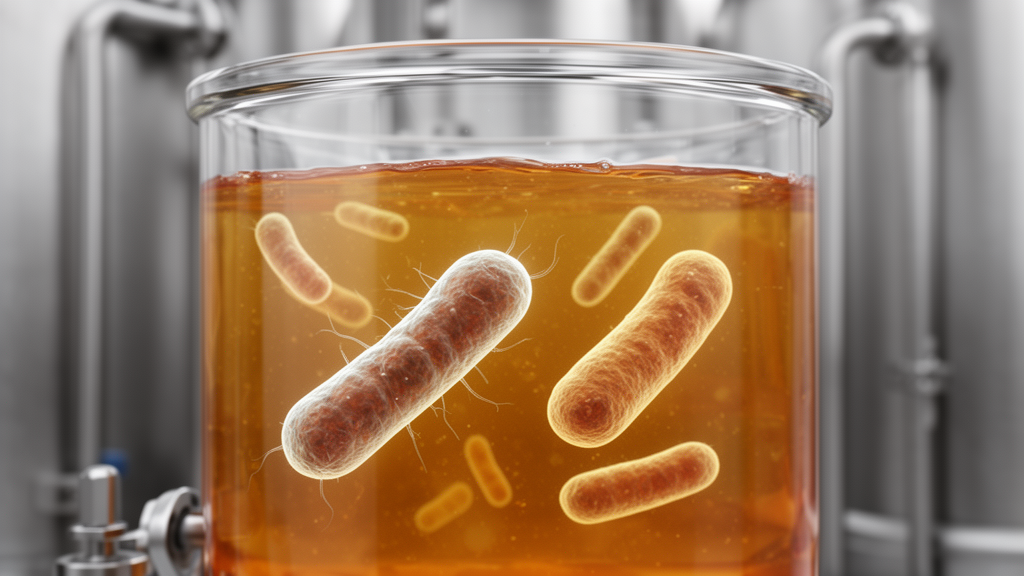
Researchers have shown that the predatory bacterium Bdellovibrio bacteriovorus can be produced at litre scale using heat-killed prey cells, an approach that could allow laboratories without bioreactor infrastructure to generate predatory stock lysates. The study, published in AMB Express, tested whether metabolically active and heat-inactivated Escherichia coli could both support the upscaled, culture-based production of a wastewater-isolated strain, B. bacteriovorus PF13.
Relative fluorescence units dropped in all heat-treated E. coli ATCC 417373 samples compared with untreated controls, and the 65 °C treatment produced the lowest fluorescence, indicating the most complete loss of metabolic activity among the conditions tested.
With heat treatment validated, the researchers upscaled co-cultures of B. bacteriovorus PF13 with either metabolically active or heat-inactivated (65 °C) E. coli prey in a stepwise progression from 100 mL to 1 L and finally to 2.5 L. This volume ladder allowed them to track how predatory production performed as the culture size increased.
In co-cultures with metabolically active prey, the predatory yield grew consistently across all volumes. For the 100 mL, 1 L and 2.5 L cultures, respectively, the plaque-forming units per millilitre of B. bacteriovorus PF13 increased by 2.84, 1.40 and 2.37 logs, while cell counts per millilitre rose by 1.12, 0.86 and 0.80 logs.
Heat-inactivated prey also supported predatory growth, though the pattern differed. In the 100 mL, 1 L and 2.5 L co-cultures using heat-killed E. coli, the cell density of B. bacteriovorus PF13 increased by 1.27, 1.23 and 0.29 logs, respectively. The abstract reports these cell-count increases for the heat-inactivated condition; the corresponding plaque-forming unit figures for that condition are not provided in the available abstract text.
The declining cell-count gain at 2.5 L with heat-inactivated prey, from 1.23 logs at 1 L to 0.29 logs at 2.5 L, suggests that scaling this particular approach further may require adjustments. The authors note that further optimisation is needed to produce predatory lysates in shorter incubation periods, indicating that the current protocol is a proof of feasibility rather than a finished production method.
The strain used in this study, PF13, was isolated from wastewater, and the prey organism was the reference strain E. coli ATCC 417373. The study was conducted as a culture-based laboratory investigation, and its findings concern production methodology rather than clinical efficacy.
The significance of the result lies in the production logistics. The authors suggest that using heat-inactivated prey with simple culture-based methods may potentially circumvent the need for such infrastructure, which they describe as particularly crucial for laboratories in resource-limited countries.
Because the article is being shared early as a peer-reviewed accepted manuscript, the reported figures are subject to the final version of record. Within those limits, the study demonstrates that heat-treated prey cells can support the production of predatory stock lysates at volumes up to 2.5 L, with the 65 °C treatment emerging as the most effective inactivation condition tested, and it establishes a baseline for the further optimisation the authors identify as the next step.
Subject of Research: Upscaled culture-based production of Bdellovibrio bacteriovorus using metabolically active and heat-inactivated E. coli prey
Article Title: Upscaling the production of Bdellovibrio bacteriovorus using metabolically active and heat-inactivated Escherichia coli
Article References: Kennedy, A.-L., Morris, T. C., Waso-Reyneke, M., Botha, A., Khan, S., & Khan, W. (2026). Upscaling the production of Bdellovibrio bacteriovorus using metabolically active and heat-inactivated Escherichia coli. AMB Express. https://doi.org/10.1186/s13568-026-02124-3
Image Credits: AI Generated
DOI: 10.1186/s13568-026-02124-3
Keywords: Bdellovibrio bacteriovorus, predatory bacteria, Escherichia coli, heat-inactivated prey, bioproduction upscaling, resazurin assay, PFU, stock lysates, antibiotic alternatives, wastewater isolate, resource-limited laboratories, AMB Express
Cite Scienmag News
Gregory Coleman. (October 28, 2026). Heat-Killed E. coli Can Support Scaled-Up Production of Predatory Bacteria. Scienmag. https://scienmag.com/heat-killed-e-coli-can-support-scaled-up-production-of-predatory-bacteria/
Gregory Coleman. "Heat-Killed E. coli Can Support Scaled-Up Production of Predatory Bacteria." Scienmag, 28 October 2026, https://scienmag.com/heat-killed-e-coli-can-support-scaled-up-production-of-predatory-bacteria/. Accessed 28 October 2026.
Gregory Coleman. "Heat-Killed E. coli Can Support Scaled-Up Production of Predatory Bacteria." Scienmag. October 28, 2026. https://scienmag.com/heat-killed-e-coli-can-support-scaled-up-production-of-predatory-bacteria/