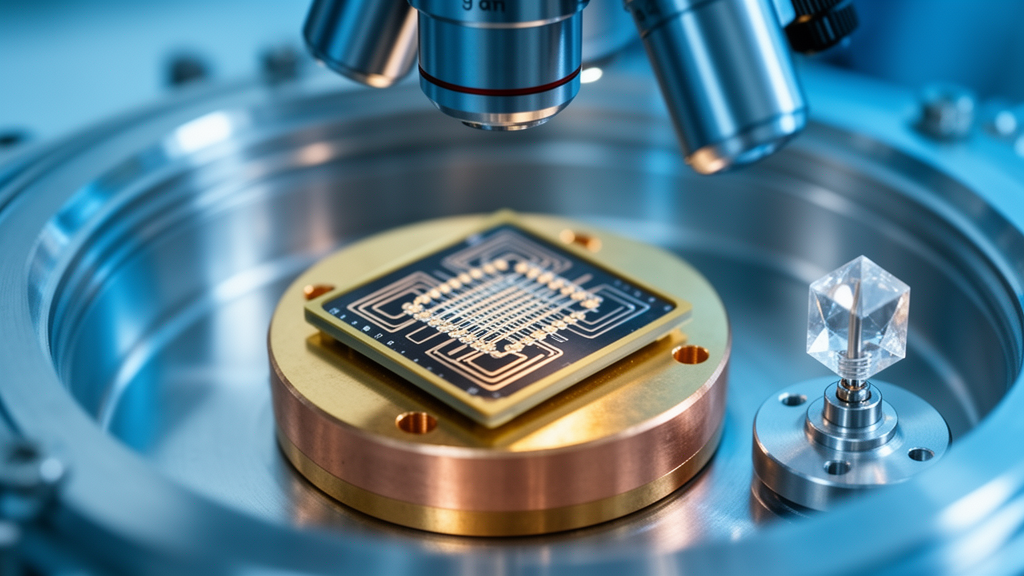
A new review published in the journal Discover Quantum Science maps out how superconducting qubits—artificial atoms built from Josephson junctions in superconducting circuits—can be coherently coupled to tiny mechanical resonators, and how adding optical cavities to those electromechanical platforms opens a route toward converting microwave quantum states into light. Written by Roson Nongthombam, Urmimala Dewan and Amarendra K. Sarma, the article surveys the fundamentals and applications of hybrid electro- and opto-mechanical systems built around two of the most widely used superconducting qubit platforms, the transmon and the fluxonium.
Superconducting qubits behave as artificial atoms with anharmonic energy spectra, meaning their energy levels are not equally spaced. That anharmonicity is what allows engineers to selectively address the transition between the two lowest states while leaving higher levels untouched. Since the emergence of circuit quantum electrodynamics, or cQED, in the early 2000s—marked experimentally by Wallraff and colleagues’ 2004 demonstration of strong coupling between a superconducting qubit and microwave photons in a transmission line resonator—these circuits have become leading candidates for scalable quantum devices and a natural foundation for hybrid systems that combine otherwise incompatible physical platforms.
The review begins from the Cooper pair box, the archetypal Josephson-junction circuit in which Cooper pairs tunnel between two superconducting islands separated by an insulating barrier. The balance between the charging energy and the Josephson tunnelling energy determines the operating regime. When the Josephson energy dominates, the circuit enters the transmon regime, where charge dispersion is exponentially suppressed and the qubit becomes insensitive to charge noise, at the modest cost of reduced anharmonicity. The transmon’s anharmonicity, given by the charging energy, typically sits in the range of a few hundred megahertz—small compared with its gigahertz transition frequency, but large enough relative to linewidths to be resolved and exploited in experiments.
The fluxonium takes a different route. One junction of a split Cooper pair box is replaced by an array of roughly 300 large-area Josephson junctions acting as a superinductance that shunts the remaining small junction. The resulting energy spectrum is far more anharmonic than the transmon’s, and its eigenstates draw substantial contributions from many harmonic oscillator levels rather than only adjacent ones. That richer structure allows transitions between multiple level pairs, provided the states have opposite parity, giving designers unusual flexibility: one transition can be coupled to a mechanical resonator while another, in the gigahertz range, handles dispersive readout through a microwave cavity.
Readout itself relies on the dispersive regime. A qubit placed inside a microwave resonator shifts the cavity frequency by an amount that depends on the qubit state, so measuring that shift reveals whether the qubit is in its ground or excited state. For the transmon, whose eigenstates resemble those of a weakly anharmonic oscillator, the dispersive shifts follow an approximate harmonic-oscillator selection rule, dominated by adjacent levels. For fluxonium, higher Fock-state contributions are significant and the shifts must generally be computed numerically.
The heart of the review concerns how mechanical resonators—suspended membranes, cantilevers, nanobeams, drumheads, and acoustic modes in phononic crystals—couple to these qubits. Two channels exist. Through the charge degree of freedom, coupling is capacitive: a suspended mechanical element can replace one plate of the qubit’s capacitor, or a piezoelectric material such as aluminium nitride converts the qubit’s electric field into bulk or surface acoustic waves, sometimes via an interdigitated transducer and often in a flip-chip architecture with qubit and resonator on separate chips. Through the phase degree of freedom, a suspended segment of the superconducting loop moves in a magnetic field, generating a motion-dependent flux that modulates the Josephson potential and couples mechanical displacement to the superconducting phase.
These two channels produce qualitatively different interactions. Charge-mediated coupling yields transverse, Jaynes–Cummings-type dynamics in which excitations coherently swap between qubit and resonator. At exact resonance, an excited qubit and an empty resonator oscillate back and forth: at time t = π/2G the excitation has fully transferred, and at t = π/4G the pair sits in a maximally entangled state. Such vacuum Rabi oscillations, and the mode splitting of 2G visible in the semiclassical regime, underpin state transfer and entanglement generation. In the dispersive regime, the qubit’s spectrum can even resolve individual phonon number states of the resonator, with the spectral lineshape crossing over from Lorentzian to Gaussian as average phonon occupancy grows—a resource the authors note is useful for quantum metrology.
Phase-mediated coupling, by contrast, is predominantly longitudinal at the flux bias points examined, meaning the interaction commutes with the qubit Hamiltonian. That property enables a striking set of protocols. A red-detuned drive on the qubit lets it act as a cold reservoir, absorbing phonons from the megahertz-frequency resonator and thereby cooling it toward its ground state. Modulating the coupling at the mechanical frequency encodes the qubit state into coherent states of the resonator with equal magnitude and opposite phase. Starting from a qubit superposition, the same longitudinal interaction generates mechanical Schrödinger cat states—superpositions of two coherent states with opposite phases—which a projective qubit measurement projects onto even or odd cat states. Cat states of size around two have been demonstrated with fidelities of roughly 70 to 80 percent, though decoherence rates grow rapidly with cat size, and megahertz resonators require additional ground-state cooling because thermal phonon occupation remains near 100 even at dilution refrigerator temperatures around 15 millikelvin.
Cat states are also a metrological resource. Their interference fringes are exquisitely sensitive to external perturbations: a weak force displacing the cat state rotates it in phase space by an angle proportional to the cat’s size, yielding force sensitivity scaling as the inverse square root of the mean boson number—the standard quantum limit for a single cat state—which multipartite entangled cat states can push toward Heisenberg-limited scaling. Frequency-shift sensing follows a similar logic, with accumulated phase scaling linearly with mean boson number, and since a mechanical oscillator’s resonance frequency depends on its effective mass, the same protocol extends to mass sensing. The authors stress, however, that decoherence and thermal noise remain severe practical obstacles, even as advances in cryogenics, quantum control, and bosonic error correction steadily improve cat-state robustness.
The final extension adds an optical cavity, forming a hybrid electro-optomechanical system in which mechanical displacement shifts the optical resonance through radiation pressure. Because the single-photon optomechanical coupling in suspended resonators is typically on the order of 1 hertz, experiments drive the cavity with many photons to enhance the effective coupling. The payoff is quantum transduction: a double-swap scheme maps a qubit excitation onto the mechanical resonator and then onto an optical photon, offering optical access to microwave quantum states for long-distance quantum communication and quantum networks. The review is candid about the trade-offs: demonstrated microwave-to-optical conversion efficiencies near 40 percent have come with added noise of about 50 quanta, while near-quantum-limited operation with added noise below one quantum has been achieved only at efficiencies around 10 to the minus 5. Gigahertz-frequency acoustic resonators in crystalline materials, with single-photon couplings of several hundred kilohertz and near-ground-state thermal occupation, currently favour the low-noise end of that trade-off, whereas megahertz resonators suffer weaker confinement, larger effective mass, and heavy thermal occupation. Transmon-based mechanical coupling is experimentally well established, but fluxonium-mechanical coupling through the flux degree of freedom has not yet been realised, hindered by demanding readout at megahertz transition frequencies, the strong aligned magnetic fields needed to bias the qubit without introducing vortices, and formidable fabrication challenges—challenges the authors flag as a clear direction for future work.
Subject of Research: Hybrid electromechanical and optomechanical systems coupled to superconducting transmon and fluxonium qubits
Article Title: Fundamentals and applications of hybrid electro- and opto- mechanical system coupled to superconducting qubit: a short review
Article References: Nongthombam, R., Dewan, U., & Sarma, A. K. (2026). Fundamentals and applications of hybrid electro- and opto- mechanical system coupled to superconducting qubit: a short review. Discover Quantum Science, 2(1), Article 38. https://doi.org/10.1007/s44464-026-00041-9
Image Credits: AI Generated
DOI: 10.1007/s44464-026-00041-9
Keywords: superconducting qubits, transmon, fluxonium, circuit quantum electrodynamics, mechanical resonators, quantum transduction, Schrödinger cat states, ground-state cooling, quantum sensing, optomechanics, Josephson junctions, hybrid quantum systems
Cite Scienmag News
Katie Riggs. (October 28, 2026). Superconducting Qubits Meet Mechanical Resonators in Hybrid Quantum Systems Review. Scienmag. https://scienmag.com/superconducting-qubits-meet-mechanical-resonators-in-hybrid-quantum-systems-review/
Katie Riggs. "Superconducting Qubits Meet Mechanical Resonators in Hybrid Quantum Systems Review." Scienmag, 28 October 2026, https://scienmag.com/superconducting-qubits-meet-mechanical-resonators-in-hybrid-quantum-systems-review/. Accessed 28 October 2026.
Katie Riggs. "Superconducting Qubits Meet Mechanical Resonators in Hybrid Quantum Systems Review." Scienmag. October 28, 2026. https://scienmag.com/superconducting-qubits-meet-mechanical-resonators-in-hybrid-quantum-systems-review/