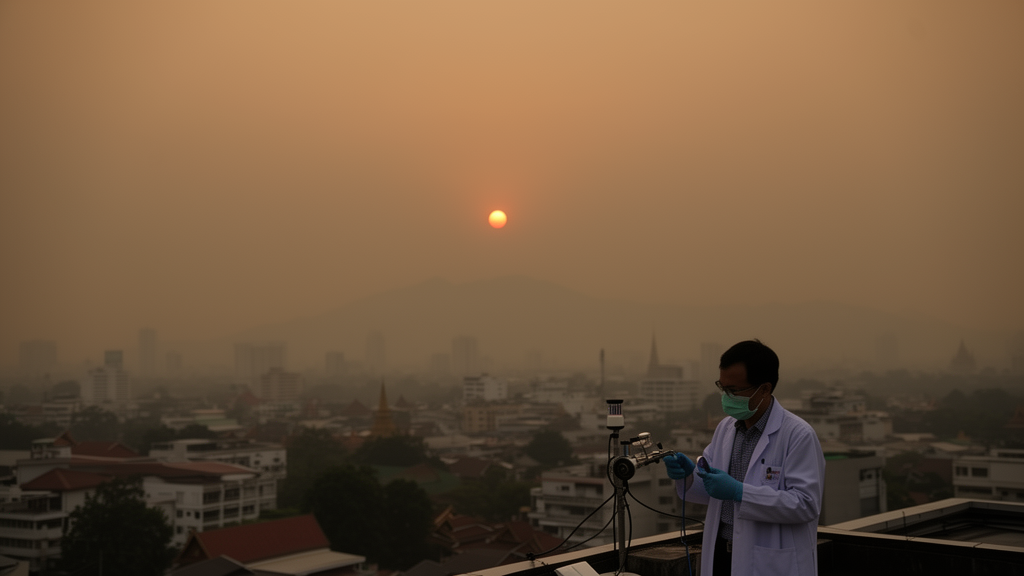
During March 2024, the northern Thai city of Chiang Mai sat under a pall of smoke so dense that fine particulate matter averaged 64.3 micrograms per cubic meter—roughly 4.3 times the World Health Organization’s 24-hour guideline of 15 micrograms per cubic meter. An intensive field campaign at Chiang Mai Rajabhat University, conducted from March 8 to 27 as part of the international ASIA-AQ collaboration, has now documented in detail how that haze was built from carbonaceous aerosols, how biomass burning dominated their chemistry, and how a poorly understood component called brown carbon took over a striking share of the city’s shortwave light absorption.
The campaign coincided with a strong El Niño event reported by the World Meteorological Organization, which brought anomalously hot and dry conditions across the Indochina Peninsula. According to the Thai Meteorological Department, mean temperatures in northern Thailand ran 1.8 to 2.2 degrees Celsius above the climatological average, while precipitation collapsed to just 4.2 millimeters—about 13 percent of the normal level. Those conditions served as a direct catalyst for forest fires in the mountains surrounding the Chiang Mai basin, where satellite data from NASA’s FIRMS system showed dense clusters of active fire hotspots concentrated on the slopes around the city.
Geography amplified the problem. Chiang Mai lies in a basin ringed by high mountain ranges, a configuration that favors surface temperature inversions and low wind speeds during the dry season. The measurements bore this out: in the early morning hours between 01:00 and 07:00, when particulate levels climbed steadily, average wind speed fell to roughly 0.2 meters per second, and cooler nighttime temperatures averaging 23.9 degrees Celsius created conditions favorable for inversion layers that trapped pollutants near the surface. By day, temperatures near 35.6 degrees Celsius and winds of about 3.0 meters per second drove mixing that rapidly diluted the haze. PM2.5 correlated negatively with both wind speed and temperature, confirming these diurnal meteorological shifts as the physical mechanism controlling accumulation and dispersal.
The chemical signature of the aerosols pointed squarely at burning vegetation. Organic carbon averaged 29.5 micrograms per cubic meter, making up 45.9 percent of total PM2.5 mass and emerging as the single most dominant component, while elemental carbon contributed 4.9 micrograms per cubic meter, or 7.6 percent. The mean OC/EC ratio stood at 6.0, well within the range of 4.1 to 14.5 typical of biomass burning emissions and far above the 1.0 to 2.0 generally associated with gasoline and diesel exhaust. The researchers cautioned, however, that these diagnostic ratios offer qualitative rather than quantitative source apportionment for total PM2.5 mass, and that rigorous apportionment would require receptor modeling such as Positive Matrix Factorization with comprehensive chemical speciation.
Corroborating evidence came from gases. PM2.5 showed a strong positive correlation with carbon monoxide, a tracer of incomplete combustion, with a correlation coefficient of 0.71 at a mean CO concentration of 924.5 parts per billion. Sulfur dioxide, by contrast, averaged a mere 2 parts per billion and correlated weakly with particulate levels, indicating that coal combustion from large-scale industry played only a limited role. The high linear correlation between organic and elemental carbon, at 0.95, further suggested that the two shared common sources or accumulated together during the severe early-morning stagnation.
To separate traffic from burning in the black carbon record, the team applied the standard Aethalometer model, which partitions light absorption between fossil fuel combustion and biomass burning assuming distinct absorption Ångström exponents of 1.0 and 2.0 respectively. Over the full campaign, fossil sources accounted for 62.5 percent of black carbon and biomass burning for 37.5 percent, establishing a consistent urban traffic background. But during a defined high-concentration episode—58 consecutive hours from 05:00 on March 14 to 14:00 on March 16, when black carbon exceeded 10 micrograms per cubic meter and PM2.5 persistently topped 100 micrograms per cubic meter—the biomass burning share surged to a mean of 44.4 percent, peaking at an hourly maximum of 55.6 percent and driving the overall variability in black carbon concentration.
Particle size distributions independently supported that attribution. During the episode, number concentrations rose distinctly in the 100 to 300 nanometer accumulation mode, and those particles correlated strongly with biomass-derived black carbon (R = 0.64) while showing only a weak link to fossil-derived black carbon (R = 0.16). Unlike vehicular emissions, which concentrate below 100 nanometers, biomass burning particles are characteristically abundant in the 100 to 300 nanometer range. Diurnal patterns added further texture: fossil-derived black carbon followed the classic morning rush hour profile, dropping after 22:00 and spiking with traffic, whereas biomass-derived black carbon began rising in the pre-dawn hours when traffic was minimal, consistent with fire emissions accumulating overnight in the shallow boundary layer and draining into the basin floor.
The optical findings were the study’s most striking. The mean absorption Ångström exponent across the campaign was 1.5, well above the value of about 1.0 expected for pure black carbon from fossil fuel combustion, signaling a strong influence of brown carbon—the light-absorbing fraction of organic aerosol that absorbs preferentially at ultraviolet and short visible wavelengths. Using an extrapolation method anchored at 880 nanometers, where brown carbon absorption is negligible, the team calculated that brown carbon contributed a campaign mean of 35.1 percent of total light absorption at 370 nanometers, rising to an hourly maximum of 50.5 percent during the high-concentration episode. Under those conditions, the optical influence of brown carbon could rival or even exceed that of black carbon itself.
The brown carbon absorption coefficient correlated with biomass-derived black carbon at R = 0.99, though the authors noted an important caveat: both quantities are derived from the same multi-wavelength Aethalometer dataset, introducing mathematical co-dependence and shared scaling from the total absorption coefficient. Even so, the correlation with fossil-derived black carbon was lower, at 0.87, suggesting that shortwave absorption enhancement was driven predominantly by biomass burning rather than traffic, with the residual fossil correlation reflecting meteorologically driven co-accumulation of all carbonaceous pollutants in the stagnant basin. The optical estimates also showed qualitative consistency with independent indicators, including filter-based organic carbon (R = 0.95) and carbon monoxide (R = 0.71).
The authors attribute the maximized brown carbon contribution to accelerated secondary organic aerosol formation under the hot, dry El Niño conditions, combined with the nocturnal influx and accumulation of combustion particles from the surrounding mountains, while noting that direct quantification of secondary contributions was not performed and would require molecular tracers or advanced modeling. Overall, the study concludes that the core of Chiang Mai’s severe dry-season pollution lies in the growth and shortwave optical absorption of biomass-burning carbonaceous components, compounded by anomalous meteorology and basin topography. The source-specific optical parameters derived here, the team argues, will serve as foundational data for high-resolution climate modeling and for designing particulate matter mitigation strategies across Southeast Asia, where the interplay between climate variability and regional air quality appears to be intensifying.
Subject of Research: Chemical composition and light absorption of biomass-burning carbonaceous aerosols in Chiang Mai, Thailand, during the 2024 El Niño event
Article Title: Chemical and optical properties of carbonaceous aerosols in Chiang Mai, Thailand, during the 2024 El Niño event
Article References: Song, I. H., Park, J. S., Jung, S., Jeong, J., Park, S.-M., Kang, S., Jung, H.-J., Lee, S.-H., Kang, D.-I., Seong, J., & Lim, Y.-J. (2026). Chemical and optical properties of carbonaceous aerosols in Chiang Mai, Thailand, during the 2024 El Niño event. Asian Journal of Atmospheric Environment, 20(1), Article 17. https://doi.org/10.1007/s44273-026-00097-0
Image Credits: AI Generated
DOI: 10.1007/s44273-026-00097-0
Keywords: Chiang Mai, carbonaceous aerosols, brown carbon, black carbon, biomass burning, PM2.5, El Niño, Aethalometer model, light absorption, source apportionment, atmospheric stagnation, Southeast Asia haze
Cite Scienmag News
Russell Cooper. (October 28, 2026). Brown Carbon Drove Shortwave Light Absorption in Chiang Mai’s 2024 El Niño Haze. Scienmag. https://scienmag.com/brown-carbon-drove-shortwave-light-absorption-in-chiang-mais-2024-el-nino-haze/
Russell Cooper. "Brown Carbon Drove Shortwave Light Absorption in Chiang Mai’s 2024 El Niño Haze." Scienmag, 28 October 2026, https://scienmag.com/brown-carbon-drove-shortwave-light-absorption-in-chiang-mais-2024-el-nino-haze/. Accessed 28 October 2026.
Russell Cooper. "Brown Carbon Drove Shortwave Light Absorption in Chiang Mai’s 2024 El Niño Haze." Scienmag. October 28, 2026. https://scienmag.com/brown-carbon-drove-shortwave-light-absorption-in-chiang-mais-2024-el-nino-haze/