Saturday, October 31, 2026
Science
No Result
View All Result
  • Login
  • HOME
  • SCIENCE NEWS
  • CONTACT US
  • HOME
  • SCIENCE NEWS
  • CONTACT US
No Result
View All Result
Scienmag
No Result
View All Result
Home Science News Medicine

Contrast Agents May Rescue Failing Bedside Brain Ultrasound Exams

October 28, 2026
in Medicine
Cassandra Pierce
By Cassandra Pierce Scienmag Editorial Profile - Systems Neuroscience
Reading Time: 3 mins read
0
Contrast Agents May Rescue Failing Bedside Brain Ultrasound Exams

Contrast Agents May Rescue Failing Bedside Brain Ultrasound Exams

65
SHARES
587
VIEWS
Share on FacebookShare on Twitter
ADVERTISEMENT

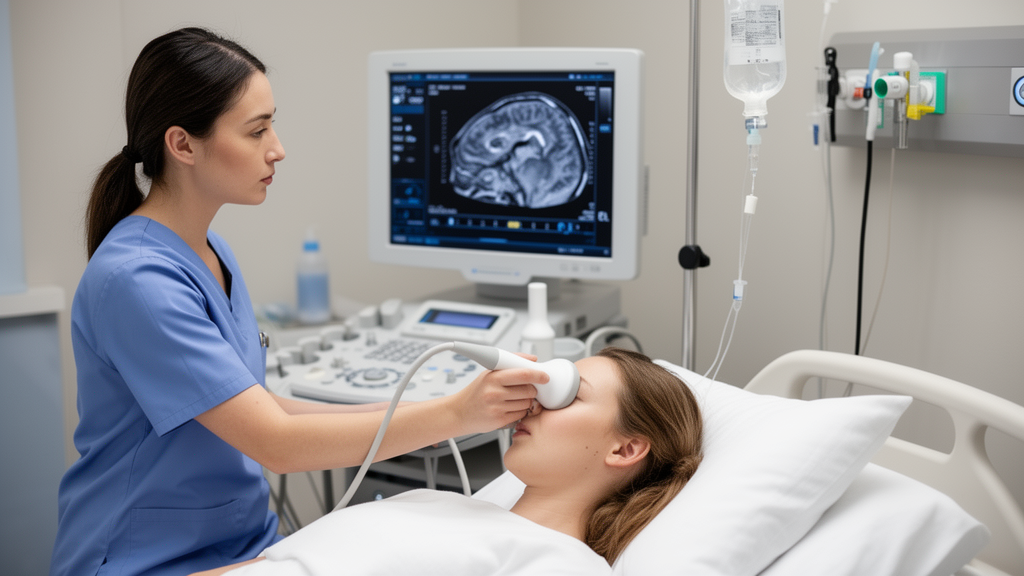
Neuro-point-of-care ultrasound, or NeuroPOCUS, is an emerging bedside technique that extends the neurological examination by allowing real-time assessment of cerebral structure and blood-flow dynamics in neurocritical care. A new narrative review argues that a familiar tool from specialist neurosonology—ultrasound contrast agents—could help overcome one of the technique’s most persistent obstacles: poor image quality.

It is a clinically oriented synthesis of existing literature rather than a new clinical trial, drawing on studies, reviews and guideline documents retrieved from PubMed/MEDLINE, Embase and Scopus through June 2026.

The core problem the authors address is the acoustic window. According to the review, implementation is often hampered by inadequate acoustic windows and poor image and Doppler signal quality, frequently leading to nondiagnostic examinations. The result is frequently a nondiagnostic examination, which undermines efforts to integrate the modality into routine clinical pathways—even though international guidelines have endorsed transcranial ultrasound-based neuromonitoring.

According to the review, the available evidence indicates that these agents improve Doppler signal quality, enhance visualization of intracranial vessels, and increase the proportion of diagnostic examinations in patients with limited acoustic windows. In practical terms, that means more bedside hemodynamic assessments become interpretable when they would otherwise have failed.

The authors organize the evidence by clinical application. The applications they examine include monitoring for vasospasm, assessing intracranial pressure, evaluating steno-occlusive cerebrovascular disease, and determining cerebral circulatory arrest, along with other neurocritical care uses. For each, the review descriptively synthesizes what contrast-enhanced transcranial ultrasound has shown so far.

The review is candid about the barriers that remain. Implementation is constrained by operator dependence, heterogeneous acquisition and interpretation protocols, and limited standardization. The authors also flag the need for structured training and for validated, application-specific velocity cutoffs.

Looking ahead, the authors suggest that contrast enhancement may expand the scope of bedside neurovascular assessment, including in emergency and acute-care settings where dedicated probes and presets are not readily available. They also note the agents’ favorable safety profile and the enhanced bedside feasibility that contrast provides, which they argue may help bridge the gap between guideline recommendations and actual clinical practice.

That bridge, however, is not yet built. The review emphasizes that further technical and clinical validation is needed before contrast-enhanced ultrasound can be said to have a defined role in frontline NeuroPOCUS. Because this is a narrative review synthesizing available evidence rather than a prospective study, its conclusions describe where the field stands and what must be standardized, not a demonstrated clinical benefit at the bedside.

For clinicians in neurocritical care, the takeaway is that the technology to recover diagnostic information in difficult-to-image patients already exists in specialist practice, and the review maps out what would need to happen—training, protocols, validated thresholds—for it to move reliably into frontline bedside use.

Subject of Research: Use of ultrasound contrast agents to improve bedside transcranial ultrasound in neurocritical care

Article Title: Contrast-Enhanced NeuroPOCUS in Neurocritical Care: Overcoming Technical Barriers to Bedside Transcranial Ultrasound

Article References: Bianchini, A., Malferrari, G., Zanoni, A., Volpe, G., Felicani, C., Modolon, C., & Zangheri, E. (2026). Contrast-Enhanced NeuroPOCUS in Neurocritical Care: Overcoming Technical Barriers to Bedside Transcranial Ultrasound. Neurocritical Care. https://doi.org/10.1007/s12028-026-02683-0

Image Credits: AI Generated

DOI: 10.1007/s12028-026-02683-0

Keywords: NeuroPOCUS, transcranial ultrasound, ultrasound contrast agents, neurocritical care, cerebral hemodynamics, vasospasm, intracranial pressure, cerebral circulatory arrest, acoustic windows, narrative review, Contrast-Enhanced, Neurocritical

Cite Scienmag News

Cassandra Pierce. (October 28, 2026). Contrast Agents May Rescue Failing Bedside Brain Ultrasound Exams. Scienmag. https://scienmag.com/contrast-agents-may-rescue-failing-bedside-brain-ultrasound-exams/

Cassandra Pierce. "Contrast Agents May Rescue Failing Bedside Brain Ultrasound Exams." Scienmag, 28 October 2026, https://scienmag.com/contrast-agents-may-rescue-failing-bedside-brain-ultrasound-exams/. Accessed 31 October 2026.

Cassandra Pierce. "Contrast Agents May Rescue Failing Bedside Brain Ultrasound Exams." Scienmag. October 28, 2026. https://scienmag.com/contrast-agents-may-rescue-failing-bedside-brain-ultrasound-exams/


Tags: acoustic windowsbedside neuroimaging for stroke and brain injurycerebral circulatory arrestcerebral hemodynamicsclinical applications of contrast-enhanced neurosonologyContrast-enhancedDoppler signal enhancement with contrast agentsenhancing intracranial vessel visualizationimproving bedside brain ultrasound image qualityintracranial pressurenarrative reviewNeurocriticalneurocritical careneurocritical care diagnostic challengesNeuroPOCUSNeuroPoint-of-Care Ultrasoundneurosonology guidelines for bedside neuroimagingovercoming acoustic window limitations in neurosonologyreal-time cerebral blood flow assessmenttranscranial ultrasoundultrasound contrast agent efficacy in neuroimagingultrasound contrast agentsultrasound contrast agents in neurocritical carevasospasm
Share26Tweet16
Previous Post

FinTech Alone Does Not Drive the EU’s Circular Agrifood Transition, Study Finds

Next Post

Shallow basement aquifers in southwestern Nigeria show limited natural protection, study finds

Related Posts

ZNF207 shields glutamine transporter ASCT2 from degradation to fuel liver cancer growth
Cancer

ZNF207 shields glutamine transporter ASCT2 from degradation to fuel liver cancer growth

October 30, 2026
Most Ethiopian HIV patients on dolutegravir therapy show good knowledge, survey finds
Medicine

Most Ethiopian HIV patients on dolutegravir therapy show good knowledge, survey finds

October 30, 2026
Serum and urine protein biomarkers may sharpen prostate cancer detection beyond PSA
Medicine

Serum and urine protein biomarkers may sharpen prostate cancer detection beyond PSA

October 30, 2026
One gene locus flags atrial fibrillation risk after major surgery, UK Biobank study finds
Medicine

One gene locus flags atrial fibrillation risk after major surgery, UK Biobank study finds

October 30, 2026
Deep-learning CT reconstruction sharpens calcium visibility in phantom tests, but dose evens the score
Medicine

Deep-learning CT reconstruction sharpens calcium visibility in phantom tests, but dose evens the score

October 30, 2026
Pennywort Leaf Extract Lowers Blood Sugar in Diabetic Rats, Study Finds
Medicine

Pennywort Leaf Extract Lowers Blood Sugar in Diabetic Rats, Study Finds

October 30, 2026
Next Post
Shallow basement aquifers in southwestern Nigeria show limited natural protection, study finds

Shallow basement aquifers in southwestern Nigeria show limited natural protection, study finds

  • Mothers who receive childcare support from maternal grandparents show more optimized

    Mothers who receive childcare support from maternal grandparents show more parental warmth, finds NTU Singapore study

    27656 shares
    Share 11059 Tweet 6912
  • University of Seville Breaks 120-Year-Old Mystery, Revises a Key Einstein Concept

    1061 shares
    Share 424 Tweet 265
  • Bee body mass, pathogens and local climate influence heat tolerance

    682 shares
    Share 273 Tweet 171
  • Researchers record first-ever images and data of a shark experiencing a boat strike

    546 shares
    Share 218 Tweet 137
  • Groundbreaking Clinical Trial Reveals Lubiprostone Enhances Kidney Function

    531 shares
    Share 212 Tweet 133
Science

Embark on a thrilling journey of discovery with Scienmag.com—your ultimate source for cutting-edge breakthroughs. Immerse yourself in a world where curiosity knows no limits and tomorrow’s possibilities become today’s reality!

RECENT NEWS

  • Trademarks Meet Patents in New Method to Spot Technology Opportunities
  • Reddit self-declarations offer auditable labels for demographic inference
  • Scots pine needles map trace element pollution in Polish industrial town
  • Dual-blockchain scheme secures vehicle handovers without pre-shared keys

Categories

  • Agriculture
  • Anthropology
  • Archaeology
  • Athmospheric
  • Biology
  • Biotechnology
  • Blog
  • Bussines
  • Cancer
  • Chemistry
  • Climate
  • Earth Science
  • Editorial Policy
  • Marine
  • Mathematics
  • Medicine
  • Pediatry
  • Policy
  • Psychology & Psychiatry
  • Science Education
  • Science News
  • Social Science
  • Space
  • Technology and Engineering

Subscribe to Blog via Email

Enter your email address to subscribe to this blog and receive notifications of new posts by email.

Join 5,150 other subscribers

© 2025 Scienmag - Science Magazine

Welcome Back!

Login to your account below

Forgotten Password?

Retrieve your password

Please enter your username or email address to reset your password.

Log In
No Result
View All Result
  • HOME
  • SCIENCE NEWS
  • CONTACT US

© 2025 Scienmag - Science Magazine

Discover more from Science

Subscribe now to keep reading and get access to the full archive.

Continue reading