A new study published in the Springer journal Discover Surfaces reports that a carefully tuned ultrasound-assisted extraction protocol can pull nearly 36 milligrams of phenolic compounds, measured as gallic acid equivalents, from every gram of dried cassava leaf powder.
The plant in question, Manihot esculenta, is better known as cassava, a staple root crop cultivated across the tropics. While the starchy roots feed hundreds of millions of people, the leaves are largely underutilized despite containing phenolic acids, flavonoids, carotenoids and other secondary metabolites. Recovering these constituents could add value to what is currently a low-value biomass stream. But the researchers are careful about claims: they note that any environmental advantage of the process depends on solvent use, energy demand, extraction yield and downstream processing, and they explicitly avoid describing ultrasound-assisted extraction as intrinsically sustainable. The study evaluates extraction efficiency and biomass valorization without claiming a demonstrated life-cycle benefit.
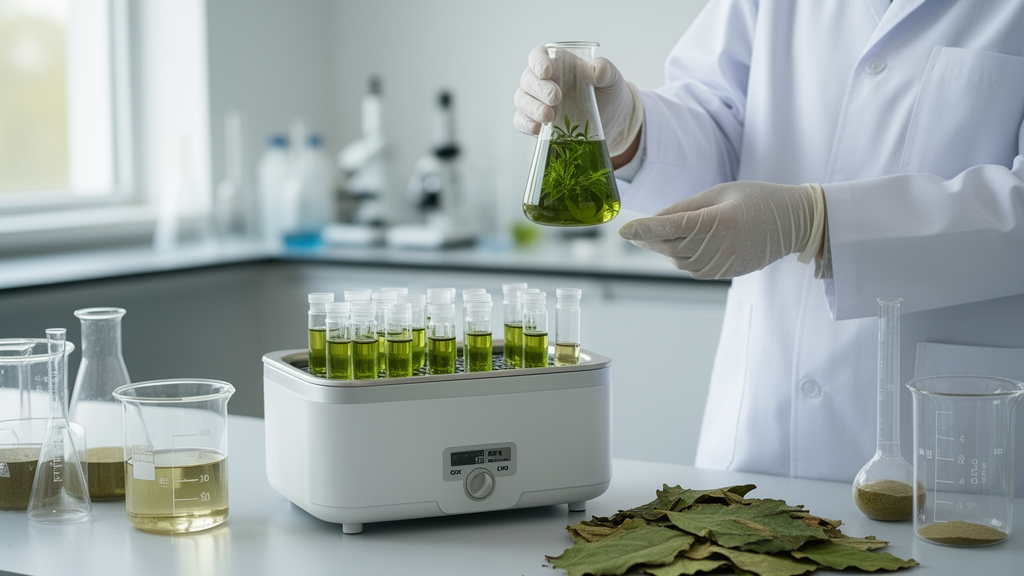
The extraction method itself relies on acoustic cavitation. Ultrasound waves passing through a liquid generate microscopic bubbles that collapse violently, disrupting plant tissue and accelerating the transfer of dissolved compounds out of the plant matrix. In this study, the team used a laboratory ultrasonic cleaning bath operating at 40 kilohertz, preheated to 55 degrees Celsius, with 96 percent ethanol as the solvent. Two and a half grams of dried, ground cassava leaf powder, sieved to particles between 0.2 and 1.0 millimeters, were extracted in a round-bottom flask fitted with a reflux condenser to prevent solvent evaporation. After each run, the mixture was rapidly cooled in an ice bath and filtered, with the filtrate stored cold until analysis. Temperature, bath frequency and ethanol concentration were held constant throughout, a deliberate choice that defined the scope of the optimization.
To explore how extraction time and the solid-to-liquid ratio affected yield, the researchers employed a Box-Wilson central composite design, a mainstay of response surface methodology. The factorial levels ranged from 60 to 180 minutes and from 1:5 to 1:15 weight-per-volume, with rotatable axial points extending the domain to 35.15 to 204.85 minutes and 1:2.93 to 1:17.07. The design required only 13 runs: four factorial, four axial and five replicates at the center point of 120 minutes and 1:10. Those five center-point replicates, which yielded 24.19 plus or minus 3.17 milligrams of gallic acid equivalents per gram of dry weight, provided the estimate of pure experimental error needed for the lack-of-fit test. Across all 13 runs, total phenolic content ranged dramatically, from 1.37 to 37.92 milligrams per gram of dry weight, underscoring how sensitive the outcome is to process conditions.
The statistical analysis delivered a clear verdict. A second-order quadratic model fitted to the data was highly significant, with an F-value of 21.63 and a p-value of 0.0004, and it explained 93.92 percent of the variability in total phenolic content. The adjusted R-squared of 0.8958 sat close to the raw value, though the predicted R-squared of 0.7129 was lower, suggesting weaker out-of-sample prediction than in-sample fit, a gap the authors flag as warranting cautious interpretation. Crucially, the lack-of-fit test was non-significant at p equals 0.2927, indicating the model captured the data without systematic deviation. Residual diagnostics supported this: residuals fell on both sides of zero without a funnel or curvature pattern, and the normal probability plot aligned approximately with the reference line, all within the limitations of a 13-run design.
The dominant factor was unambiguous. The solid-to-liquid ratio, essentially how much solvent is available per unit of biomass, was overwhelmingly the most significant term, with a p-value below 0.0001 and an F-value of 103.05. Extraction time, by contrast, showed no statistical significance within the tested range, with a p-value of 0.5121. The interaction term and both quadratic terms were also non-significant, meaning the response surface was shaped mainly by the linear effect of solvent volume. The authors offer plausible mechanisms for the time result: cavitation-assisted release of phenolics may be rapid, the process may approach solid-liquid equilibrium quickly, or prolonged ultrasonic exposure may degrade compounds. Distinguishing among these possibilities, they note, would require compound-specific measurements. The solvent effect is more intuitive: a larger solvent volume maintains the concentration gradient between plant matrix and liquid phase while reducing saturation of the extraction medium, favoring mass transfer.
Numerical optimization using a desirability function identified the best condition within the design space: 113.68 minutes of extraction at a solid-to-liquid ratio of 1:15. The model predicted a total phenolic content of 34.63 milligrams of gallic acid equivalents per gram of dry weight at these settings, with an overall desirability of 0.910. The researchers then put the prediction to the test with three independently prepared extractions. The measured value was 35.82 plus or minus 0.26 milligrams per gram, a coefficient of variation of just 0.73 percent, and a relative error of only 3.43 percent against the prediction. The authors are careful to note that the selected ratio sits at the upper factorial boundary of the design, so it should be regarded as the best condition within the imposed experimental limits rather than a universal optimum; experiments at higher ratios, along with assessments of solvent recovery, energy consumption and process economics, would be needed before any process-scale conclusions.
Two secondary measurements complicate the picture in instructive ways. At the selected condition, total flavonoid content reached 191.56 plus or minus 0.56 milligrams of quercetin equivalents per gram of dry weight, a number the team stresses was not an optimization response and should not be read as the maximum recoverable flavonoid level. They also caution that the numerically higher flavonoid value does not mean flavonoids exceed total phenolics on a mass basis, because the two assays use different calibration standards, reaction chemistries and reporting equivalents. More striking is the antioxidant result: the same optimized extracts produced only 5.02 plus or minus 0.08 percent inhibition of the DPPH free radical under the single concentration tested. The authors consider several explanations, including weak reactivity of the extracted constituents toward DPPH, matrix interference in the nonspecific colorimetric assays, solvent effects, degradation during processing, or simply an extract concentration below the effective range. Because only one concentration was tested, neither an IC50 value nor a Trolox-equivalent antioxidant capacity could be calculated, and the authors call for concentration-response testing alongside complementary assays such as ABTS or FRAP in future work.
The study closes with a morphological characterization that looks toward eventual material applications. The optimized extract was concentrated under vacuum and spray-dried with maltodextrin as a wall material at a one-to-one ratio, and scanning electron microscopy revealed irregular, aggregated particles with heterogeneous apparent dimensions and rough surfaces. The authors attribute this morphology to the combined effects of the extract, the maltodextrin matrix, feed composition, atomization and rapid moisture removal during spray drying, rather than to the phenolic extract alone. No particle-size distribution or specific surface area was measured. Their conclusions are measured: cassava leaves appear to be a promising source for further phytochemical investigation, but demonstrating suitability for coatings, films, encapsulation systems or controlled-release applications will require compound profiling, formulation studies and application-specific performance testing.
Subject of Research: Optimization of ultrasound-assisted extraction of phenolic compounds from cassava leaves using central composite design
Article Title: Central composite design process optimization of ultrasound-assisted extraction of phenolic compounds from Manihot esculenta leaves
Article References: Mazlan, A. N. S., Azlina, N. A., Wahab, M. S. A., Halim, M. O., Sembada, A. A., & Osman, M. S. (2026). Central composite design process optimization of ultrasound-assisted extraction of phenolic compounds from Manihot esculenta leaves. Discover Surfaces, 1(1), Article 9. https://doi.org/10.1007/s44507-026-00010-w
Image Credits: AI Generated
DOI: 10.1007/s44507-026-00010-w
Keywords: cassava leaves, phenolic compounds, ultrasound-assisted extraction, central composite design, response surface methodology, total phenolic content, solid-to-liquid ratio, Manihot esculenta, DPPH antioxidant assay, spray drying, biomass valorization, Malaysia
Cite Scienmag News
Bethany Barker. (October 27, 2026). Solvent Ratio, Not Time, Drives Phenolic Recovery from Cassava Leaves in Optimized Ultrasound Extraction. Scienmag. https://scienmag.com/solvent-ratio-not-time-drives-phenolic-recovery-from-cassava-leaves-in-optimized-ultrasound-extraction/
Bethany Barker. "Solvent Ratio, Not Time, Drives Phenolic Recovery from Cassava Leaves in Optimized Ultrasound Extraction." Scienmag, 27 October 2026, https://scienmag.com/solvent-ratio-not-time-drives-phenolic-recovery-from-cassava-leaves-in-optimized-ultrasound-extraction/. Accessed 28 October 2026.
Bethany Barker. "Solvent Ratio, Not Time, Drives Phenolic Recovery from Cassava Leaves in Optimized Ultrasound Extraction." Scienmag. October 27, 2026. https://scienmag.com/solvent-ratio-not-time-drives-phenolic-recovery-from-cassava-leaves-in-optimized-ultrasound-extraction/