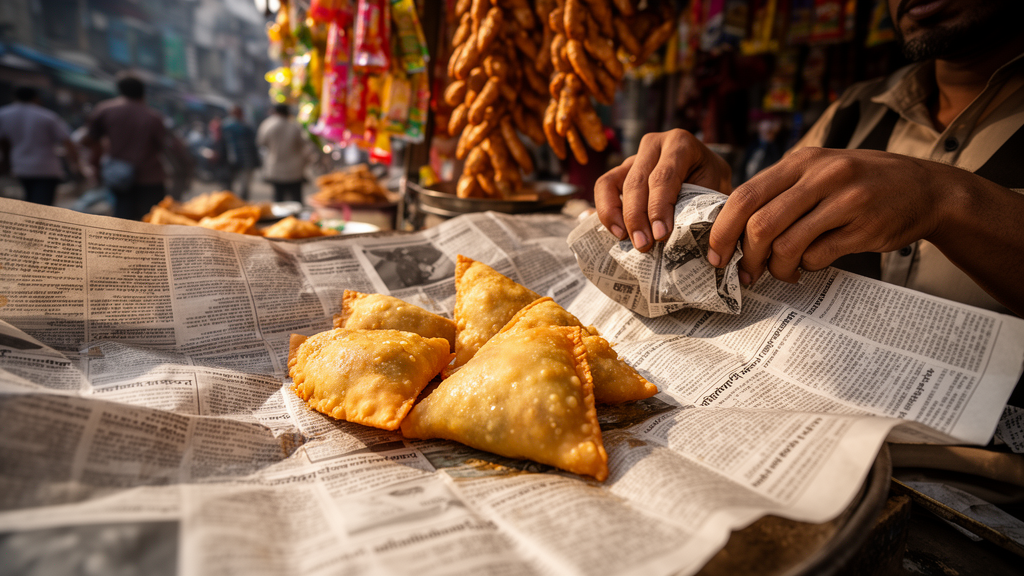
Street vendors in Dhaka routinely wrap hot, oily food in newspaper, magazine, and book pages that were never designed for food contact. A new study of 38 paper samples purchased from local vendors in the Bangladeshi capital found that seven trace elements—arsenic, lead, cadmium, chromium, nickel, copper, and manganese—were present in all of the analyzed materials, and that concentrations of arsenic, lead, cadmium, and chromium frequently exceeded international safety limits by factors of two to one hundred. The research, published in the journal Food Safety and Risk, offers the first baseline data on trace element contamination in paper-based food packaging materials in Bangladesh, while its authors caution that the health risk figures attached to those measurements are conservative screening estimates rather than definitive risk characterizations.
The newspaper set covered ten of the country’s most widely circulated dailies, including Prothom Alo, The Daily Star, and Kaler Kantho, and each sheet was subdivided into light-font, bold-font, and photo-printed areas to capture variation in ink density. Magazine and book samples were smaller in number, four pages each, a limitation the authors acknowledge. All samples were purchased new to avoid recycled content or prior contamination, then digested in acid and analyzed with inductively coupled plasma mass spectrometry at an ISO/IEC 17025-accredited laboratory, with certified reference recoveries between roughly 96 and 103 percent.
Copper and manganese dominated the elemental profiles across every paper category. Copper reached a maximum of 61.9 parts per million in photo-printed newspaper, with a mean of 45.479 ppm in that category, while manganese peaked at 31.7 ppm in bold-font newspaper. The authors attribute these patterns to printing chemistry: copper phthalocyanine pigments are standard in cyan and green inks, and manganese compounds serve as drying agents that accelerate oxidative drying in high-speed offset printing. Lead was highest in newspaper bold font at a mean of 3.239 ppm, nickel peaked in magazine paper at 4.279 ppm, and chromium was highest in book paper at 2.793 ppm. Arsenic and cadmium occurred at lower absolute levels, ranging from 0.055 to 0.444 ppm and 0.070 to 0.108 ppm respectively.
Multivariate statistics revealed material-specific contamination signatures that the researchers link to ink formulations and printing processes. Hierarchical clustering of the 38 samples produced five groups, including one consisting exclusively of magazine samples with the highest nickel levels, which the authors suggest may originate from nickel-based pigments or catalysts, and another of bold and photo newspaper samples with the highest copper concentrations. Principal component analysis separated bold-font newspapers along an axis driven by arsenic and lead, and magazines along an axis driven by nickel, with the first two components explaining 77.7 percent of the total variance. One outlier sample, from the bold-font section of the daily Samakal, showed an arsenic concentration of 2.81 ppm, more than six times the overall mean. Cadmium and chromium, by contrast, did not differ significantly across paper types, suggesting ubiquitous sources such as recycled pulp or base coatings rather than ink-specific applications.
The health risk calculations followed the United States Environmental Protection Agency methodology and rested on several conservative assumptions. The researchers assumed a 15 percent migration factor drawn from a published Sri Lankan study, daily food consumption of 200 grams for adults and 100 grams for children, body weights of 70 and 15 kilograms, and complete bioavailability of the ingested elements. Under those assumptions, the cumulative Hazard Index exceeded the safety threshold of one for children across all five paper categories, ranging from 1.774 for magazine paper to 3.962 for bold-font newspaper. For adults, Hazard Index values ranged from 0.836 for magazines to 1.704 for bold-font newspapers. Only two individual element-paper combinations exceeded the threshold of one on their own: arsenic in bold-font newspaper for children, with a Hazard Quotient of 1.482, and copper in photo-printed newspaper for children, at 1.137.
The cancer risk estimates carry even heavier caveats. Assuming worst-case conditions in which all chromium was present in its hexavalent form—a known human carcinogen—while trivalent chromium has far lower carcinogenic potential, all four carcinogenic metals exceeded the acceptable risk level of one in a million across all paper categories. Chromium produced the highest modeled values, up to 1.15 × 10⁻¹ for children consuming food wrapped in book paper, followed by arsenic at up to 6.67 × 10⁻⁴. Children showed roughly 2.3 times higher estimated risk than adults across all elements, reflecting their lower body weight and higher food intake per kilogram of body weight. The authors stress that no speciation analysis was performed for chromium or arsenic, whose toxicity varies sharply with chemical form, and that the figures should be read as upper-bound screening values, not measured exposures.
That distinction matters because the study measured total trace element content in the paper itself, not the amounts that actually transfer into food. Migration depends on temperature, contact time, and the fat and acidity of the food, none of which were tested experimentally. The 15 percent migration factor borrowed from prior literature may overstate or understate real transfer under Dhaka’s street-vending conditions, where hot and oily foods are commonly wrapped for extended periods. The authors also note that the risk reference doses and cancer slope factors come from US EPA and WHO databases and may not reflect the sensitivity of the Bangladeshi population, and that sampling was confined to Dhaka with small magazine and book sample sizes.
The context in Dhaka gives the findings public health relevance despite those uncertainties. The city of more than 20 million inhabitants hosts an estimated 200,000 street vendors who collectively serve millions of meals daily, and discarded newspapers, book pages, and magazines are commonly used as low-cost wrappers in Bangladesh, India, Pakistan, and several African nations. Printing inks in such materials are not held to food-contact safety standards, and when they contact hot or fatty foods, metals can migrate into the food. Bangladesh currently lacks national standards for trace element content in food-contact papers, a regulatory gap the study’s authors describe as urgent, though they recommend confirmatory research before any prohibition on non-food-grade papers.
Internationally, the measured concentrations sit at the high end of comparable studies. Research from India reported newspaper lead levels of 0.005 to 0.009 ppm and chromium of 0.006 to 0.011 ppm, far below the Dhaka samples, while Sri Lankan kraft paper studies found similarly low values. By contrast, a Nigerian study of food packaging papers reported arsenic, lead, chromium, and nickel levels comparable to those measured here, and a United Kingdom analysis from 2000 reported copper concentrations of 20 to 30 ppm, consistent with the current findings. The authors suggest these regional differences likely reflect variation in ink formulations, recycling practices, and regulatory enforcement.
The research team recommends a precautionary but evidence-based path forward: controlled migration studies using local food matrices such as hot oils and acidic chutneys, speciation analyses of chromium and arsenic, bioaccessibility testing with in vitro digestion models, expanded sampling across urban and semi-urban regions, and eventually epidemiological work on exposed populations. In the interim, they propose mandatory certification of food-contact materials, vendor education campaigns, and promotion of affordable certified food-grade packaging so vendors can move away from recycled and printed paper. Should confirmatory studies bear out the screening-level concerns, they argue, stronger interventions including prohibitions on non-food-grade papers for direct food wrapping would be warranted.
Subject of Research: Trace element contamination in non-food-grade paper food packaging in Dhaka and associated modeled health risks
Article Title: Trace element contamination and health risks in paper-based food packaging in Bangladesh
Article References: Bintu, F. A., Tithi, S. Z., Rahman, M. T., Chowdhury, P., Saha, B., Chowdhury, F. A., Arafat, M. Y., Moniruzzaman, M., Alam, O., & Hossain, M. L. (2026). Trace element contamination and health risks in paper-based food packaging in Bangladesh. Food Safety and Risk, 13(1), Article 46. https://doi.org/10.1186/s40550-026-00169-7
Image Credits: AI Generated
DOI: 10.1186/s40550-026-00169-7
Keywords: Bangladesh, food packaging, trace elements, heavy metals, street food, printing ink, health risk assessment, newspaper, ICP-MS, Dhaka, food safety, carcinogenic risk
Cite Scienmag News
Alan Morgan. (October 27, 2026). Printed Papers Used as Food Wrappers in Dhaka Carry Toxic Trace Elements. Scienmag. https://scienmag.com/printed-papers-used-as-food-wrappers-in-dhaka-carry-toxic-trace-elements/
Alan Morgan. "Printed Papers Used as Food Wrappers in Dhaka Carry Toxic Trace Elements." Scienmag, 27 October 2026, https://scienmag.com/printed-papers-used-as-food-wrappers-in-dhaka-carry-toxic-trace-elements/. Accessed 28 October 2026.
Alan Morgan. "Printed Papers Used as Food Wrappers in Dhaka Carry Toxic Trace Elements." Scienmag. October 27, 2026. https://scienmag.com/printed-papers-used-as-food-wrappers-in-dhaka-carry-toxic-trace-elements/