


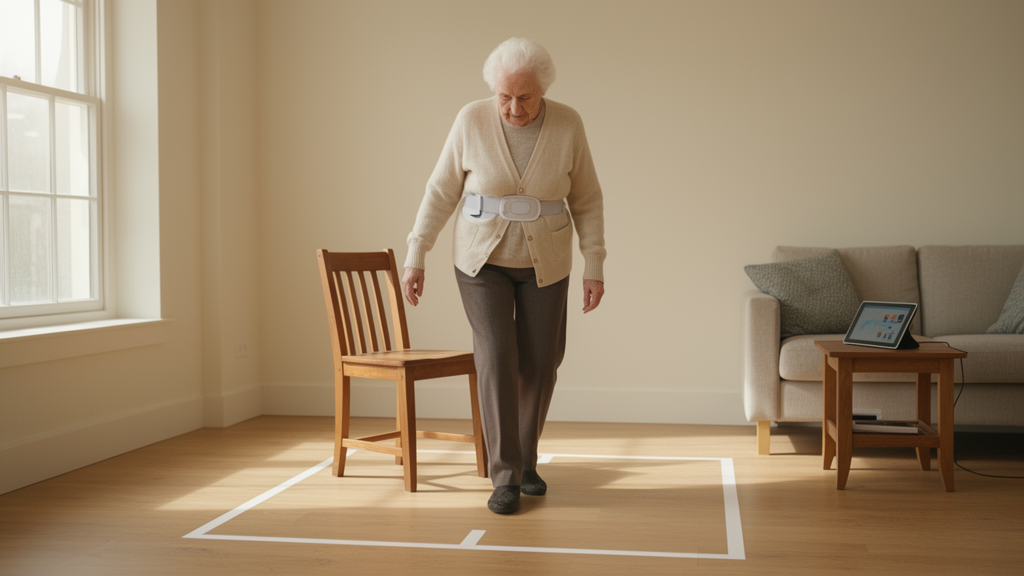
Rising from a chair, walking three meters, turning, returning, and sitting down again sounds simple, but for people in their late eighties each component of that sequence carries its own mechanical demands. A new study published in Frontiers in Psychology has broken this continuous movement task into six distinct phases and measured how long each one took, along with the accelerations and trunk angles recorded at the lower back, in a group of 21 very old women with a mean age of 87.95 years. The results offer a phase-by-phase portrait of functional mobility in an age group that is rarely studied in such granular detail, while the authors themselves are careful to frame the findings as exploratory descriptions rather than established clinical predictors.
The research team, led by Chao-Fu Chen and Jie Meng of Henan University together with colleagues at Zhengzhou University of Industrial Technology and the Xinxiang Institute of Engineering, recruited participants from an older adult residential facility in Fujian Province, China, in 2025. Nurses at the facility identified potential participants, and thirty individuals were screened for the ability to walk independently without assistive devices and to complete every component of the assessment on their own. Twenty-one women aged between 82 and 90 years met those criteria and took part. Their mean height was 153.24 centimeters and their mean body mass was 55.33 kilograms. Notably, every participant had both hypertension and diabetes mellitus, a comorbidity profile that reflects the reality of many residential care populations but also limits how broadly the findings can be generalized.
The experimental task followed the timed up and go protocol, one of the most widely used clinical tests of functional mobility. Participants began seated in a standardized armless chair with a seat height of 45 centimeters, and on a verbal command they stood, walked three meters at a self-selected comfortable speed, turned around, walked back, and sat down again. What distinguished this study from a conventional timed up and go test was the measurement apparatus. A wearable inertial measurement unit, the baiobit sensor weighing roughly 37 grams, was secured to the posterior trunk at the level of the fifth lumbar vertebra using an elastic belt. The device combined triaxial accelerometers, gyroscopes, and magnetometers to capture linear accelerations in the vertical, anteroposterior, and mediolateral directions, and to estimate trunk orientation in the sagittal, frontal, and transverse planes, corresponding to flexion-extension, lateral bending, and axial rotation.
Using predefined event-based criteria, the researchers segmented the continuous sequence into six phases: standing up, walking forward, the mid-turn at the three-meter mark, walking after the turn, the final turn in front of the chair, and sitting down. Phase boundaries were identified from the task structure and the sensor time series, and were visually checked by the researchers for consistency with the observed movement. Each participant completed a single recorded trial, a choice made to reduce fatigue and testing burden in this very old sample, though it also means within-person variability and test-retest reliability could not be assessed.
The headline temporal result was a total completion time of 28.20 seconds on average, with a standard deviation of 12.22 seconds, reflecting considerable spread between individuals. The walking-after-turn phase was the longest at 10.36 seconds on average, followed by walking forward at 7.31 seconds, the mid-turn at 3.40 seconds, standing up at 2.62 seconds, sitting down at 2.36 seconds, and the final turn at 2.16 seconds. When the researchers correlated each phase duration with the total, two phases stood out: walking after the turn correlated at r = 0.782 and standing up at r = 0.743, both reported as strong. Walking forward correlated at 0.519, while the mid-turn, final turn, and sitting down showed weaker coefficients of 0.386, 0.295, and 0.227 respectively.
The authors are explicit that these phase-total correlations carry an important caveat. Because each phase duration is mathematically a component of the total, which was calculated as the sum of the segmented phases, the associations are partly part-whole relationships rather than independent predictors. The team also declined to run a multivariable regression model for precisely this reason, noting that including all phase durations as predictors of a total they sum to would produce tautological interpretation and unstable estimates. The differences between correlation coefficients were not formally tested either, so it cannot be concluded from these data that the standing-up or walking-after-turn phases are somehow more decisive for overall mobility than the others.
The trunk kinematics added a second layer of description. During standing up, peak trunk accelerations averaged 1.11 meters per second squared vertically, 0.88 anteroposteriorly, and only 0.38 mediolaterally. Sitting down showed a different pattern: vertical acceleration was similar at 1.12 meters per second squared, but anteroposterior acceleration was higher at 3.74 and mediolateral acceleration at 1.77. Among the correlations, vertical and mediolateral peak accelerations during standing up were positively associated at r = 0.561, and mediolateral accelerations across the two transitions covaried at r = 0.461. The authors stress that such coefficients describe between-participant covariation only; they do not demonstrate propulsive force, lateral instability, or any particular balance-control strategy, and the small sample limits the precision of every estimate.
Trunk orientation measures revealed some of the study’s most striking numbers. During standing up, the sagittal flexion-extension angle averaged 27.43 degrees, with frontal lateral bending of 4.61 degrees and transverse axial rotation of 5.52 degrees. During sitting down, the sagittal angle rose to 32.30 degrees and the transverse rotation measure averaged 24.43 degrees, though with a standard deviation of 47.37 degrees, indicating that one or more participants produced extreme values in that plane. Within-transition correlations across planes were positive throughout, and the sitting-down sagittal-transverse association was especially large at r = 0.951. The authors interpret this as a strong between-participant association, not as evidence of synchronized movement over time, and they suggest that chair alignment during the final approach may be a useful context for future investigation of multiplanar trunk motion. Endpoint analyses added further candidate relationships, including a negative correlation between maximum and minimum flexion-extension measures during standing up at r = -0.545, a positive one during sitting down at r = 0.419, and a sitting-down minimum axial rotation measure that correlated at 0.943 with the standing-up minimum flexion-extension measure.
How do these values compare with earlier work? The discussion references an instrumented timed up and go study by Zarzeczny and colleagues from 2017 involving 26 nursing-home women aged 80 to 93, which reported a median total time of 21.06 seconds and a median sit-to-stand time of 2.18 seconds, against the present means of 28.20 and 2.62 seconds. The authors treat this comparison cautiously, noting that summary statistics, recruitment settings, and event definitions differ between studies, and that acceleration ranges in the earlier work cannot be equated with the peak accelerations measured here. The comparison, they write, supports examining subtasks while underscoring the need for harmonized definitions across studies.
The limitations are considerable and the authors enumerate them candidly. The sample comprised only 21 very old women from a single residential facility, all with hypertension and diabetes, all able to walk independently without aids, a combination of characteristics that introduces selection bias and restricts generalizability to men, younger older adults, and people who need mobility assistance. No a priori sample size calculation was performed; the study simply included every eligible resident available during the recruitment window. Only one trial per participant was recorded, no reliability analysis was possible, and the cross-sectional design with bivariate correlations cannot support causal inference. Multiple comparisons were partially addressed with Bonferroni correction, with associations that did not survive correction interpreted cautiously as exploratory. The study did not test diagnostic accuracy, prospective falls, intervention responsiveness, or any incremental value over total timed up and go time, so no clinical thresholds or training recommendations can be drawn from it. What the paper does deliver is a detailed, sensor-based descriptive map of how a small group of very old women distribute their time and trunk motion across the components of a familiar mobility task, along with a set of candidate associations that larger samples, repeated trials, and longitudinal designs will need to test.
Subject of Research: Phase-specific trunk kinematics and timing during a timed up and go task in very old women
Article Title: Phase-specific trunk kinematics during functional mobility in very old adults
Article References: Chen, C.-F., Meng, J., Zhu, L., & Sun, X. (2026). Phase-specific trunk kinematics during functional mobility in very old adults. Frontiers in Psychology, 17, Article 1805004. https://doi.org/10.3389/fpsyg.2026.1805004
Image Credits: AI Generated
DOI: 10.3389/fpsyg.2026.1805004
Keywords: timed up and go test, trunk kinematics, inertial measurement unit, older adults, functional mobility, postural transitions, wearable sensors, sit-to-stand, correlation analysis, gerontology, biomechanics, fall risk
Cite Scienmag News
Beatrice Stafford. (October 27, 2026). Trunk Sensor Study Maps How Very Old Women Move Through Each Step of the Timed Up and Go. Scienmag. https://scienmag.com/trunk-sensor-study-maps-how-very-old-women-move-through-each-step-of-the-timed-up-and-go/
Beatrice Stafford. "Trunk Sensor Study Maps How Very Old Women Move Through Each Step of the Timed Up and Go." Scienmag, 27 October 2026, https://scienmag.com/trunk-sensor-study-maps-how-very-old-women-move-through-each-step-of-the-timed-up-and-go/. Accessed 27 October 2026.
Beatrice Stafford. "Trunk Sensor Study Maps How Very Old Women Move Through Each Step of the Timed Up and Go." Scienmag. October 27, 2026. https://scienmag.com/trunk-sensor-study-maps-how-very-old-women-move-through-each-step-of-the-timed-up-and-go/


