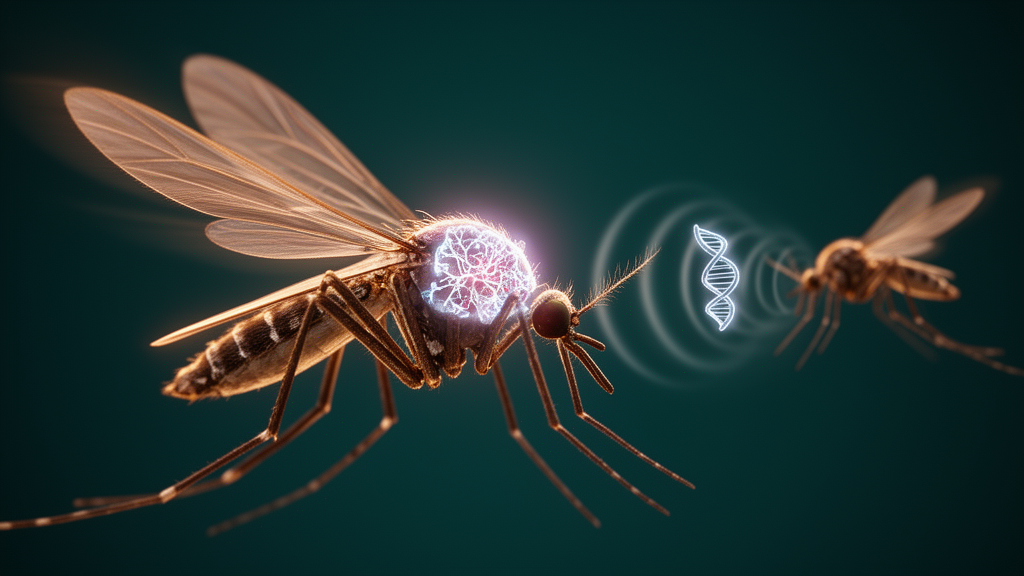
Researchers have identified the gene that gives male mosquitoes their remarkable ability to find females by ear. The gene, called fruitless, is responsible for building the male auditory system of the yellow fever mosquito, Aedes aegypti, and for the behavior of homing in on the sound of a female’s wingbeats. When the team mutated this gene in males, the insects lost the ability to locate females entirely. The work, led by Postdoctoral Researcher Yumin Loh, Assistant Professor Matthew Su, and Professor Azusa Kamikouchi of the Institute of Transformative Bio-Molecules (WPI-ITbM) at Nagoya University in Japan, in collaboration with Professor Daniel Eberl of the University of Iowa, was published in the peer-reviewed journal PLOS Biology on October 27, 2026.
The yellow fever mosquito is a vector of dengue fever, Zika fever, and yellow fever, which is why scientists have long studied its reproductive mechanisms in the hope of controlling population sizes. At dusk, male Aedes aegypti gather in swarms, where they detect the wingbeat sounds of females flying into the swarm, pursue them, and mate. After mating, females seek a host, take a blood meal, and lay eggs. Because hearing is an essential sensory modality for male mating success, understanding how the male auditory system is built could point toward new strategies for interfering with reproduction.
In insects, fruitless is one of the genes that generates sex differences in neural function. Previous studies in Drosophila fruit flies showed that fruitless is primarily responsible for generating sex differences in behavior. The Nagoya-led team set out to determine what the gene does in mosquitoes, examining its influence on both male behavior and the structure and performance of the hearing organ itself.
A mosquito’s ears are auditory organs made up of the Johnston’s organ at the base of the antenna and the long flagellum extending from it. These ears are highly sexually dimorphic, with substantial differences between the sound frequencies to which male and female ears are tuned. The researchers confirmed strong expression of fruitless in the Johnston’s organ, suggesting the gene is directly involved in ear function.
The behavioral consequences of losing the gene were striking. Fruitless mutant males, unlike normal males, did not gather with other males at dusk and instead exhibited female-like behavior. And while normal males showed strong attraction to frequencies matching female wingbeat sounds, the mutant males were not attracted to any of the frequencies tested.
Measurements of ear performance revealed why. Normal males actively vibrate their ears to achieve peak sensitivity toward female wingbeat sounds, but in mutant males the peak sensitivity was shifted higher, outside the frequency range of female wingbeats. Sound detection was also severely impaired: the auditory neuron response to sounds in mutant males was one-sixth of that seen in normal males.
Anatomy offered a further clue. Across all insects, only mosquito ears contain auditory efferent neurons, which project from the central nervous system to the ear and modulate hearing function. Close examination of the internal anatomy of the Johnston’s organ showed that mutant males had an altered auditory efferent network compared with control males. In effect, mutating fruitless partially feminizes the males and leaves them unable to amplify sounds.
To trace the molecular pathway, the team analyzed RNA sequencing datasets from mosquito ears. Fruitless is assumed to directly suppress female-type genes while indirectly enhancing male gene expression. The analysis identified changes in the expression of genes encoding dyneins, large molecular motor proteins previously linked to differences in hearing function between the sexes. The types of dynein highly expressed differed between mutant and wild-type males, which may contribute to the impaired hearing amplification in the mutants. The researchers suggest that the accumulated effect of changes in multiple dyneins establishes the male-specific ear that enables males to detect female wingbeat sounds.
The findings clarify that fruitless is responsible for establishing male auditory function in Aedes aegypti, and they may have practical applications for mosquito control. Because males must hear female wingbeat sounds for mating to occur, targeting fruitless and its downstream genes could make it possible to interfere with the earliest stages of reproduction, offering a potential new avenue for reducing populations of a disease-carrying insect.
Subject of Research: The role of the fruitless gene in male Aedes aegypti mosquito hearing and mate attraction
Article Title: Why male mosquitoes are attracted to the sound of female wingbeats
Article References: Why male mosquitoes are attracted to the sound of female wingbeats. Original publication (Bibliographic details unavailable.)
Image Credits: AI Generated
DOI: Not provided
Keywords: mosquitoes, Aedes aegypti, fruitless gene, hearing, Johnston's organ, dyneins, mating behavior, PLOS Biology, vector-borne disease, auditory efferent neurons, Nagoya University, genetics
Cite Scienmag News
Juliet Wilcox. (October 27, 2026). Gene behind male mosquitoes’ attraction to female wingbeats identified. Scienmag. https://scienmag.com/gene-behind-male-mosquitoes-attraction-to-female-wingbeats-identified/
Juliet Wilcox. "Gene behind male mosquitoes’ attraction to female wingbeats identified." Scienmag, 27 October 2026, https://scienmag.com/gene-behind-male-mosquitoes-attraction-to-female-wingbeats-identified/. Accessed 4 November 2026.
Juliet Wilcox. "Gene behind male mosquitoes’ attraction to female wingbeats identified." Scienmag. October 27, 2026. https://scienmag.com/gene-behind-male-mosquitoes-attraction-to-female-wingbeats-identified/