


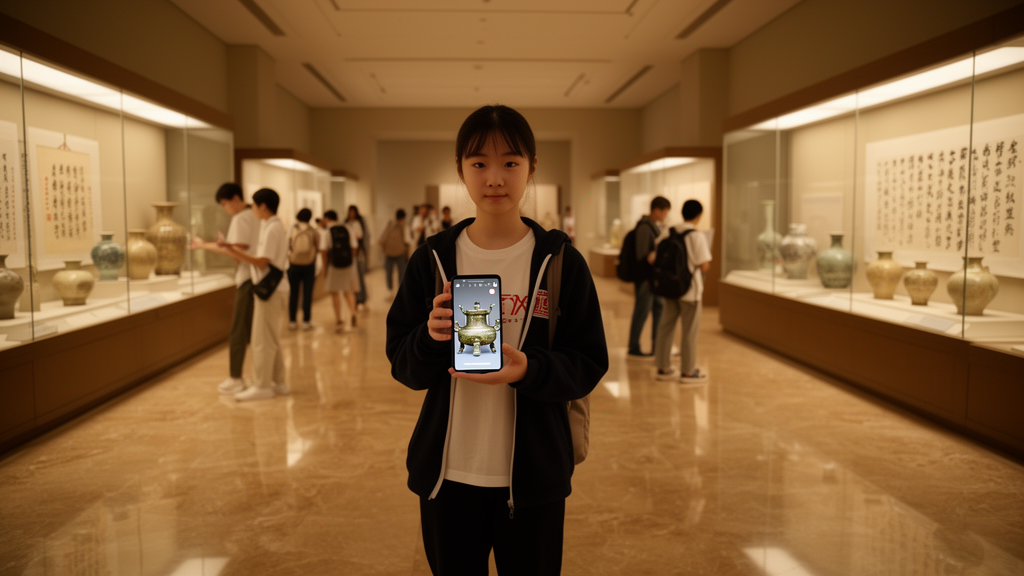
A cross-sectional survey of 425 Generation Z college students in China suggests that the way a digital museum communicates and presents itself is associated with how strongly those students feel connected to the cultural heritage it displays. Using the Intelligent National Digital Museum as the study context, researchers found that perceptions of the platform’s social media communication and website aesthetics were positively associated with cultural heritage understanding, telepresence, and social presence, and that these three psychological states were in turn positively associated with heritage-related cultural identity. The study, published in Frontiers in Psychology, framed the outcome not as technology adoption or revisit intention, but as an identity-related cognitive and affective response measured through pride in the presented history and culture, recognition of the importance of heritage preservation, personal connection, and emotional attachment.
The research team, based at Southwest Minzu University in Chengdu, organized the analysis around the Stimulus–Organism–Response framework, a model from environmental psychology in which external cues influence outcomes through internal psychological states. Social media marketing, operationalized through perceptions of entertainment, interaction, trendiness, and customization, and website aesthetics, modeled as a higher-order construct combining perceived unity, novelty, interactivity, and immersion, served as the two stimuli. Cultural heritage understanding, telepresence, and social presence represented the organism-level states at the cognitive, spatial, and social levels. The authors emphasized that the stimuli were retrospectively perceived evaluations of prior media experiences rather than independently observed or experimentally manipulated environmental features.
Data were collected through an anonymous online questionnaire hosted on Wenjuanxing between January 1 and January 31, 2026. Eligible respondents had to confirm both prior use of the digital museum platform and prior exposure to content from its official social media channels. Of 506 recorded responses, 425 valid cases remained after incomplete responses, unusually fast completions, and invariant response patterns were excluded. The final sample was nearly evenly split by gender, with 214 male and 211 female students, and spanned all undergraduate years. A sample-adequacy calculation based on the inverse square root method estimated a minimum requirement of 275 cases, which the final sample exceeded.
The symmetric analysis used partial least squares structural equation modeling with 5,000 bootstrap resamples. All eleven hypothesized direct paths were positive and statistically significant. Social media marketing showed its strongest association with cultural heritage understanding (β = 0.271), while website aesthetics was associated with cultural heritage understanding (β = 0.174), telepresence (β = 0.170), and social presence (β = 0.132). Among the three paths to heritage-related cultural identity, telepresence had the numerically largest coefficient (β = 0.234), followed by cultural heritage understanding (β = 0.210) and social presence (β = 0.192). The authors cautioned that the differences among these three coefficients were not substantial and should not be read as evidence that telepresence substantively dominates the other mechanisms.
All twelve hypothesized indirect associations were statistically significant in the primary model, with 95% bias-corrected bootstrap confidence intervals excluding zero. The largest specific indirect association from social media marketing ran through cultural heritage understanding (β = 0.057), while the largest from website aesthetics ran through telepresence (β = 0.040). Cultural heritage understanding was also indirectly associated with identity through telepresence (β = 0.052) and social presence (β = 0.054), a pattern the authors interpreted as suggesting a potential role as a cognitive hub linking meaning-making to spatial and social experience. The four sequential indirect paths, in which the stimuli operated through understanding and then through one form of presence, were significant but small, with coefficients between 0.009 and 0.015.
A robustness check complicated part of that picture. When direct paths from both stimuli to heritage-related cultural identity were added to the model, both direct associations were significant, and explained variance in identity rose from 22.2% to 26.4%. Most principal indirect pathways remained stable, but the two sequential associations originating from website aesthetics dropped to β = 0.007 and no longer met the conventional 0.05 significance threshold, with p-values of 0.052 and 0.061. The authors concluded that the findings are more consistent with the coexistence of direct and indirect associations than with a full-mediation interpretation, and that statistical support for the website-aesthetics sequences depended on model specification.
The configurational analysis used fuzzy-set qualitative comparative analysis to examine whether high heritage-related cultural identity requires particular combinations of conditions. After calibrating the seven-point Likert responses into fuzzy-set membership scores using the 95th, 50th, and 5th percentiles as anchors, a necessity analysis found that no single condition reached the recommended consistency threshold of 0.90. The sufficiency analysis identified six configurations associated with high identity, which the authors descriptively grouped into cognition–immersion, cognition–social media, and aesthetics–social presence patterns. Notably, one configuration combined the core presence of cultural heritage understanding and telepresence with the core absence of website aesthetics, indicating that strong interface aesthetics is not a necessary prerequisite in every pathway, even though website aesthetics showed positive average associations in the structural model.
Four configurations were associated with low heritage-related cultural identity, and these were not simple mirror images of the high-identity solutions, a pattern the authors described as configurational asymmetry. Solution consistency was 0.797 with coverage of 0.781 for the high-identity solution, and 0.834 with coverage of 0.474 for the low-identity solution. Because the high-identity consistency remained slightly below 0.80 and robustness checks showed sensitivity to PRI and frequency cutoffs, the authors repeatedly characterized these configurations as exploratory, sample-specific patterns rather than stable user types or generalizable taxonomies. Raising the consistency cutoff to 0.85 left the solutions unchanged, but stricter PRI and frequency settings altered the number of configurations and core-condition assignments.
The authors were explicit about the limits of causal inference. Because the data are cross-sectional and all constructs were assessed retrospectively from the same respondents in a single survey, the structural coefficients and indirect effects are interpreted as theory-specified associations rather than demonstrated temporal causation, and the design cannot establish that media exposure strengthens or changes identity over time. The common-source design may introduce shared evaluative variance and potential common-method bias. The sample comprised Chinese Generation Z college students with experience of a single platform, participants evaluated their overall prior experience rather than a standardized exhibition, and detailed information on usage frequency, duration, and recency was not systematically collected, all of which limit generalizability.
The primary model explained 22.2% of the variance in heritage-related cultural identity, which the authors described as meaningful but modest and incomplete. They suggested that future research incorporate pre-existing cultural identity, heritage familiarity, perceived authenticity, narrative quality, institutional trust, and digital literacy, and employ longitudinal, cross-lagged, or experimental designs to test whether the proposed sequence occurs over time. On the practical side, the findings suggest that digital museums might balance cultural interpretation, immersive spatial presentation, and socially engaging narratives rather than concentrating resources on a single technology, and prioritize comprehensible immersion, content accuracy, accessibility, and system stability over decorative complexity, though the authors noted that the study did not examine algorithmic recommendation and does not justify intensive user profiling.
Subject of Research: Psychological pathways linking digital museum media environments to heritage-related cultural identity among Generation Z college students in China
Article Title: Psychological pathways linking digital museum environments to heritage-related cultural identity among generation Z college students in China
Article References: Zhao, B., Li, W., Hou, X., & Huang, T. (2026). Psychological pathways linking digital museum environments to heritage-related cultural identity among generation Z college students in China. Frontiers in Psychology, 17, Article 1979445. https://doi.org/10.3389/fpsyg.2026.1979445
Image Credits: AI Generated
DOI: 10.3389/fpsyg.2026.1979445
Keywords: digital museums, cultural identity, media psychology, telepresence, social presence, PLS-SEM, fsQCA, Generation Z, cultural heritage, China, survey research, Stimulus-Organism-Response
Cite Scienmag News
Glenn Wilkins. (October 27, 2026). Digital Museums May Shape Cultural Identity Through Understanding and Presence, Study of Chinese Students Finds. Scienmag. https://scienmag.com/digital-museums-may-shape-cultural-identity-through-understanding-and-presence-study-of-chinese-students-finds/
Glenn Wilkins. "Digital Museums May Shape Cultural Identity Through Understanding and Presence, Study of Chinese Students Finds." Scienmag, 27 October 2026, https://scienmag.com/digital-museums-may-shape-cultural-identity-through-understanding-and-presence-study-of-chinese-students-finds/. Accessed 27 October 2026.
Glenn Wilkins. "Digital Museums May Shape Cultural Identity Through Understanding and Presence, Study of Chinese Students Finds." Scienmag. October 27, 2026. https://scienmag.com/digital-museums-may-shape-cultural-identity-through-understanding-and-presence-study-of-chinese-students-finds/


