
Thursday, October 29, 2026
Science
No Result
View All Result
  • Login
  • HOME
  • SCIENCE NEWS
  • CONTACT US
  • HOME
  • SCIENCE NEWS
  • CONTACT US
No Result
View All Result
Scienmag
No Result
View All Result
Home Science News

Research report: Impact of geomagnetic storm intensity on thermospheric density and orbital decay of LEO satellites: a G1–G5 per-event analysis

October 27, 2026
in Science News
Cameron Wolfe
By Cameron Wolfe Scienmag Editorial Profile - Space Weather
Reading Time: 2 mins read
0
Research report: Impact of geomagnetic storm intensity on thermospheric density and orbital decay of LEO satellites: a G1–G5 per-event analysis

Research report: Impact of geomagnetic storm intensity on thermospheric density and orbital decay of LEO satellites: a G1–G5 per-event analysis

65
SHARES
587
VIEWS
Share on FacebookShare on Twitter
ADVERTISEMENT

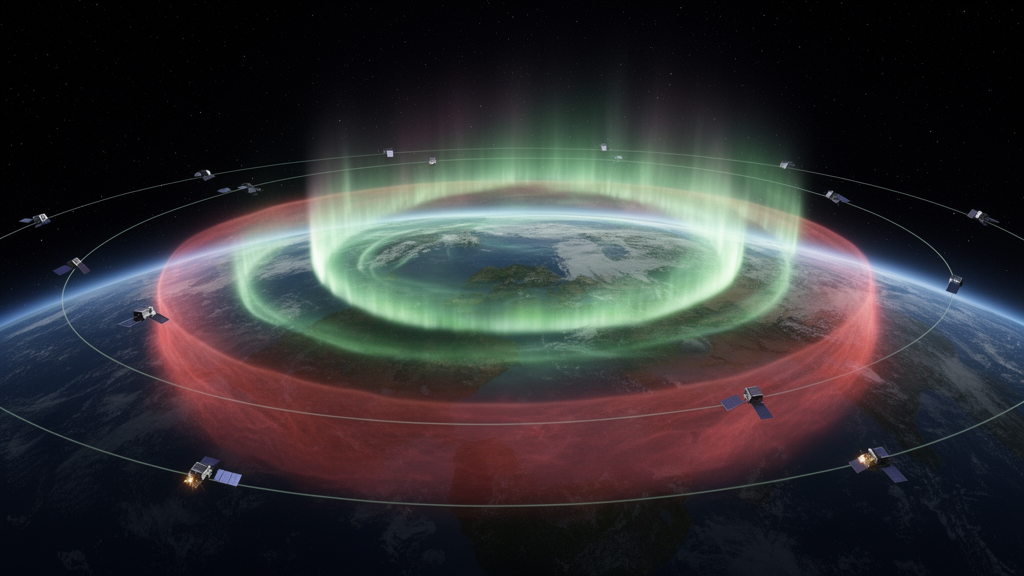
Geomagnetic storms thicken the upper atmosphere, and that extra density can drag low-Earth-orbit satellites toward an early reentry. A new per-event analysis of 22 storms ranging from minor G1 to extreme G5, published in Scientific Reports, now quantifies just how much each storm class speeds up orbital decay, using data from the GRACE and GRACE-Follow On missions between 2003 and 2024, including the May 2024 Gannon storm. Unlike earlier studies that averaged many storms together with superposed epoch techniques, the researchers compared each storm's peak-time orbit against a matched quiet-time reference orbit for the same satellite.

This event-by-event approach revealed a clear but noisy pattern: the mean enhancement in orbital decay rate climbed with storm intensity, reaching 77.2 percent for G1 storms, 98.5 percent for G2, 138.1 percent for G3, 149.6 percent for G4, and 166.5 percent for G5 events. Those averages, however, hide enormous scatter within each category. Some weak storms produced drag responses as strong as those from more intense ones, a reminder that per-event variability can be as operationally important as the category average.

Altitude emerged as a second decisive factor. To turn these observations into a predictive tool, the team built an empirical multiple linear regression model using three inputs: the quiet-time decay rate, the maximum Kp index reached during the storm, and the satellite's operating altitude. The model reproduced storm-time decay rates with an R-squared of 0.91 and a root mean square error of 12.3 meters per day, and a leave-one-out validation yielded an RMSE of 15.1 meters per day, indicating the fit is not simply overfitting the sample.

Substituting the open-ended Hp30 index for Kp produced similar performance, suggesting the results do not depend on one particular measure of geomagnetic activity. The practical stakes are high. In February 2022, a moderate geomagnetic storm increased drag enough that 38 newly launched Starlink satellites failed to reach their intended orbits, a loss that highlighted how quickly storm-time density changes can catch operators off guard.

The authors position the work as a complement to superposed epoch analyses rather than a replacement. By providing per-event benchmarks across the full G1 to G5 range, the dataset offers a reference point for empirical thermospheric density models and a foundation for storm-time orbit prediction. Its main limitations are the sample size of 22 events and its reliance on a single satellite pair, so extending the analysis to more spacecraft and storms remains an obvious next step for the field.

Subject of Research: Effect of geomagnetic storm intensity on thermospheric density and orbital decay of low-Earth-orbit satellites

Article Title: Impact of geomagnetic storm intensity on thermospheric density and orbital decay of LEO satellites: a G1–G5 per-event analysis

Article References: Kim, J.-H., Eom, G., Kwak, Y.-S., Yang, T.-Y., & Huh, H. (2026). Impact of geomagnetic storm intensity on thermospheric density and orbital decay of LEO satellites: a G1–G5 per-event analysis. Scientific Reports. https://doi.org/10.1038/s41598-026-78052-w

Image Credits: AI Generated

DOI: 10.1038/s41598-026-78052-w

Keywords: geomagnetic storms, thermospheric density, orbital decay, LEO satellites, GRACE, space weather, Kp index, Hp30 index, atmospheric drag, Starlink, Gannon storm, orbit prediction

Cite Scienmag News

Cameron Wolfe. (October 27, 2026). Research report: Impact of geomagnetic storm intensity on thermospheric density and orbital decay of LEO satellites: a G1–G5 per-event analysis. Scienmag. https://scienmag.com/research-report-impact-of-geomagnetic-storm-intensity-on-thermospheric-density-and-orbital-decay-of-leo-satellites-a-g1-g5-per-event-analysis/

Cameron Wolfe. "Research report: Impact of geomagnetic storm intensity on thermospheric density and orbital decay of LEO satellites: a G1–G5 per-event analysis." Scienmag, 27 October 2026, https://scienmag.com/research-report-impact-of-geomagnetic-storm-intensity-on-thermospheric-density-and-orbital-decay-of-leo-satellites-a-g1-g5-per-event-analysis/. Accessed 29 October 2026.

Cameron Wolfe. "Research report: Impact of geomagnetic storm intensity on thermospheric density and orbital decay of LEO satellites: a G1–G5 per-event analysis." Scienmag. October 27, 2026. https://scienmag.com/research-report-impact-of-geomagnetic-storm-intensity-on-thermospheric-density-and-orbital-decay-of-leo-satellites-a-g1-g5-per-event-analysis/

Tags: atmospheric density changes during geomagnetic disturbancesatmospheric dragevent-by-event analysis of geomagnetic stormsG1 to G5 geomagnetic storm classificationGannon stormgeomagnetic storm impact on satellite orbital decaygeomagnetic stormsGRACEGRACE satellite data for space weather analysisHp30 indexinfluence of storm intensity on satellite orbitKp indexLEO satelliteslow-Earth-orbit satellite reentry predictionorbit predictionorbital decaypredictive modeling of satellite orbital decaysatellite drag response to space weather eventsspace weatherspace weather effects on LEO satellite operationsStarlinkthermospheric densitythermospheric density variation during geomagnetic stormsvariability in satellite
Share26Tweet16
Previous Post

Machine Learning Hints at Knee Surgery Recovery Using Preoperative Strength Tests

Next Post

TinyRoute pairs TinyML with few-shot learning to secure vehicular networks

Related Posts

Research report: The effects of socioscientific issue-based education on science teachers’ cognitive structures, affective tendencies and scientific thinking habits
Science Education

Research report: The effects of socioscientific issue-based education on science teachers’ cognitive structures, affective tendencies and scientific thinking habits

October 29, 2026
Humans kill most cougars in five-year Alberta tracking study of 80 big cats
Biology

Humans kill most cougars in five-year Alberta tracking study of 80 big cats

October 29, 2026
Organic molecular qubit joins photonic chip in push toward scalable quantum computing
Mathematics

Organic molecular qubit joins photonic chip in push toward scalable quantum computing

October 29, 2026
Science Advances Issues Editorial Expression of Concern Over CNS Injury Paper’s Figures
Policy

Science Advances Issues Editorial Expression of Concern Over CNS Injury Paper’s Figures

October 29, 2026
Breathing by the numbers: bedside lung mechanics reshape ARDS ventilation
Medicine

Breathing by the numbers: bedside lung mechanics reshape ARDS ventilation

October 29, 2026
Trial to Test Whether Interactive Exercise Eases Autism Symptoms in Children
Psychology & Psychiatry

Trial to Test Whether Interactive Exercise Eases Autism Symptoms in Children

October 29, 2026
Next Post
TinyRoute pairs TinyML with few-shot learning to secure vehicular networks

TinyRoute pairs TinyML with few-shot learning to secure vehicular networks

  • Mothers who receive childcare support from maternal grandparents show more optimized

    Mothers who receive childcare support from maternal grandparents show more parental warmth, finds NTU Singapore study

    27656 shares
    Share 11059 Tweet 6912
  • University of Seville Breaks 120-Year-Old Mystery, Revises a Key Einstein Concept

    1061 shares
    Share 424 Tweet 265
  • Bee body mass, pathogens and local climate influence heat tolerance

    682 shares
    Share 273 Tweet 171
  • Researchers record first-ever images and data of a shark experiencing a boat strike

    546 shares
    Share 218 Tweet 137
  • Groundbreaking Clinical Trial Reveals Lubiprostone Enhances Kidney Function

    531 shares
    Share 212 Tweet 133
Science

Embark on a thrilling journey of discovery with Scienmag.com—your ultimate source for cutting-edge breakthroughs. Immerse yourself in a world where curiosity knows no limits and tomorrow’s possibilities become today’s reality!

RECENT NEWS

  • Research report: The effects of socioscientific issue-based education on science teachers’ cognitive structures, affective tendencies and scientific thinking habits
  • Humans kill most cougars in five-year Alberta tracking study of 80 big cats
  • Organic molecular qubit joins photonic chip in push toward scalable quantum computing
  • Science Advances Issues Editorial Expression of Concern Over CNS Injury Paper’s Figures

Categories

  • Agriculture
  • Anthropology
  • Archaeology
  • Athmospheric
  • Biology
  • Biotechnology
  • Blog
  • Bussines
  • Cancer
  • Chemistry
  • Climate
  • Earth Science
  • Editorial Policy
  • Marine
  • Mathematics
  • Medicine
  • Pediatry
  • Policy
  • Psychology & Psychiatry
  • Science Education
  • Science News
  • Social Science
  • Space
  • Technology and Engineering

Subscribe to Blog via Email

Enter your email address to subscribe to this blog and receive notifications of new posts by email.

Join 5,151 other subscribers

© 2025 Scienmag - Science Magazine

Welcome Back!

Login to your account below

Forgotten Password?

Retrieve your password

Please enter your username or email address to reset your password.

Log In
No Result
View All Result
  • HOME
  • SCIENCE NEWS
  • CONTACT US

© 2025 Scienmag - Science Magazine

Discover more from Science

Subscribe now to keep reading and get access to the full archive.

Continue reading