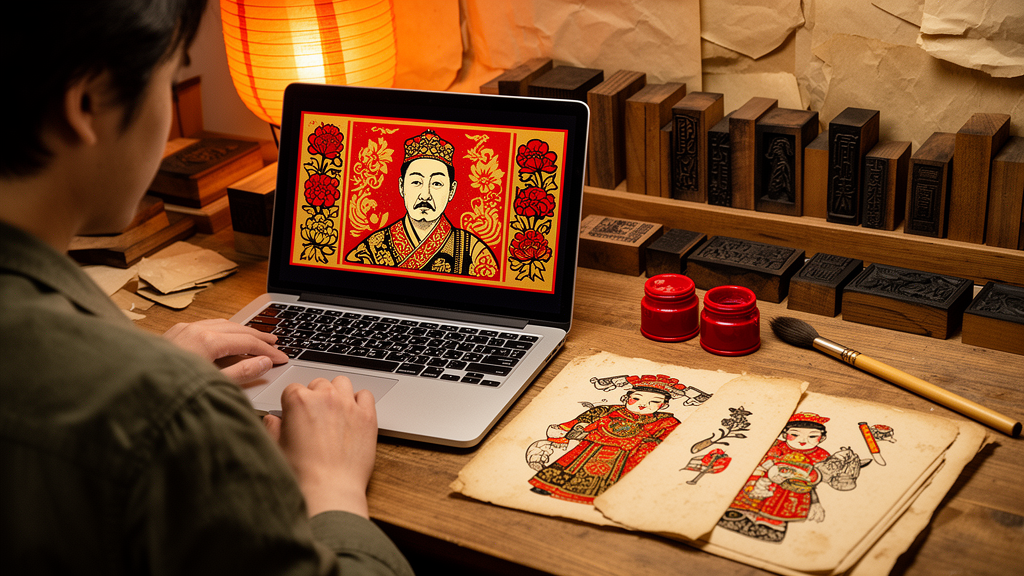
Researchers in China have built an artificial intelligence system that transforms a person's face into the distinctive visual style of Yangliuqing New Year Prints, a woodblock folk art tradition from Tianjin that stretches back more than four centuries, and then lets users watch their stylized portrait move with their own head in real time. The system, called ChineseNYP, was evaluated with expert assessments, a user experience survey and a structural model of embodied experience, and the results suggest that seeing yourself rendered in a traditional art form can create a surprisingly strong sense of cultural connection, at least in the moment. Yangliuqing New Year Prints originated in Yangliuqing Town during the late Ming Dynasty and flourished under the Qing Dynasty.
The prints were traditionally pasted up in homes during the Lunar New Year, combining decorative function with symbolic meanings of prosperity, protection and good fortune. Like many forms of intangible cultural heritage, however, the tradition has struggled to hold the attention of contemporary audiences as urbanization and changing consumption habits have eroded the rural social contexts in which the prints were once produced and displayed. The research team, Bolun Zhang and Han Cheng, writing in Discover Artificial Intelligence, argue that new modes of presentation are needed to bridge that gap, and that generative AI may offer one path.
Technically, ChineseNYP rests on two pillars. The first is an image generation module built on Stable Diffusion XL, fine-tuned with a custom-trained Low-Rank Adaptation model and guided by an SDXL-compatible Lineart ControlNet. The second is an interaction module that pairs MediaPipe facial tracking with TouchDesigner, a node-based visual programming environment.
The diffusion model handles the on-demand stylization of a facial photograph, while MediaPipe detects 468 three-dimensional facial landmarks from a live webcam feed and TouchDesigner maps the generated portrait onto the tracked face, updating its position, orientation and scale as the user moves. Importantly, the real-time component covers tracking and visual interaction rather than continuous generation of new diffusion images. A crucial ingredient was a purpose-built dataset.
The authors report that no previously documented dataset existed specifically for facial-style learning from Yangliuqing prints, so they constructed one, named NYPv1, by manually collecting images from the Chinese New Year Prints Database and the Tianjin Yangliuqing Woodblock New Year Print Museum. Faces were cropped to retain the complete facial contour, hairstyle or hair ornaments and part of the upper garment, then resized to 1024 by 1024 pixels in 8-bit RGB format. After screening out duplicates, unverifiable sources and images with blur, watermarks or damage, the final dataset contained 783 standardized facial images, split into 626 training, 78 validation and 79 test images, with crops from the same artwork kept in the same subset to prevent information leakage.
Training ran on a machine with an Intel i7-13700K CPU and an NVIDIA RTX 4080 GPU, using a batch size of 4 across 100 epochs with checkpoints every 10 epochs, a learning rate of 0.0001, mixed-precision fp16 training and a clip_skip of 2. At inference, the ControlNet weight was set to 0.85 to preserve recognizable facial structure, the LoRA weight to 0.90 to drive the stylistic transformation, and each portrait was generated at 1024 by 1024 pixels with 15 sampling steps and a classifier-free guidance scale of 7. The authors chose facial imagery deliberately: Yangliuqing prints, which inherit the meticulous linework of Northern Song court painting, maintain relatively consistent visual conventions in their human figures, making them a tractable target for controllable style transfer.
An exploratory case-level comparison against a transformer-based StyTr2 model and two facial style transfer methods, Pastiche Master and Vtoonify, showed the trade-off at the heart of the design. ChineseNYP achieved the lowest style loss among the compared methods, meaning its outputs aligned most closely with the traditional print aesthetic, but its content loss was relatively high, meaning less of the original photographic detail survived. The authors are candid that this reflects a deliberate choice to retain artistic brushstrokes and expressive elements of the prints, and that because the comparison involved only a single input image without variability estimates or inferential statistics, it does not demonstrate overall superiority.
The experiential evaluation was threefold. Four experts, including a design professor with over 20 years of experience, two intangible cultural heritage scholars and Mr. Huo, the sixth-generation inheritor of the Yangliuqing tradition, independently rated randomly ordered, blinded portraits on colour consistency, representation of form, traditional pattern characteristics and overall visual appeal. Their mean ratings ranged from 3.25 to 4.00 on a five-point scale, indicating broadly positive but not uncritical assessments.
The inheritor was the most cautious, stressing that the ethical legitimacy and cultural sustainability of introducing AI into the tradition demand further deliberation, even while acknowledging the method's novelty and appeal. User testing followed two tracks. A User Experience Questionnaire completed by 34 participants aged 18 to 30, measured on a scale from minus 3 to plus 3, returned four dimensions rated good, one above average and one excellent against benchmarks drawn from more than 21,000 users of 468 products, with all reliability coefficients above 0.7.
A larger survey of 140 participants produced 127 valid responses for partial least squares structural equation modeling. Technological Interaction showed a significant positive association with Embodied Experience (beta 0.544, t 6.552), as did Technology Acceptance (beta 0.363, t 4.107), and Embodied Experience was strongly associated with perceived Cultural Identity (beta 0.832, t 26.075). Indirect effects through embodied experience were also significant, and the model explained 75.9 percent of the variance in embodied experience and 69.3 percent in cultural identity, with SRMR values indicating acceptable fit.
The authors are careful about what these numbers do and do not show. The structural analysis rests on cross-sectional, self-reported data collected immediately after a single session, so it establishes associations consistent with the theoretical model but cannot demonstrate that using ChineseNYP caused increases in embodied experience or cultural identity. The cultural identity construct captures immediate perceived affiliation rather than a stable, long-term shift, and the study did not measure changes in public attention, repeated participation or actual dissemination of the prints.
The young, purposively sampled participant pool, the small UEQ sample and the possible influence of technological novelty further limit generalizability, and the expert panel lacked a formal inter-rater reliability statistic. Even with those caveats, the work points to a provocative idea: AI-generated heritage imagery may function not merely as visual output but as a medium through which people connect personal representation with cultural tradition. The researchers suggest potential value for exhibitions, education and participatory cultural settings, while calling for longitudinal and experimental designs, larger and more diverse samples, expanded datasets and continued attention to privacy, algorithmic bias and the involvement of heritage inheritors before any claims about lasting heritage preservation can be made.
Subject of Research: AI-driven facial style transfer and interactive evaluation for Yangliuqing New Year Print cultural heritage
Article Title: AI-driven style transfer for enhancing cultural experience in Yangliuqing new year prints
Article References: Zhang, B., & Cheng, H. (2026). AI-driven style transfer for enhancing cultural experience in Yangliuqing new year prints. Discover Artificial Intelligence, 6(1), Article 1593. https://doi.org/10.1007/s44163-026-02598-x
Image Credits: AI Generated
DOI: 10.1007/s44163-026-02598-x
Keywords: artificial intelligence, style transfer, intangible cultural heritage, Yangliuqing New Year Prints, Stable Diffusion, LoRA, ControlNet, user experience, embodied experience, cultural identity, PLS-SEM, digital heritage
Cite Scienmag News
Denise Maddox. (October 27, 2026). AI turns your face into a 400-year-old Chinese New Year print. Scienmag. https://scienmag.com/ai-turns-your-face-into-a-400-year-old-chinese-new-year-print/
Denise Maddox. "AI turns your face into a 400-year-old Chinese New Year print." Scienmag, 27 October 2026, https://scienmag.com/ai-turns-your-face-into-a-400-year-old-chinese-new-year-print/. Accessed 28 October 2026.
Denise Maddox. "AI turns your face into a 400-year-old Chinese New Year print." Scienmag. October 27, 2026. https://scienmag.com/ai-turns-your-face-into-a-400-year-old-chinese-new-year-print/