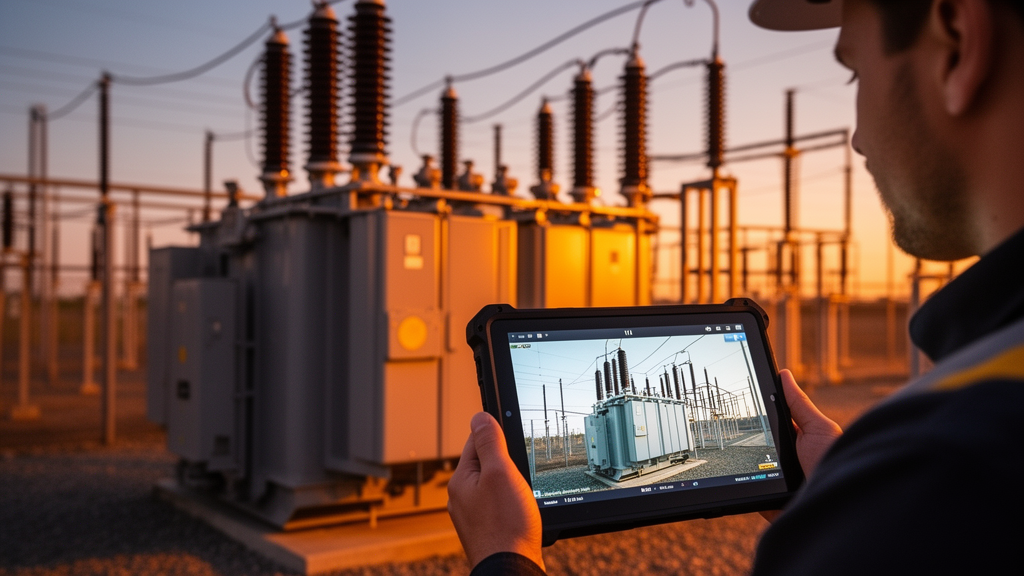
Oil-immersed transformers keep power grids running, but spotting faults inside them usually means taking equipment offline for inspection. A new study published in Discover Artificial Intelligence describes an online fault diagnosis method that reads video footage of transformers instead, combining several machine learning techniques into a single pipeline.
The system, developed by Xiyan Wang and Fang Li, integrates a Grey Wolf Optimizer with a Back Propagation neural network. Around this core, the researchers built a multi-stage process: synthetic minority over-sampling to handle imbalanced fault data, a Gated Recurrent Unit network to extract sequential features from video, Random Forest for feature selection, and adaptive boosting to ensemble the final classification.
In experiments, the model reached an online diagnosis accuracy of 96.02%, a recall rate of 91.02%, and a fault classification rate of 94.23% across multiple fault types in oil-immersed transformers.
Robustness was a key test. Under strong Gaussian noise, 10% video frame loss, and oil temperature fluctuations of 20 °C, the model still maintained a high F1 score, suggesting it can cope with the messy conditions of real-world monitoring rather than only clean laboratory footage.
The design is also compact. The entire model contains just 2.89 million parameters, and its inference delay drops as low as 178 milliseconds, fast enough for online use rather than retrospective analysis.
According to the authors, this combination of accuracy, robustness, and small size allowed the model to outperform the comparison models they tested against in comprehensive performance.
The approach addresses a known weakness of conventional condition assessment, which relies on offline detection and extracts video features inefficiently. By processing video streams directly, the new method aims to bring continuous fault diagnosis to transformers in service.
The researchers conclude that the model is suitable for online detection of faults in oil-immersed transformers, offering grid operators a way to watch for developing problems without interrupting equipment operation.
Subject of Research: Machine learning-based online video fault diagnosis for oil-immersed transformers
Article Title: An online video-based fault diagnosis method for oil-immersed transformers using GWO and BP
Article References: Wang, X., & Li, F. (2026). An online video-based fault diagnosis method for oil-immersed transformers using GWO and BP. Discover Artificial Intelligence, 6(1), Article 1589. https://doi.org/10.1007/s44163-026-02526-z
Image Credits: AI Generated
DOI: 10.1007/s44163-026-02526-z
Keywords: oil-immersed transformers, fault diagnosis, Grey Wolf Optimizer, back propagation neural network, video-based monitoring, machine learning, gated recurrent unit, random forest, adaptive boosting, power grid, SMOTE, robustness
Cite Scienmag News
Blake Davidson. (October 27, 2026). Video-Based AI Model Spots Transformer Faults with 96% Accuracy. Scienmag. https://scienmag.com/video-based-ai-model-spots-transformer-faults-with-96-accuracy/
Blake Davidson. "Video-Based AI Model Spots Transformer Faults with 96% Accuracy." Scienmag, 27 October 2026, https://scienmag.com/video-based-ai-model-spots-transformer-faults-with-96-accuracy/. Accessed 28 October 2026.
Blake Davidson. "Video-Based AI Model Spots Transformer Faults with 96% Accuracy." Scienmag. October 27, 2026. https://scienmag.com/video-based-ai-model-spots-transformer-faults-with-96-accuracy/