


Public safety power shutoffs, the preemptive blackouts that California utilities deploy to keep power lines from sparking wildfires, are associated with an increased risk of acute respiratory illness, according to a study published October 27th in PLOS Medicine. Lauren Blair Wilner of the University of Washington and colleagues analyzed seven years of data and found that planned outages were linked to higher rates of emergency department visits and unscheduled hospital admissions for respiratory conditions, with the association growing substantially stronger when shutoffs coincided with wildfire smoke.
The research comes against a backdrop of rising risk. The prevalence of wildfires and co-occurring power outages is increasing in the United States, and utilities increasingly rely on de-energizing power lines during dangerous fire weather. While such shutoffs are intended to protect the public, they carry consequences of their own: during an outage, people cannot run air filtration systems, refrigerators, air conditioners, or other electricity-dependent devices. Until now, the health effects of these events had not been well studied.
To fill that gap, the research team identified public safety power shutoff events between 2013 and 2019. They categorized shutoff magnitude based on the number of people without power in each zip code, and then analyzed emergency room visits and unscheduled hospital admissions across 1,504 California zip codes during planned outages. The study, published as a time-stratified case-crossover analysis, was observational in design, meaning it can identify associations but cannot prove that shutoffs directly caused the illnesses observed.
The findings were consistent across measures of acute care. Planned power shutoffs were associated with increased rates of healthcare utilization related to respiratory conditions. When shutoffs occurred in conjunction with wildfires, smoke further exacerbated emergency department visits and hospital admissions related to acute respiratory illnesses. In other words, the two hazards did not merely add together; their co-occurrence appeared to compound the harm, a pattern the authors attribute to the combined effects of losing electricity and breathing degraded air at the same time.
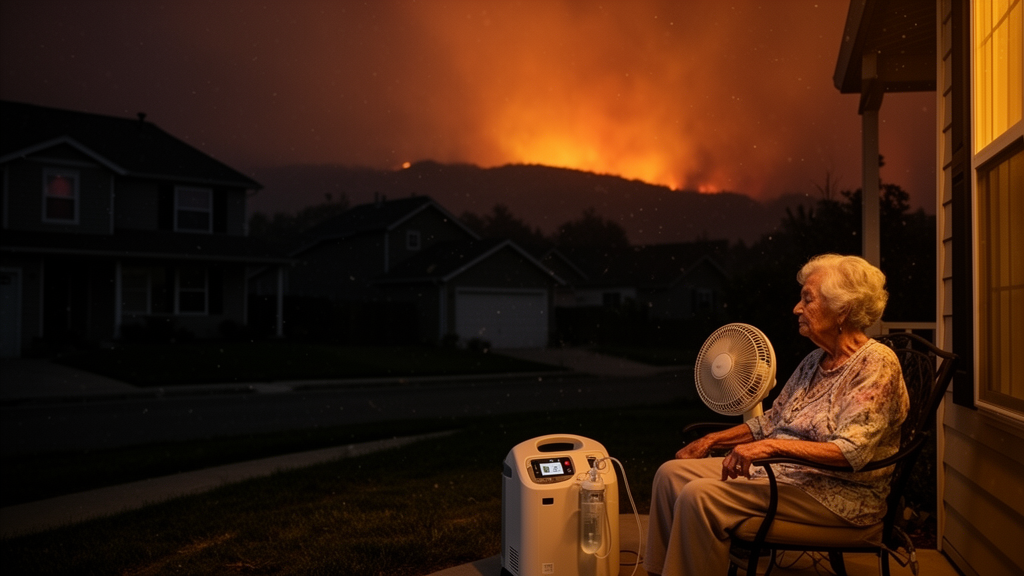
The effects were not uniform across conditions. Wilner noted that the association was strongest among people seeking care for COPD, chronic obstructive pulmonary disease, many of whom rely on electricity-dependent medical equipment such as oxygen concentrators. For these patients, a shutoff is not simply an inconvenience: losing power can mean losing access to the devices that keep them breathing comfortably, precisely when wildfire smoke is making the air harder to breathe.
Wilner also emphasized the timing problem inherent in the strategy. Public safety power shutoffs are meant to keep power lines from sparking wildfires, she explained, but they often occur when wildfires are already burning, or they fail to prevent a wildfire from igniting. Power outages and smoke can each affect health, and together they may be more harmful. In California from 2013 to 2019, her team found that shutoff events were associated with elevated risk of emergency department visits and hospitalizations for respiratory conditions, and that this association was substantially stronger when the shutoffs coincided with wildfire smoke.
The authors argue that these health costs deserve a place in utility decision-making. While intended to promote public well-being, they write, these power shutoffs may affect health, particularly for people with respiratory conditions or dependence on electricity-powered medical equipment. As climate change drives more frequent wildfires and the electric grid continues to age, utilities and policymakers must weigh the health costs of these shutoffs against their wildfire-prevention benefits, and act to reduce harm when shutoffs do occur.
Looking ahead, the researchers frame the question not as whether shutoffs should happen, but how to make them safer. Wildfires are becoming more common and severe, and shutoff events are likely to follow a similar trajectory, Wilner noted. Accordingly, before shutting off the power, she argued, utilities need a plan to protect vulnerable populations, including the many patients with COPD who depend on electricity-powered medical equipment like oxygen concentrators.
The study has important limitations that shape how its findings should be read. The authors note, for example, a lack of individual-level exposure data, meaning the analysis relied on zip-code-level measures of shutoff magnitude rather than precise measurements of what each household experienced. Future studies are needed to better understand individual households’ exposure levels in order to more accurately assess related health outcomes. As an observational study of people in California between 2013 and 2019, its findings speak most directly to that state and that period, though the underlying dynamics of aging grids, worsening fires, and electricity-dependent patients extend well beyond it.
The research, co-authored by Wilner along with colleagues including Cindy G. Jones-Ngo, Chen Chen, Brian Kwoka, Viviana Do, and James D. Kaufman, was published in PLOS Medicine under the title ‘Co-exposure to planned power outages and wildfire PM2.5 and acute healthcare utilization in California: A time-stratified case-crossover study.’ The paper is freely available, and the authors hope its findings will inform the difficult trade-offs utilities face as fire seasons lengthen and the practice of preemptive shutoff becomes ever more routine.
Subject of Research: Associations between public safety power shutoffs, wildfire smoke, and acute respiratory healthcare utilization in California.
Article Title: Planned power shutoffs aimed at preventing wildfires may increase risk of acute respiratory illness
Article References: Planned power shutoffs aimed at preventing wildfires may increase risk of acute respiratory illness. Original publication (Bibliographic details unavailable.)
Image Credits: AI Generated
DOI: Not provided
Keywords: public safety power shutoffs, wildfire smoke, respiratory illness, power outages, California, PLOS Medicine, emergency department visits, COPD, case-crossover study, electric grid, climate change, PM2.5
Cite Scienmag News
Ophelia Keating. (October 27, 2026). Planned wildfire-prevention power shutoffs linked to higher acute respiratory illness risk. Scienmag. https://scienmag.com/planned-wildfire-prevention-power-shutoffs-linked-to-higher-acute-respiratory-illness-risk/
Ophelia Keating. "Planned wildfire-prevention power shutoffs linked to higher acute respiratory illness risk." Scienmag, 27 October 2026, https://scienmag.com/planned-wildfire-prevention-power-shutoffs-linked-to-higher-acute-respiratory-illness-risk/. Accessed 27 October 2026.
Ophelia Keating. "Planned wildfire-prevention power shutoffs linked to higher acute respiratory illness risk." Scienmag. October 27, 2026. https://scienmag.com/planned-wildfire-prevention-power-shutoffs-linked-to-higher-acute-respiratory-illness-risk/


