


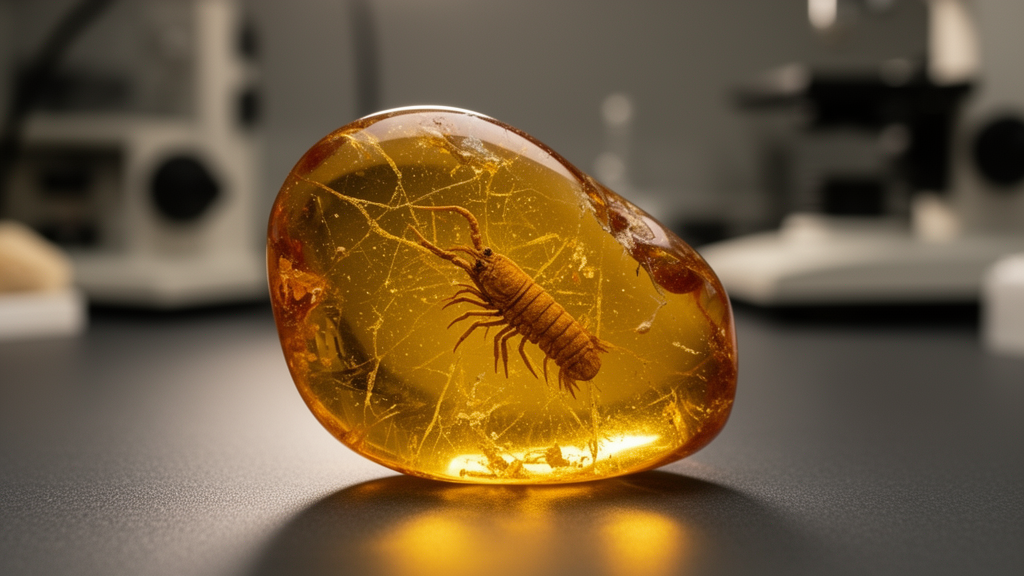
A tiny crustacean entombed in golden amber from northern Myanmar has turned out to be a species new to science, and the first Cretaceous tanaidacean ever found outside Europe. The animal, formally named Tanaidaurum kachinensis, comes from the famous Kachin amber deposits of the Hukawng Valley, dated to about 100 million years ago. Its description, published in the journal Fossil Record, expands the known Cretaceous diversity of a group of small, mostly marine crustaceans whose fossil record is heavily skewed toward a handful of European amber sites.
Tanaidaceans are benthic crustaceans, an ingroup of the larger group Peracarida, with roughly 1,200 formally described living species and only 26 fossil species. Like other peracarids, including woodlice, females carry their offspring in a ventral brood pouch. Most tanaidaceans are marine and occur at all depths, although four species live in freshwater; all species burrow in the substrate, some constructing self-built tubes. The animals measure between one and seven millimeters long, and their bodies are organized into 20 segments, a pattern inherited ancestrally from Eumalacostraca. They can be told apart from isopods, which they distantly resemble, by a pair of prominent chelae formed by the appendages of the last segment of the functional head.
The fossil record of the group reaches back to the Carboniferous, roughly 350 million years ago, but it is especially rich in Cretaceous amber from Spain and France, which together have yielded 13 of the 26 formally described fossil species. The Spanish Álava amber alone has produced six species. The new specimens therefore fill a conspicuous geographic gap: until now, every Cretaceous tanaidacean had come from European deposits, despite the extraordinary diversity of arthropods preserved in Asian ambers such as Kachin.
The description rests on three specimens preserved in two pieces of Burmese amber. Sample SNHMB.G 8008, the holotype, contains one specimen accessible in dorso-ventral view and is deposited in the collections of the Staatliches Naturhistorisches Museum Braunschweig in Germany. Sample BUB 4227, from a private collection and available for study on request, holds two specimens, one accessible in lateral view and the other in ventral view, the latter partly obscured by impurities in the amber. All specimens were legally purchased, and the amber pieces contain small fragments of plants as syninclusions. The researchers interpreted all three specimens as a single species because of their great similarity and the lack of distinctive differences among them.
The specimens were documented with a Keyence VHX-6000 digital microscope, using cross-polarized and ring light against white and black backgrounds, with image stacks fused into fully focused panoramas and recorded in high dynamic range. Measurements taken from the images show the holotype’s body, measured from the anterior edge of the shield to the tip of the telson, at 1.77 millimeters, with the second measurable specimen at 1.84 millimeters. The functional head accounts for roughly a quarter of the body length, and the detailed measurements of individual trunk and pleon segments reveal body ratios that are quite stable among Cretaceous tanaidaceans.
The new species shows a combination of characters unknown from both the fossil and the extant record of Tanaidacea. Its body is cylindrical with a smooth surface, and the shield carries set-off triangular sclerites postero-laterally on each side. Most strikingly, both the antennula and the antenna have four elements, a feature different from all other fossil or living tanaidaceans. The cheliped has an ischium not separated from the basipod, while the anterior trunk appendages are slender with a separated ischium and a distinctly sclerotized, elongated distal claw segment. The posterior trunk appendages are stouter, with a curved, sickle-shaped dactylus specialized as a claw, and the uropods bear two rami differing only slightly in length, each with two elements and terminal long setae.
This character combination places the species within Tanaidomorpha, a monophyletic group supported by molecular phylogenetic analyses and characterized by apomorphies including a uni-flagellate antennula, a uniramous antenna, and a cheliped and first trunk appendage without an exopod. More precisely, the fossils possess an apomorphy of the unnamed group Paratanaoidea plus Tanaidoidea, the cheliped ischium not separated from the basipod, while retaining plesiomorphic states elsewhere. They lack the apomorphic characters of Tanaidoidea, so they essentially resemble modern paratanaoideans, but could branch off the lineage toward modern paratanaoideans, the early lineage toward tanaidoideans, or the stem lineage of Paratanaoidea plus Tanaidoidea itself. Among Cretaceous amber species, Tanaidaurum kachinensis is most similar to Proleptochelia tenuissima from the Álava amber of Spain, roughly 110 to 105 million years old, especially in the shape of the chelipeds, anterior trunk appendages and uropods.
The hook-shaped dactylus on trunk appendages 4 to 6, seen in the new species, exists today in different ingroups of Paratanaoidea, almost exclusively in shallow-water forms, which is compatible with preservation in amber. The authors therefore consider it safe to assume the species lived in shallow water, although its morphology does not reveal whether it was a freshwater or marine organism. Kachin amber is thought to derive from resin produced by trees possibly near the sea, in an area subject to occasional flooding, making the entombment of an aquatic crustacean taphonomically plausible.
The broader fossil record of Tanaidacea is strongly biased, and the authors caution against over-interpreting it. All records so far come from the northern hemisphere, which very likely reflects the historical concentration of palaeontological research there rather than the true palaeogeographic distribution of the group. About half of the fossil species are based on rock fossils and half on amber specimens, with amber preserving far more detail. Many rock fossils are highly fragmentary, and some species have been described from isolated pieces of trunk and pleon, while isolated chelae have been attributed to species known from other body parts. A morphometric approach using the remarkably stable ratios of trunk and pleon segments has proved useful for interpreting such fragments, although its phylogenetic value among tanaidacean ingroups remains unclear.
The relative abundance of tanaidaceans in amber assemblages varies dramatically. In the French La Buzinie amber, two tanaidacean specimens among seventeen euarthropods make up about 11 percent of the records, and in Pyrenean amber six specimens among 29 account for roughly 20 percent. In Vendean amber, 29 isopods among 171 euarthropod fossils represent about 16 percent of the assemblage. By contrast, peracarid crustaceans make up only about 2.58 percent of the 760 euarthropod fossils in French Charentese amber, and roughly 1.22 percent of more than 2,300 fossils in the Spanish Álava amber. The authors expect that future studies increasing the overall number of specimens will likely bring the unusually high percentages of La Buzinie, Pyrenean and Vendean ambers closer to the Charentese and Álava figures. Overall, 49 tanaidacean specimens from Cretaceous ambers represent 14 formally described species, all belonging to Paratanaoidea plus Tanaidoidea, suggesting the Cretaceous was a period of diversification of Tanaidomorpha. The only fossil showing the apomorphies of modern tanaidoideans, Pseudopancolus minutus, comes from Miocene Chiapas amber in Mexico, about 23 million years old, suggesting that the diversification of Tanaidoidea happened after the Cretaceous-Paleogene extinction.
Subject of Research: A new tanaidacean crustacean species from Cretaceous Kachin amber and a review of the group's biased fossil record
Article Title: New species of Tanaidacea from Cretaceous Kachin amber, with a brief review of the fossil record of tanaidacean crustaceans
Article References: Pazinato, P. G., Müller, P., & Haug, J. T. (2023). New species of Tanaidacea from Cretaceous Kachin amber, with a brief review of the fossil record of tanaidacean crustaceans. Fossil Record, 26(1), 39-50. https://doi.org/10.3897/fr.26.99995
Image Credits: AI Generated
DOI: 10.3897/fr.26.99995
Keywords: Tanaidacea, Kachin amber, Cretaceous, crustaceans, paleontology, Tanaidomorpha, Myanmar, amber fossils, Peracarida, fossil record, Paratanaoidea, new species
Cite Scienmag News
Gavin Prescott. (October 27, 2026). Crustacean in Golden Amber Reveals First Cretaceous Tanaidacean Outside Europe. Scienmag. https://scienmag.com/crustacean-in-golden-amber-reveals-first-cretaceous-tanaidacean-outside-europe/
Gavin Prescott. "Crustacean in Golden Amber Reveals First Cretaceous Tanaidacean Outside Europe." Scienmag, 27 October 2026, https://scienmag.com/crustacean-in-golden-amber-reveals-first-cretaceous-tanaidacean-outside-europe/. Accessed 27 October 2026.
Gavin Prescott. "Crustacean in Golden Amber Reveals First Cretaceous Tanaidacean Outside Europe." Scienmag. October 27, 2026. https://scienmag.com/crustacean-in-golden-amber-reveals-first-cretaceous-tanaidacean-outside-europe/


