


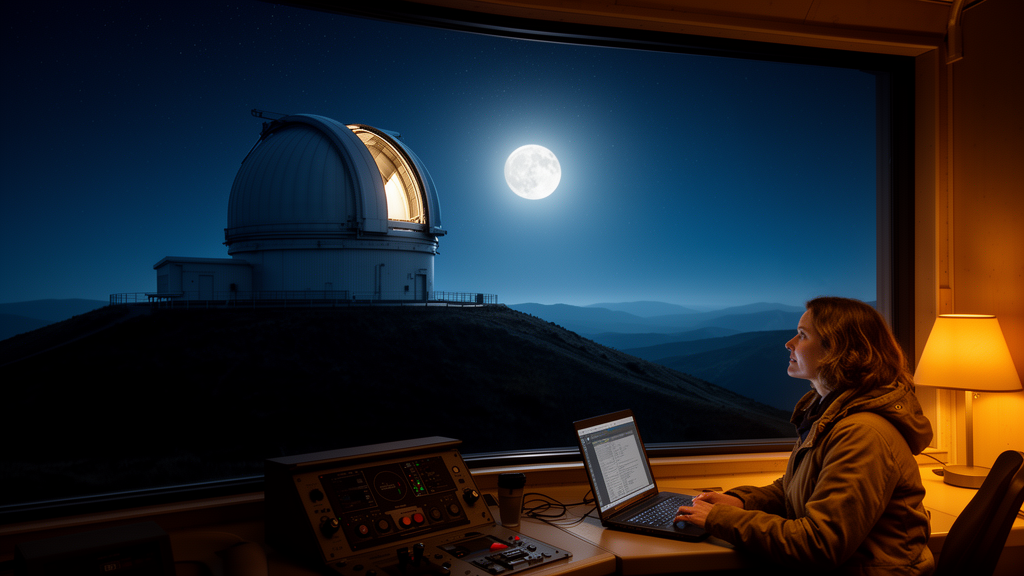
Moonlight is one of the most persistent obstacles facing ground-based observation systems, and a new study in Astrophysics and Space Science sets out to measure exactly how much it matters. Researchers led by Hao Fu, Hou-Yuan Lin, Chen Zhang and Jian-Ning Xiong report a machine learning framework that predicts the probability that a target in the sky will be visible to an observer under varying lunar conditions, from moonless nights to bright full-moon periods.
The team’s central argument is that lunar interference is a primary limiting factor for the spatiotemporal coverage of ground-based observation systems. To tackle it, they quantified the lunar impact on target visibility and produced visibility probability predictions across varying lunar phases, lunar separations, target brightness and aerosol optical depth. The optimization of lunar impact is primarily applicable to high-altitude and geostationary orbit (GEO) targets, for which avoiding lunar interference and scheduling observations are of practical importance.
The work rests on a substantial data collection effort. The researchers gathered 15 months of data using a moon-centered cross distribution sampling strategy that prioritizes nearby targets over distant ones. From this dataset, they applied density-based spatial clustering of applications with noise (DBSCAN), a clustering algorithm that identifies dense regions of samples while ignoring sparse outliers, to derive the contours of concentrated samples in the parameter space. These contours allowed the team to determine limiting visibility conditions for each lunar period, to quantify the waste rate of static avoidance strategies, and to perform simple visibility discrimination based on fixed thresholds.
Static avoidance strategies, in which observers simply rule out periods when the Moon is expected to interfere, can discard usable observing time. By measuring how much of that discarded time is actually wasted, the study offers a concrete accounting of the cost of crude scheduling rules, and the clustering-based contours provide a more nuanced set of limiting conditions tied to each phase of the lunar cycle.
For prediction, the researchers turned to a deep learning architecture based on the fully connected residual network-18 (FC ResNet-18). The model predicts visibility probabilities for targets under varying lunar phases, lunar separations, brightness and aerosol optical depth, the same four parameters that govern how strongly moonlight contaminates an observation.
To check that the neural network had learned something physically meaningful rather than an arbitrary mapping, the team compared the conditional probability distributions derived from DBSCAN with those produced by FC ResNet-18. They judged the latter to be compatible with the discriminant logic of the former, meaning the deep model’s decisions align with the structure found independently by the clustering analysis.
The model’s performance was assessed when applied to high-altitude and GEO satellite visibility prediction. It achieved a mean positive-class entropy of 0.100 to 0.229 during weak moonlight and moonless periods, and 0.115 to 0.125 during strong moonlight periods. The researchers state that these results demonstrate the effectiveness of the visibility prediction model under lunar impact.
The study, published on 27 October 2026 as Volume 371, article number 128 of the journal, positions itself as a tool for observation scheduling. For operators of systems tracking high-altitude and GEO satellites, the framework offers a way to replace fixed lunar avoidance windows with probability-based predictions that account for the Moon’s phase, the angular separation between target and Moon, the target’s brightness and atmospheric aerosol loading.
As with any model trained on a specific 15-month dataset, the reported entropy figures describe performance on that collected data, and the authors frame the optimization as primarily applicable to high-altitude and GEO targets rather than to all astronomical observation. Within that scope, the work provides a quantified link between lunar conditions and the odds that a given target can actually be seen.
Subject of Research: A machine learning framework for predicting how moonlight affects the visibility of high-altitude and geostationary targets in ground-based observations.
Article Title: Quantifying the lunar impact on astronomical observations using a machine learning framework for visibility prediction
Article References: Fu, H., Lin, H.-Y., Zhang, C., & Xiong, J.-N. (2026). Quantifying the lunar impact on astronomical observations using a machine learning framework for visibility prediction. Astrophysics and Space Science, 371(10), Article 128. https://doi.org/10.1007/s10509-026-04657-2
Image Credits: AI Generated
DOI: 10.1007/s10509-026-04657-2
Keywords: moonlight interference, visibility prediction, machine learning, DBSCAN, FC ResNet-18, geostationary satellites, observation scheduling, lunar phases, aerosol optical depth, ground-based observation, Astrophysics and Space Science, Quantifying
Cite Scienmag News
Teresa Odom. (October 27, 2026). Machine learning model predicts when moonlight will block satellite observations. Scienmag. https://scienmag.com/machine-learning-model-predicts-when-moonlight-will-block-satellite-observations/
Teresa Odom. "Machine learning model predicts when moonlight will block satellite observations." Scienmag, 27 October 2026, https://scienmag.com/machine-learning-model-predicts-when-moonlight-will-block-satellite-observations/. Accessed 27 October 2026.
Teresa Odom. "Machine learning model predicts when moonlight will block satellite observations." Scienmag. October 27, 2026. https://scienmag.com/machine-learning-model-predicts-when-moonlight-will-block-satellite-observations/


