


Chronic wounds such as diabetic ulcers and pressure injuries remain among the leading causes of long-term disability worldwide, placing a heavy burden on patients and healthcare systems. A new review published in Advanced Science argues that the fusion of natural phytochemicals with hydrogel biomaterials has attracted growing attention in regenerative wound care because such systems support localized delivery, sustained release, and active modulation of healing. Where traditional wound management has relied on passive dressings that merely protect the wound surface, recent advances in phytochemical encapsulation and hydrogel engineering now offer multifunctional systems capable of actively regulating inflammation, infection, and tissue regeneration. The review’s central contribution is a framework that links the physicochemical bottlenecks of each phytochemical class to the rational design logic of their hydrogel carriers, while incorporating AI-driven formulation discovery and 3D-printed spatial control as enabling tools within a single translational pipeline.
The review begins by grounding readers in wound biology. Wound repair is classically divided into four temporally ordered but overlapping stages: hemostasis, inflammation, proliferation, and remodeling. In hemostasis, platelet adhesion and activation trigger the coagulation cascade, and the resulting fibrin clot forms a provisional matrix while activated platelets secrete more than 300 proteins, including growth factors and chemokines that initiate inflammatory cell recruitment. The inflammatory phase is characterized by orchestrated immune cell recruitment, beginning with neutrophil infiltration within hours and subsequent monocyte arrival, with the critical shift from pro-inflammatory M1 to anti-inflammatory M2 macrophage phenotypes shaping healing outcomes. The proliferative phase brings coordinated angiogenesis, fibroblast activation, and re-epithelialization driven by hypoxia and growth factor signaling, with hypoxia-inducible factor-1α acting as a master regulator of VEGF expression. Remodeling extends for months to years, characterized by collagen reorganization and matrix maturation that gradually enhance tissue tensile strength. Chronic wounds, by contrast, are characterized by impaired tissue restoration and a failure to follow this normal sequence, with disturbances including epidermal hyperproliferation, persistent inflammation, dysfunctional leukocytes, fibroblast senescence, and reduced angiogenesis.
Against this pathological backdrop, the review maps the major phytochemical classes relevant to wound healing: polyphenols, terpenoids, alkaloids, and quinones. Natural phytochemicals play a valuable role because they can regulate several biological processes simultaneously, including inflammation, oxidative stress, microbial control, and tissue regeneration, and their diverse chemical structures allow them to act on multiple signaling pathways, offering broader therapeutic effects than single-target drugs. The review identifies five interlinked hallmarks of chronic wounds that these compounds engage: persistent NF-κB-driven inflammation, excessive reactive oxygen species accumulation, bacterial colonization and biofilm formation, deficient VEGF/HIF-1α-mediated angiogenesis, and M1-to-M2 macrophage polarization imbalance. Rather than acting on a single target, most phytochemicals simultaneously engage two or more of these axes, which the authors identify as their principal advantage over conventional single-agent therapies.
Each class, however, carries distinct physicochemical barriers that have prevented direct clinical application. Polyphenols such as quercetin, curcumin, and epigallocatechin gallate suffer from poor aqueous solubility and oxidative instability. Terpenoids, including asiaticoside from Centella asiatica, are poorly water-soluble and rapidly cleared from the wound site. Alkaloids such as berberine and matrine are poorly stable, often undergo N-oxidation, and have limited oral bioavailability, short half-lives, and fast clearance rates. Quinones such as shikonin present narrow therapeutic windows because the very redox activity that makes them effective also creates the potential for off-target effects and dose-dependent cytotoxicity; the line between therapeutic ROS generation and damaging oxidative stress to healthy cells can be thin. The review presents a detailed table matching each compound to its specific bioactivity, the physicochemical challenge addressed, and the rational design strategy employed, from host-guest supramolecular assembly to eutectogel formation for extremely hydrophobic emodin.
The hydrogel design strategies that answer these requirements form the review’s technical core. Stimuli-responsive systems are divided into endogenous triggers intrinsic to the wound bed and exogenous triggers applied by the clinician. Endogenous systems respond to the alkaline pH shift caused by bacterial colonization, excess ROS, persistent hyperglycemia, and abnormally elevated protease activity, releasing their payload autonomously and in proportion to wound severity, though they afford little temporal control. Exogenous systems respond to heat, light, electrical current, or magnetic fields, providing precise, on-demand, clinician-controlled dosing at the cost of requiring external hardware and patient compliance. Among the pH-responsive examples, a poly(vinyl alcohol)-borax hydrogel with resveratrol-grafted cellulose nanofibrils released 2.33 times more drug at pH 5.4 than at pH 7.4, adapting to the acidic environments of healing tissue. ROS-responsive platforms exploit oxidant-labile motifs such as boronic acids and esters, and one dual glucose/ROS-responsive injectable hydrogel enabled controlled release of salvianolic acid B while coordinating antibacterial, antioxidant, immunomodulatory, and pro-angiogenic activities in the diabetic wound microenvironment.
Enzyme-responsive networks exploit the protease-rich microenvironment of chronic wounds, in which MMP and serine-protease activities remain abnormally elevated relative to healing wounds. MMP-cleavable peptide crosslinkers act as molecular gates, keeping hydrogels stable under physiological conditions but triggering on-demand release at inflammatory sites. Beyond serving as passive cargo, certain phytochemicals actively participate in network assembly: epigallocatechin gallate acts as a potent natural inhibitor of collagenase, exhibiting 88% inhibition of collagenase activity and conferring 95% resistance of collagen to collagenolytic hydrolysis at micromolar concentrations. On the exogenous side, near-infrared light enables photothermal strategies in which agents such as tannic acid/iron chelates convert light into localized heat; one agarose-based hydrogel containing these chelates reached 53.4 °C within 10 minutes, eliminating bacteria without thermal damage to surrounding healthy tissue, while tannic-acid-modified MXene hydrogels achieved inhibition rates of 97.7 ± 2.2% against E. coli and 96.0 ± 1.7% against S. aureus under irradiation.
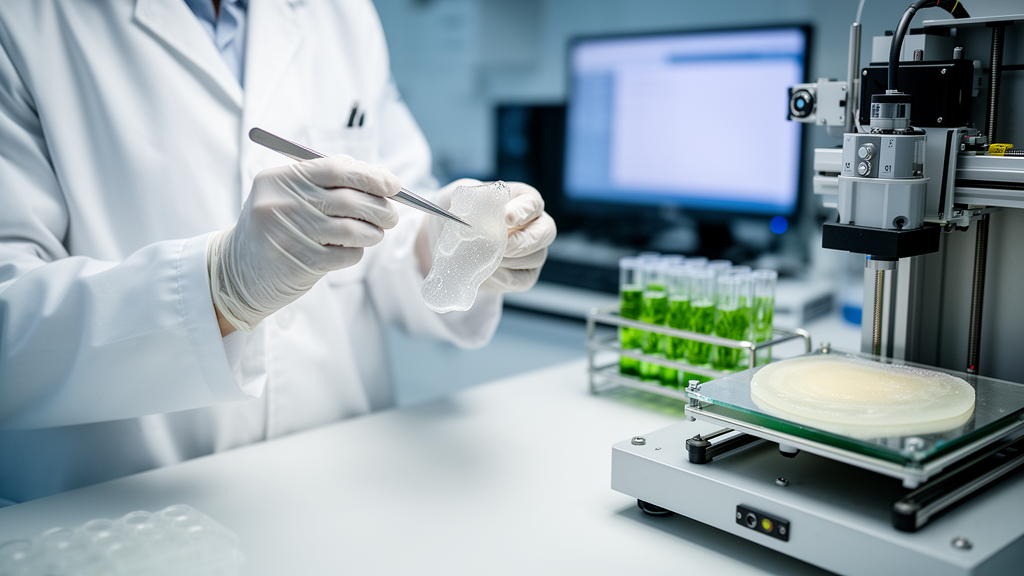
Three-dimensional printing transforms these bioactive compounds from passive additives into functional components of engineered scaffolds, controlling shape, thickness, porosity, and internal channels while supporting repeatable manufacturing. The review highlights a multi-layered GelMA-PVA dual-network hydrogel delivering andrographolide in a gradient fashion, achieving localized high-intensity antibacterial action in the deep wound bed while maintaining a cell-friendly surface interface. A living scaffold comprising Panax notoginseng saponins and autotrophic microalgae printed via microfluidic technology pairs pro-angiogenic payload delivery with continuous photosynthetic oxygen generation, directly alleviating the hypoxic state typical of diabetic wounds. Yet the authors are candid about the bottlenecks: bioink stability remains problematic because post-printing crosslinking can degrade heat-sensitive phytochemicals, photo-crosslinking generates free radicals that can oxidize redox-sensitive polyphenols, incomplete fusion between printed filaments creates spatially heterogeneous swelling and unpredictable release, and current extrusion systems typically require hours to print a single dressing, limiting applicability in emergency settings.
Artificial intelligence enters the pipeline at multiple levels, and the review is careful to distinguish demonstrated capabilities from conceptual extrapolations. Machine learning has been applied to predict gelation kinetics and rheological readouts, accelerating formulation screening, and neural networks have predicted discrete swelling states of temperature-responsive PNIPAAm hydrogels with a relative prediction error of 0.11 in the test dataset. In natural product discovery, the InflamNat platform achieved AUC values of 0.842 and 0.872 for predicting anti-inflammatory activity and compound-target interactions, while Elastic Net and Random Forest algorithms identified xanthohumol as a primary anti-inflammatory agent from hop extracts by analyzing mass spectrometry data. What has not yet been demonstrated, the authors note, is the final step of the closed-loop vision: feedback-regulated release of an encapsulated phytochemical payload governed by a predictive model. Data scarcity remains the most pressing limitation, since most experimental datasets in hydrogel formulation research are too small for conventional deep learning, and model interpretability, cross-class generalizability, and the cost of embedding sensors and AI inference hardware in biodegradable dressings all await resolution.
On clinical evidence, the review reports that meta-analyses aggregating data across several studies found combination herbal hydrogel therapy significantly increased the likelihood of complete wound healing by 70% compared to conventional care (RR = 1.70). A pilot randomized controlled trial of a nano-hydrogel integrating quercetin and oleic acid achieved total re-epithelialization in 92.8% of diabetic patients within 60 days, compared with 57.1% in the hyaluronic acid control group, with zero incidence of local infection in the treatment arm. Outcomes can be heterogeneous, however: an independent randomized comparative trial of a Mimosa tenuiflora cortex extract hydrogel for venous leg ulcers showed no significant superiority over blank hydrogel, despite demonstrated anti-inflammatory effects. The authors attribute such discrepancies to differences in wound etiology, patient population, formulation, and phytochemical dose, while noting that available studies do not allow the responsible factors to be distinguished conclusively. Four interlocking barriers gate translation: raw-material standardization against marker compounds, heavy metals, and pesticide residues; regulatory ambiguity over drug/device/combination classification under FDA and EMA frameworks; manufacturing scalability and GMP compliance; and the absence of formal cost-effectiveness analyses, which is especially consequential for low- and middle-income settings bearing the greatest chronic wound burden. The review concludes that current clinical evidence remains largely limited to small sample pilot trials, and that progress on standardization, validated analytical fingerprinting, and larger well-controlled trials across different wound types will determine whether phytochemical hydrogels can advance from early results into routine wound care.
Subject of Research: Phytochemical-hydrogel systems for chronic wound management
Article Title: Beyond Conventional: A Review of Phytochemical‐Hydrogel Systems Enhanced by AI and 3D Printing for Chronic Wound Management
Article References: Zhou, Y., Liu, X., Wang, C., Zhao, X., Zhang, P., Gu, J., Sun, Q., Xing, M., & Yang, Y. (2026). Beyond Conventional: A Review of Phytochemical‐Hydrogel Systems Enhanced by AI and 3D Printing for Chronic Wound Management. Advanced Science, 13(59), Article e77770. https://doi.org/10.1002/advs.77770
Image Credits: AI Generated
DOI: 10.1002/advs.77770
Keywords: chronic wounds, hydrogels, phytochemicals, drug delivery, 3D printing, artificial intelligence, stimuli-responsive materials, diabetic ulcers, wound healing, biomaterials, clinical translation, Beyond
Cite Scienmag News
Denise Maddox. (October 27, 2026). Plant Compounds Meet Smart Hydrogels as AI and 3D Printing Reshape Chronic Wound Care. Scienmag. https://scienmag.com/plant-compounds-meet-smart-hydrogels-as-ai-and-3d-printing-reshape-chronic-wound-care/
Denise Maddox. "Plant Compounds Meet Smart Hydrogels as AI and 3D Printing Reshape Chronic Wound Care." Scienmag, 27 October 2026, https://scienmag.com/plant-compounds-meet-smart-hydrogels-as-ai-and-3d-printing-reshape-chronic-wound-care/. Accessed 27 October 2026.
Denise Maddox. "Plant Compounds Meet Smart Hydrogels as AI and 3D Printing Reshape Chronic Wound Care." Scienmag. October 27, 2026. https://scienmag.com/plant-compounds-meet-smart-hydrogels-as-ai-and-3d-printing-reshape-chronic-wound-care/


