


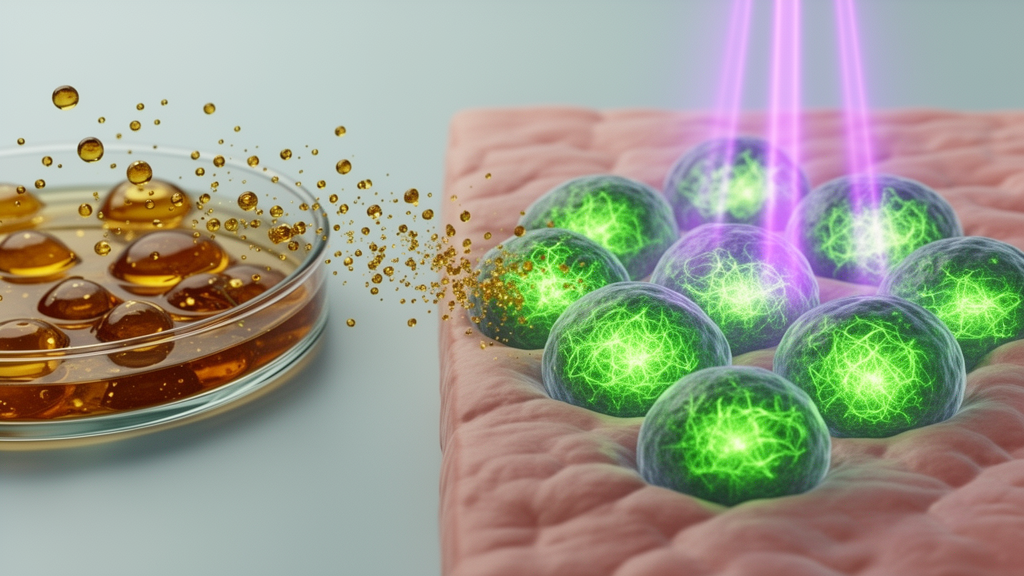
A fermented extract of Galla rhois gallnuts, prepared with the bacterium Lactiplantibacillus plantarum, improved markers of mitochondrial function in ultraviolet-damaged human dermal fibroblast cells in laboratory tests, outperforming the unfermented extract, according to a study published in Frontiers in Pharmacology. The research, conducted by scientists at Proya International Academy of Sciences in Hangzhou and the Jinhua Institute of Zhejiang University, also used metabolomics to identify leucinic acid as a potentially active metabolite in the fermented product.
The study addresses a long-standing question in skin biology: how ultraviolet radiation damages the energy-producing machinery of skin cells and whether that damage can be countered. Mitochondria, the organelles that generate most of a cell’s ATP, are vulnerable to ultraviolet exposure. The authors note that photoaging disrupts mitochondrial homeostasis in skin cells, and that mitochondrial dysfunction and oxidative stress are increasingly positioned as central drivers of UV-induced skin photoaging, contributing to a cycle of accumulating damage that aggravates skin aging.
Galla rhois gallnut extract, known as GRE, is a cosmetic raw material listed in China’s inventory of used cosmetic ingredients. It is derived from a gall induced by the Chinese aphid Schlechtendalia chinensis on the leaves of Rhus chinensis and related species, and the Chinese Pharmacopoeia records its traditional function as astringing exudations and healing sores. Previous studies have reported anti-inflammatory, hemostatic, and analgesic properties, inhibition of elastase and tyrosinase activities in vitro, and reduced MMP-1 expression in UVA-treated fibroblasts. Fermentation has long been used in traditional Chinese medicine to process medicinal materials; the authors describe a traditional fermented preparation of G. rhois called Baiyaojian, in which microbial enzymes convert high-molecular-weight tannins into gallic acid and related smaller compounds.
To produce the fermented extract, abbreviated FGRE, the team used a strain of L. plantarum isolated from fermented food and deposited at the China Center for Type Culture Collection. The bacterium was inoculated into a medium containing GRE, glucose, and a fermented nutrient salt, and incubated at 37 degrees Celsius for 36 to 48 hours with the pH controlled at 5.5. The broth was then broken open by high-pressure homogenization at 1,000 bar, centrifuged, and concentrated. Both FGRE and GRE samples were normalized to the same Brix level of 7.5 percent, with dry matter determined by heating to 105 degrees Celsius, so that the two preparations could be compared fairly.
Biochemical assays showed that fermentation changed the extract’s profile. The total phenolic content rose from 249.93 micrograms per milliliter in GRE to 353.86 micrograms per milliliter in FGRE, and FGRE achieved DPPH radical scavenging of 75.74 percent and elastase inhibition of 58.12 percent, both significantly stronger than the unfermented extract. The authors report that more than three batches were prepared to ensure batch-to-batch stability, with coefficients of variation in pH and total phenolic content below 7 percent.
The central experiments used human dermal fibroblast cells from three independent donor lots, all tested at passage 10 or less. After pretreatment with 1 percent GRE or FGRE for 24 hours, cells were exposed to UVB at a cumulative dose of 180 millijoules per square centimeter from a narrow-band lamp peaking at 311 nanometers. Oxygen consumption rates were then measured with a Seahorse XF analyzer. UVB irradiation markedly reduced basal respiration, ATP production, and maximal respiration compared with untreated cells, while both extracts improved these indicators; FGRE was significantly more effective than GRE on basal respiration, ATP production, and maximal respiration, and 1 percent FGRE was sufficient to mitigate the mitochondrial respiratory disorder caused by the irradiation.
In a parallel model using UVA irradiation at 30 joules per square centimeter, 1 percent FGRE significantly increased ATP content and the NAD+/NADH ratio compared with irradiated untreated cells. UVA exposure also skewed mitochondrial dynamics gene expression: the fusion genes Mfn1 and Opa1 declined sharply while the fission genes Drp1 and Fis1 were upregulated. FGRE intervention significantly elevated the fusion genes and inhibited the fission genes relative to the UVA group, suggesting the extract helped rebalance mitochondrial quality control at the transcriptional level, although the authors caution that protein-level and morphological confirmation remains to be done.
To find what might be responsible, the researchers performed non-targeted metabolomics on ten independently prepared batches of each extract using high-resolution mass spectrometry. Principal component analysis separated FGRE clearly from GRE along the first component, which explained 68.30 percent of the variance. Applying FDR-controlled statistics and variable importance thresholds, the team initially flagged 687 differential metabolites, most concentrated in amino acid and carboxylic acid categories, with enrichment in aminoacyl-tRNA biosynthesis, nucleotide metabolism, and purine metabolism. A stricter screen requiring at least a twofold change yielded 24 differential metabolites: 11 increased and 13 decreased after fermentation. Among the increases were leucinic acid, the urolithins UroA and UroM5, and several peptides; among the decreases were amino acids, small peptides, and choline glycerophosphate.
Quantitative analysis confirmed the shifts: leucinic acid rose from 26.96 to 97.20 micrograms per milliliter, UroM5 from 0.01 to 8.35 nanograms per milliliter, and UroA, undetectable in GRE, reached 0.49 nanograms per milliliter in FGRE. The authors attribute the urolithins to biotransformation of ellagic acid in the gallnut by L. plantarum, and leucinic acid to bacterial conversion of leucine. When tested on cells, 1 microgram per milliliter of leucinic acid, the concentration equivalent present in 1 percent FGRE, significantly improved basal respiration, ATP production, and maximal respiration in UVB-irradiated fibroblasts, and raised ATP fluorescence in UVA-irradiated cells to near untreated levels. Only the highest tested urolithin concentrations showed partial effects, leading the authors to speculate that leucinic acid is the primary contributor, though they note that depletion, supplementation, or reconstitution experiments are needed to confirm this.
The authors are explicit about the study’s limits. All findings come from in vitro cell experiments with fibroblasts from three donor lots; no human or animal data are presented. They state that in vivo studies using skin equivalents or animal models are necessary to confirm translational potential, that clinical trials would be needed to evaluate efficacy against clinical signs of photoaging, and that safety assessments including skin irritation and sensitization tests will be essential before any commercial application. They also note that a bacterial fermentation control without the gallnut extract would help clarify how much of the activity is attributable to the plant material itself. For now, the work stands as an early-stage laboratory demonstration that fermenting a traditional medicinal gallnut with L. plantarum changes its metabolite composition and improves its measured effects on mitochondrial function in UV-stressed skin cells in a dish.
Subject of Research: Fermented Galla rhois gallnut extract and mitochondrial function in UV-damaged human dermal fibroblast cells
Article Title: Enhanced mitochondrial respiratory metabolism in UV-damaged HDF cells based on metabolomics analysis of fermented Galla rhois gallnut extract
Article References: Wu, J., Wang, N., Chen, D., Zhang, Y., Sun, J., Zhang, X., Li, G., Li, X., & Huang, H. (2026). Enhanced mitochondrial respiratory metabolism in UV-damaged HDF cells based on metabolomics analysis of fermented Galla rhois gallnut extract. Frontiers in Pharmacology, 17, 1922913. https://doi.org/10.3389/fphar.2026.1922913
Image Credits: AI Generated
DOI: 10.3389/fphar.2026.1922913
Keywords: Galla rhois, fermentation, Lactiplantibacillus plantarum, mitochondria, human dermal fibroblasts, UVB, UVA, photoaging, metabolomics, leucinic acid, urolithin A, ATP
Cite Scienmag News
Beatrice Stafford. (October 27, 2026). Fermented Gallnut Extract Shows Mitochondrial Boost in UV-Damaged Skin Cells in Lab Study. Scienmag. https://scienmag.com/fermented-gallnut-extract-shows-mitochondrial-boost-in-uv-damaged-skin-cells-in-lab-study/
Beatrice Stafford. "Fermented Gallnut Extract Shows Mitochondrial Boost in UV-Damaged Skin Cells in Lab Study." Scienmag, 27 October 2026, https://scienmag.com/fermented-gallnut-extract-shows-mitochondrial-boost-in-uv-damaged-skin-cells-in-lab-study/. Accessed 27 October 2026.
Beatrice Stafford. "Fermented Gallnut Extract Shows Mitochondrial Boost in UV-Damaged Skin Cells in Lab Study." Scienmag. October 27, 2026. https://scienmag.com/fermented-gallnut-extract-shows-mitochondrial-boost-in-uv-damaged-skin-cells-in-lab-study/


