


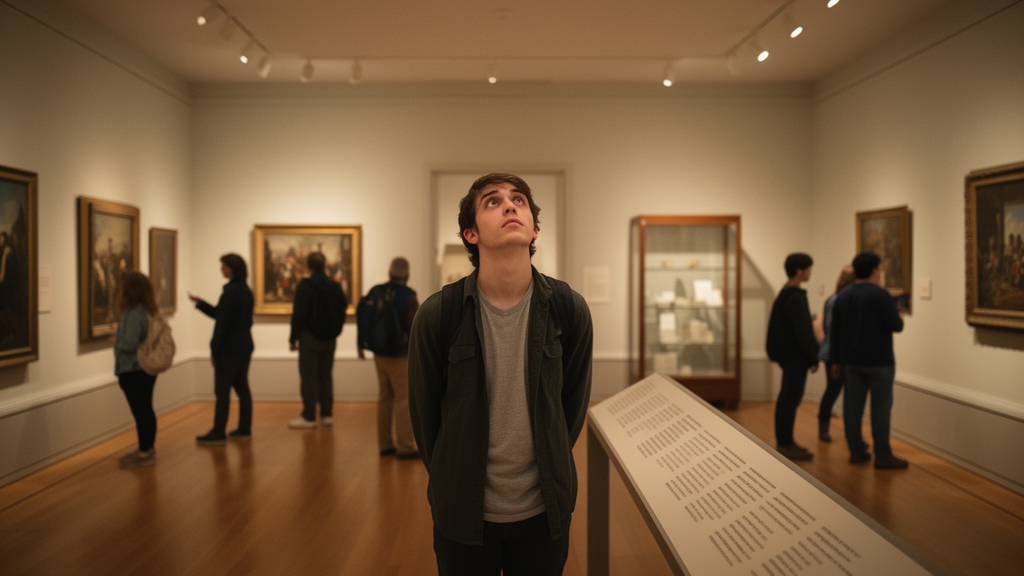
Museums are usually imagined as places of inspiration and cultural experience, and boredom is rarely the first thing that comes to mind when people picture a visit to a gallery or a house of history. Yet an international team of researchers led by Thomas Götz of the University of Vienna has now carried out the first systematic investigation of how often boredom actually occurs during museum visits, and the results offer a nuanced picture for anyone who has ever drifted through an exhibition feeling their attention dissolve. On average, visitors reported only slight boredom, but even that modest level carried a clearly measurable cost: bored visitors acquired less knowledge and rated the museum itself more poorly. The findings were published in the journal Scientific Reports.
Although boredom has been studied extensively in formal learning and performance settings such as schools and universities, learning outside those institutions has long been overlooked by researchers. Museums are among the most important venues for such informal learning, which makes the gap striking. To address it, psychologists from the University of Vienna collaborated with the University of Essex, the Australian Catholic University and Ludwig Maximilian University of Munich. Together they conducted three studies involving a total of 1,269 participants aged between 18 and 91, designed to answer three questions: how frequently museum boredom occurs, what causes it, and what consequences it has for visitors.
The fieldwork took place at two very different Vienna institutions: the Sigmund Freud Museum and the Museum of Art History, known locally as the Kunsthistorisches Museum. A total of 1,229 visitors across both museums completed a questionnaire immediately after their visit, describing their recent experience. The questionnaire included a knowledge test tailored to the specific museum they had just walked through, as well as a question asking visitors to rate the quality of the museum. In addition, the researchers conducted qualitative interviews with 72 visitors at the Sigmund Freud Museum about their experience of boredom in the museum and its causes, and these interviews were likewise carried out immediately after the visit, capturing impressions while they were still fresh.
The headline result for the museum sector is reassuring. Overall, boredom was relatively mild. Across both museums, the mean boredom score was 1.74 on a scale running from 1, meaning not at all bored, to 5, meaning very bored, and the difference between the two institutions was not statistically significant. The researchers did not measure boredom in isolation. They also assessed ten positive and negative emotions, including joy, surprise, frustration and anger. This comparison revealed that boredom was one of the most intense negative emotions visitors experienced, yet it remained significantly weaker than all of the positive emotions reported in the museum. In other words, even in a setting where boredom ranks high among the unpleasant feelings, pleasant experiences clearly dominate.
However, the average conceals an important detail. Despite the relatively low mean score, a number of visitors reported very high levels of boredom, with some responses reaching the maximum value on the scale. Boredom in museums, then, is not a universal condition but a real and sometimes acute one for a subset of visitors. Understanding who those visitors are, and what triggers their boredom, became the central question of the research, and the answers follow a well-established psychological framework.
The study is grounded in control-value theory of emotions. According to this theory, boredom arises primarily when people feel either over-challenged or under-challenged, or when they perceive an activity as having little value. The museum data confirmed precisely these predictions. Visitors who felt significantly over-challenged or under-challenged reported significantly more boredom than those whose levels of over- or under-challenge were lower. The perceived relevance of the museum, meanwhile, depended on numerous personal factors, such as whether the content connected to a visitor’s current professional activities or interests. As the theory anticipated, a high perceived relevance of the museum was associated with lower levels of boredom.
The causes of both over-stimulation and under-stimulation turned out to lie in two domains: the physical space and the content itself. Too much text or an excessive amount of information led visitors to feel overwhelmed, as did cramped and stuffy rooms. At the opposite extreme, too little information and bare, sparsely designed rooms left visitors feeling under-stimulated. Notably, under-stimulation was more pronounced in the museums studied than feeling overwhelmed, suggesting that when museums err, they tend to err on the side of providing too little rather than too much. This dual pathway helps explain why no single exhibition design can suit everyone: the same wall of dense text that overwhelms one visitor may leave another hungry for more.
The consequences of boredom were unambiguous. The study shows that boredom has a negative impact on the museum visit in two ways. First, bored visitors learnt less, a difference reflected in poorer results on the knowledge test tailored to each museum. Second, they rated the quality of the museum significantly lower than their less bored counterparts. Boredom, in other words, is not merely an unpleasant private experience; it undermines the educational mission of the institution and damages the visitor’s overall assessment of the visit itself.
What can museums do about it? The researchers point toward tailored information as a countermeasure. The right amount of information to avoid visitors feeling either under- or over-stimulated varies from person to person, and the same is true of the relevance of the content. Götz suggests that museums could cater more effectively to the diversity of their visitors by offering a depth of information and content tailored to the individual, for example through barcodes or augmented reality applications, or through tours of varying levels of difficulty and content, ranging from a short pocket tour to an in-depth deep dive. The underlying survey summary makes the same recommendation in simpler terms: offering visitors the option to choose the level of detail they wish to receive. At the same time, Götz cautions that reducing boredom should always be viewed against the backdrop of museums’ overarching objectives, and that museums should naturally not become mere venues for entertainment.
With this first-ever systematic investigation into boredom in museums, the researchers believe they are opening up a new field of research. Götz notes that museums are key venues for informal learning outside schools and universities, and that the findings show boredom plays a previously underestimated role there too. He places the results within a growing body of evidence demonstrating that boredom is detrimental to learning and performance across a wide variety of areas of life. For the museum sector, the message is double-edged: most visitors are not bored, and boredom is weaker than every positive emotion a museum evokes, but for the visitors who do switch off, the loss is real, measurable in knowledge tests and quality ratings alike, and potentially preventable through designs that let each visitor find the right depth of engagement.
Subject of Research: The prevalence, causes and consequences of boredom during museum visits
Article Title: Museum visits are generally not perceived as boring
Article References: Museum visits are generally not perceived as boring. Original publication (Bibliographic details unavailable.)
Image Credits: AI Generated
DOI: Not provided
Keywords: boredom, museums, informal learning, psychology, control-value theory, visitor experience, knowledge acquisition, exhibition design, University of Vienna, Scientific Reports, over-stimulation, under-stimulation
Cite Scienmag News
Courtney Benton. (October 27, 2026). Museum Boredom Is Mild but Real, and It Costs Visitors Knowledge. Scienmag. https://scienmag.com/museum-boredom-is-mild-but-real-and-it-costs-visitors-knowledge/
Courtney Benton. "Museum Boredom Is Mild but Real, and It Costs Visitors Knowledge." Scienmag, 27 October 2026, https://scienmag.com/museum-boredom-is-mild-but-real-and-it-costs-visitors-knowledge/. Accessed 27 October 2026.
Courtney Benton. "Museum Boredom Is Mild but Real, and It Costs Visitors Knowledge." Scienmag. October 27, 2026. https://scienmag.com/museum-boredom-is-mild-but-real-and-it-costs-visitors-knowledge/


