


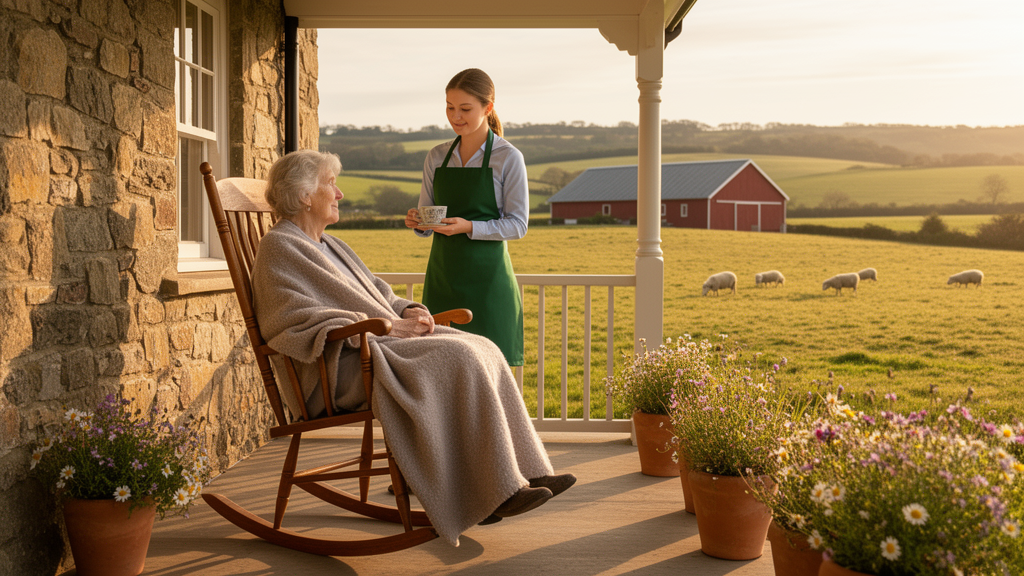
A new policy brief argues that Europe’s farms could play a far larger role in caring for a rapidly ageing population, but only if policymakers build the regulatory bridges that currently do not exist between agriculture and long-term care. The analysis, published in Public Health Reviews on 21 October 2026 by researchers at ETH Zürich’s Transdisciplinarity Lab and iilo GmbH in Zürich, examines how care farming, a service that has existed in Europe for roughly half a century, is expanding from its traditional clientele of children and young people with intellectual disabilities to older adults. The authors, Iren Bischofberger, Susann Goerlinger and Mollie Chapman, warn that despite pockets of innovation across the continent, the policy infrastructure needed to systematically interweave the public health and agricultural sectors is still missing.
Care farming, in its established European form, involves people living temporarily or permanently on a farm and participating in agricultural activities suited to their capabilities. It has historically served children and youth with disabilities as well as people with mental health conditions. Now, the authors argue, demographic shifts are pushing the model in a new direction. As European societies age, care farming for older adults is emerging as a complementary service that offers an alternative to nursing homes while simultaneously helping small and medium-sized farms diversify their products and services to sustain their businesses. The article frames this as one solution within multifunctional agriculture, positioning a farm sustainably in a changing market and demography.
The numbers behind this transformation are stark. In Switzerland, the case country for the analysis, nearly 1.6 million of the 9 million population are aged 65 years or older. According to the United Nations Population Division, Switzerland ranks fourth in Europe for life expectancy at birth, at 84 years, behind only the microstates of Monaco, Andorra and San Marino. Older adults are described as socio-economically highly heterogeneous, ranging from high to low income and spanning ages from around 65, the approximate pension age, to 90 and above. Changing family structures, with fewer children living farther away, and more women in the labour force, mean different ways of living beyond retirement. These trends bring an extended retirement phase in good health, but later also more years with care needs, for example from dementia or Parkinson’s disease.
The long-term care sector is under pressure to provide services beyond traditional nursing homes, the authors note, because baby boomers are particularly eager to live in highly self-determined settings. Municipalities, which are primarily responsible for providing long-term care services, are seeking less costly alternatives to round-the-clock nursing homes. Farms can enter this space from different starting points. Drawing on the long experience of the Netherlands, the brief describes the most common scenario: a farm begins with activities for children and young people who temporarily reside there due to an intellectual disability or during periods of adolescent struggle. Others begin with farm owners’ experiences caring for their own kin aged 65 and beyond. Often, the strategic change is initiated by the farmer’s wife, who works as a nurse or social worker and wants to practise her profession on the farm while establishing an independent income.
Two broad operational models emerge. In one, farms provide day-only services, where older adults participate in farming and social activities. Target groups might include older people seeking to prevent loneliness and employed family members who bring parents or grandparents to the farm. This model requires only moderate investment, mainly to ensure easy access to and around the farm. In the other, farms focus more strongly on care services, collaborate with a long-term care facility, and rent out permanent spaces on the farm grounds, a decision demanding substantial investment in infrastructure for older adults needing 24/7 care. Where agricultural production changes leave buildings empty, care farming can be an option for redesigning both buildings and services. A policy-relevant question in such cases is whether care farming and its outputs qualify as agricultural activities, and thus permit the use of certain buildings.
Typical activities across these models include feeding animals, caring for plants, processing vegetables and helping prepare meals for the farming team, all under the guidance of farm owners or staff. Health-prevention activities, such as cooking classes on healthy eating or fall-prevention courses, can also form part of the service. Social care on the farm means spending time with the farming community, sharing meals or playing games. Financing, however, differs sharply from the established model for children and youth, where care farming is usually reimbursed by social insurance. Care farming for older adults is often paid out-of-pocket, except for home care services normally covered by health insurance. In the Netherlands, social security options may exist to cover such activities, but in other European countries coverage through long-term care insurance has not been evaluated so far. Meanwhile, a programme on social farming as a tool for innovation in agriculture is currently being discussed at the European Union Economic and Social Committee, covering care farming with older people as well.
The evidence base for health benefits comes mainly from research in the Netherlands and Norway. These studies indicate positive effects on older adults’ physical, emotional, cognitive and social state of health. People with dementia have been studied particularly extensively, with findings indicating that care farming fosters quality of life for both patients and family caregivers. A review of grey literature reveals case studies across Europe. In Portugal, emigrants from the 1980s are returning after retirement to their home country and adopting innovative farming practices with older persons in the rural villages they left decades earlier. In Ireland, a retired couple remaining on the farm after their children left sought an older person who wanted to spend time there during the day, away from an assisted living facility. Country reports from Slovenia and Germany add further examples.
The brief also presents a real Swiss case. In 2018, the daughter of farmers inherited a farm keeping mainly cows and pigs. Facing falling milk prices, high operating costs and limited scope for economic optimisation, she transformed the pig barn into a day care centre fostering intergenerational encounters between older people and children. In 2023 she founded an association to run the activities. After taking out a mortgage, the barn became wheelchair accessible, with a living room, kitchen, toilet and relaxing room. Older persons can spend entire days on the farm, three days per week, while children aged two and a half and above attend three mornings on the same days, optionally with lunch. Activities include cooking together and processing milk, vegetables and fruits. Professional staff with health and social care backgrounds collaborate with volunteers, transport is offered, and payment is out-of-pocket.
The authors insist that this idyllic picture must be set against a darker history. From the 19th century up to the 1970s, children, adults and older persons from marginalised population groups, such as children of single mothers, were placed on farms without consent and mistreated as cheap manpower and as so-called morally fallen subjects. They also identify three normative premises embedded in Western societies that shape the field: the expectation that older people should engage in active ageing and health promotion to reduce loneliness and healthcare costs; the assumption that the family remains the responsible authority for care tasks despite shrinking and more dispersed families; and the romanticisation of rurality as a bygone idyll, even though most people in Western societies live in urban and suburban areas.
For policy, the authors argue that a transdisciplinary approach, bridging scientific knowledge with the search of social groups for solutions through systematic problem framing and multistakeholder dialogues, is the most effective way to integrate the diverse needs of this growing area. Stakeholders range from care facilities, health departments and farms to farmers’ associations, senior organisations, gerontology experts, researchers, politicians and journalists. Each brings distinct perspectives: agricultural regulators focus on production objectives, care regulators on protecting older people from risks such as fall injuries, while public health emphasises prevention and wellbeing outcomes. The authors flag that in low- and middle-income countries, where active ageing is a survival necessity rather than a normative demand, care farming could blur into forced labour or subsistence farming disguised as therapy, so good practice requires basic regulatory frameworks, minimum social protection and capacity for multi-stakeholder coordination. Sustainable policies, they conclude, must rest on systematic collaboration between the health and agriculture sectors, robust practices and models for a heterogeneous population aged 65 and older, and a mindset of experimentation and integration among all stakeholders.
Subject of Research: Policy insights on expanding care farming in Europe from children with disabilities to older adults, at the intersection of public health and agriculture.
Article Title: Care farming with older people in Europe: policy insights for public health and agriculture on providing care services on farms
Article References: Bischofberger, I., Goerlinger, S., & Chapman, M. (2026). Care farming with older people in Europe: policy insights for public health and agriculture on providing care services on farms. Public Health Reviews, 47, Article 1609528. https://doi.org/10.3389/phrs.2026.1609528
Image Credits: AI Generated
DOI: 10.3389/phrs.2026.1609528
Keywords: care farming, older adults, agriculture, public health, long-term care, dementia, transdisciplinarity, Europe, Switzerland, nursing homes, policy, ageing society
Cite Scienmag News
Alan Morgan. (October 27, 2026). Farms Could Become Care Homes: Scientists Map the Policy Path. Scienmag. https://scienmag.com/farms-could-become-care-homes-scientists-map-the-policy-path/
Alan Morgan. "Farms Could Become Care Homes: Scientists Map the Policy Path." Scienmag, 27 October 2026, https://scienmag.com/farms-could-become-care-homes-scientists-map-the-policy-path/. Accessed 27 October 2026.
Alan Morgan. "Farms Could Become Care Homes: Scientists Map the Policy Path." Scienmag. October 27, 2026. https://scienmag.com/farms-could-become-care-homes-scientists-map-the-policy-path/


