


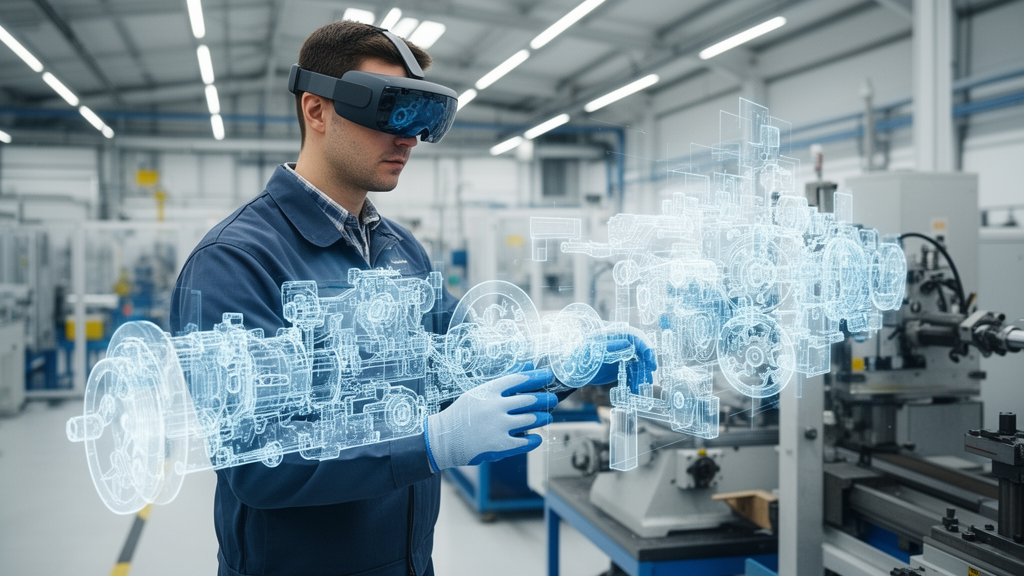
Immersive technologies such as virtual reality and augmented reality are being used to train workers across advanced manufacturing industries, from welding and assembly to mining safety and logistics, but the evidence behind them remains uneven, according to a new systematic review published in Frontiers in Virtual Reality. The review, conducted by researchers at Flinders University in Australia, synthesized 38 empirical studies published between 2015 and 2025 to answer four questions: which immersive technologies are used most often, where they are applied, what outcomes they produce, and what factors determine successful implementation. Its central conclusion is that augmented reality and virtual reality dominate the field, serious games remain comparatively rare, and the reported benefits, while encouraging, are associations rather than proven causal effects.
The research team followed the PRISMA guidelines for systematic reviews and adopted a domain-based approach, searching five databases: ACM, IEEE, ScienceDirect, Scopus, and Web of Science. The search combined terms for advanced manufacturing, immersive technologies, and training or education, and retrieved 1,421 records that were imported into the Covidence platform for screening. After duplicate removal, abstract screening, and full-text assessment by pairs of reviewers, 38 peer-reviewed empirical studies were included. The authors applied the PICOS framework to define eligibility: studies had to focus on advanced manufacturing contexts, examine at least one immersive technology such as augmented reality, virtual reality, or serious games, and report educational, performance, behavioral, or implementation-related outcomes. Reviews and conceptual papers were excluded, as were studies published outside the 2015 to 2025 window or in languages other than English.
The technologies themselves split sharply. Augmented reality appeared most frequently among the reviewed studies, followed closely by virtual reality, while mixed reality, extended reality, and serious games received far less attention. Most systems were expert-designed, meaning they were developed primarily by researchers without direct contributions from industry professionals or end users, and only a handful of studies involved co-designed technologies built in collaboration with the people who would actually use them. The authors argue this is a missed opportunity: co-design processes can enhance the authenticity and contextual relevance of immersive training by incorporating the perspectives of workers and stakeholders, and important practical considerations may be overlooked when end users are not engaged during development.
Immersive technologies were implemented in foundry and heat treatment, thermoforming, welding, cold spray, additive manufacturing, construction, textiles, medical and surgical education, electric motor manufacturing, automotive production, agricultural machinery, marine shipbuilding and maintenance, wind energy, and mining. A substantial portion of studies, 45 percent, applied these platforms in a general industrial context rather than a specific sector. Among named industries, additive manufacturing and automotive each accounted for 7.5 percent of studies, while textile and agricultural machinery appeared at 2.5 percent each. The authors note that evidence remains scant in sub-sectors such as food and beverages, possibly because assembly procedures are the most common target for such technology integration and industries with fewer assembly activities attract less attention.
Operational domains showed an even clearer concentration. Assembly was the most frequently targeted application area at 30 percent of studies, followed by tool use at 22.5 percent and studies spanning multiple domains at 25 percent. Safety and maintenance each accounted for 10 percent, while logistics trailed at just 2.5 percent. A typical assembly application places a product in a virtual environment, displays each component with instructions for the correct assembly order, and lets workers practice without touching physical parts. The authors caution that each category of industrial task carries distinct requirements and complexity, so the operational domain must be considered when applying these technologies, and underexplored domains such as logistics deserve further study.
The reported outcomes were largely positive, though the review is careful about how they are framed. The included studies reported potentially beneficial outcomes relating to knowledge acquisition, task performance, and task-completion time, along with associations between immersive technology use and greater accuracy, lower mental workload, fewer errors, improved troubleshooting and fault detection, greater hazard awareness, reduced reliance on external guidance, and stronger management and decision-making capabilities. Some individual findings were striking: one study reported that participants trained with virtual reality completed assembly tasks roughly 60 to 72 percent faster and made roughly 73 to 91 percent fewer errors than those receiving traditional training; another reported a 34 percent reduction in welding task completion time; a third found participants completed a wiring task about 10 percent faster with a zero percent error rate. An augmented reality system for robotic welding was associated with 34 percent faster learning, with 85 percent of users reporting better retention and understanding, and one study of manual assembly recorded a 22 percent improvement in learning rate and up to a 51 percent reduction in process duration during initial assembly cycles.
Crucially, the authors state that because the reviewed studies used different methodological designs, these findings represent outcomes and associations rather than demonstrated causal effects. The team assessed methodological quality using the Mixed Methods Appraisal Tool, finding that most studies clearly stated objectives and collected appropriate data, but common limitations included small sample sizes, convenience sampling, insufficient reporting of recruitment procedures, limited discussion of non-response bias, and a lack of assessor blinding in experimental studies. A few studies could not even be matched to an appraisal category. The review also categorized the studies by methodological orientation, distinguishing experimental comparative effectiveness studies, observational and field-based organizational studies, usability and user experience research, integrated design and efficacy work, prototype and technical validation studies, and developmental studies. Some studies presented mixed conclusions, and the review did not suggest that immersive technologies are consistently effective or ineffective across training contexts.
Challenges emerged as a consistent theme. The reviewed literature highlighted workforce unpreparedness for adopting these technologies, the need to acquire new skills to use them, limited availability of devices and difficulties ensuring large-scale access, high implementation costs and insufficient funding, and immaturity of software and hardware, including limited battery capacity in headsets. Privacy concerns were reported, with some workers feeling their privacy was compromised by continuous monitoring and evaluation, and research also suggested that advanced functionalities and increased dependency on these platforms may contribute to feelings of job insecurity. Physical discomfort from prolonged headset use was another recurring problem. The authors recommend that organizations align technology selection with the characteristics of their tasks and workforce rather than adopting a technology-driven approach, invest in workforce readiness, incorporate user feedback, and use co-design approaches in partnership with workers, developers, educational institutions, and industry stakeholders.
The review also mapped the types of industrial training involved, distinguishing introductory and familiarization education, process and operational training, hazard awareness and safety, cognitive and problem-solving development, performance and on-the-job hard-skill training, adoption and implementation, and soft skills and knowledge development. A notable pattern was that virtual and augmented reality were primarily used for task-specific job training, while serious games were predominantly employed for broader training related to job concepts or organizational development, such as a game simulating the role of a sustainability manager or a digital game teaching maintenance, repair, and operations concepts for offshore wind energy. The taxonomy suggested a heavier focus on process-related, technical, and safety cases, with less attention to cognitive development, learning, and soft skills, which the authors flag as an avenue for future research. They also observed an absence of clear evidence of active collaboration between higher education institutions and advanced manufacturing industries in developing and delivering such training programs.
The review has acknowledged limitations. It excluded dissertations and grey literature, searched only English-language publications, covered studies published between January 2015 and May 2025, and was not prospectively registered in a public repository. The search deliberately used the term advanced manufacturing, which may have excluded studies framed as smart manufacturing or simply manufacturing. The heterogeneity of the included studies in design, technologies, participants, training goals, and measured outcomes limits direct comparison and generalizable conclusions. The authors recommend longitudinal studies to examine longer-term effects, exploration of hybrid approaches such as gamified virtual reality experiences, expansion into underrepresented sectors, and adaptive, personalized learning models. Their overall message is measured: immersive technologies appear to offer valuable opportunities for training the advanced manufacturing workforce, but their value depends on the alignment between the worker, the work, and the organizational context in which training occurs, and further research and industry engagement are still needed.
Subject of Research: A systematic review of immersive technologies, including AR, VR, and serious games, for workforce education and training in advanced manufacturing.
Article Title: The application of immersive technologies for education and training in advanced manufacturing: a systematic review
Article References: Tanouri, A., Bayat, A., Stephenson, M., Shafei, A., & Shabahang, R. (2026). The application of immersive technologies for education and training in advanced manufacturing: a systematic review. Frontiers in Virtual Reality, 7, Article 1949492. https://doi.org/10.3389/frvir.2026.1949492
Image Credits: AI Generated
DOI: 10.3389/frvir.2026.1949492
Keywords: immersive technologies, augmented reality, virtual reality, serious games, advanced manufacturing, workforce training, systematic review, assembly training, industrial safety, PRISMA, human factors, technology adoption
Cite Scienmag News
Denise Maddox. (October 27, 2026). Virtual Reality and Augmented Reality Reshape Factory Training, Review Finds. Scienmag. https://scienmag.com/virtual-reality-and-augmented-reality-reshape-factory-training-review-finds/
Denise Maddox. "Virtual Reality and Augmented Reality Reshape Factory Training, Review Finds." Scienmag, 27 October 2026, https://scienmag.com/virtual-reality-and-augmented-reality-reshape-factory-training-review-finds/. Accessed 27 October 2026.
Denise Maddox. "Virtual Reality and Augmented Reality Reshape Factory Training, Review Finds." Scienmag. October 27, 2026. https://scienmag.com/virtual-reality-and-augmented-reality-reshape-factory-training-review-finds/


