


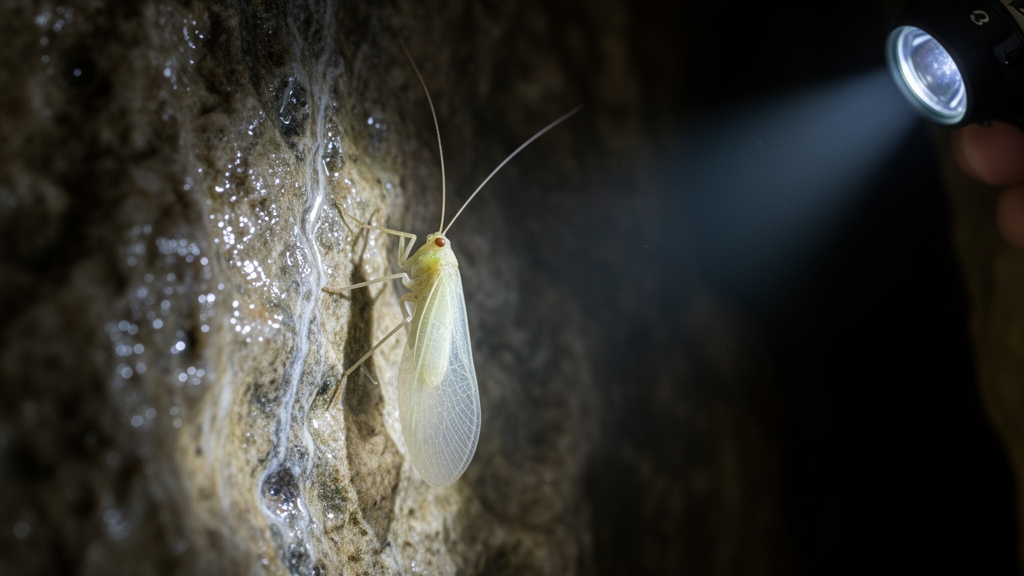
Deep inside lava tubes on Hawaii, limestone caves in Madagascar, and iron-ore caverns in Brazil, insects live out their entire lives in total darkness, blind, pale, and wingless. They are planthoppers, sap-feeding relatives of cicadas that most people would never expect to find underground. A new review published in the journal Subterranean Biology argues that these obscure insects deserve far more scientific attention, both as models for studying how animals adapt to extreme environments and as a test case for the theories scientists use to explain why any species moves underground in the first place.
The tally is striking for a group once thought unlikely to survive underground: 70 species across five planthopper families have now been explicitly reported from subterranean ecosystems. Most of them, 58 species, are true troglobionts, meaning they are permanently bound to cave habitats and display troglomorphies, the suite of adaptations correlated with cavern life, such as reduced eyes, lost pigmentation, and vestigial wings. The family Cixiidae dominates the list with 44 species, followed by the Meenoplidae with 14, the Kinnaridae with 7, the Delphacidae with 3, and single representatives of the Hypochthonellidae and Flatidae.
The history of the field is itself a story of overlooked discoveries. The first cave-dwelling planthopper was noted in 1907 by the Romanian biologist Emil Racovitza, who observed an unpigmented cixiid in a cave on the Balearic island of Mallorca but never formally described it, and no voucher specimens survive. Nearly half a century later, a far stranger species turned up in Zimbabwe: a maggot-like, eyeless planthopper living in soil, apparently feeding on maize and tobacco roots and tended by ants. It was so modified that it could not be placed in any existing planthopper family, and it became the sole member of a new family, Hypochthonellidae, described in 1952. The genus remains monospecific to this day.
Since those early records, cavernicolous planthoppers have been discovered across an unexpectedly wide geography, from Argentina, Australia, and New Zealand to Brazil, the Canary Islands, Hawaii, Mexico, Madagascar, La Réunion, and several European countries including Croatia, France, Italy, Slovenia, and Spain. The authors emphasize that many species likely remain undiscovered, as vast cave systems around the world are still unexplored. Notably, even well-studied parts of Europe have yielded new cave planthoppers only in the past two decades, in Italy, the Canary Islands, Croatia, Spain, and France.
What makes planthoppers such an intriguing model is their biology. They are obligatory phytophages, insects that must feed on living plant tissue, yet underground the only plant tissue available is roots. Cave-dwelling planthoppers are therefore primary consumers in subterranean ecosystems, feeding on root strands that hang from cave ceilings or run along walls and floors. They also communicate through low-frequency, substrate-borne vibrations, a behavior general to planthoppers and essential to their mating. In permanent darkness, this vibration channel presumably allows them to locate mates, and it has been confirmed and analyzed in several cavernicolous species, both in the field and in the laboratory.
Much of what scientists know about cave planthopper biology comes from a single case study: the blind, flightless, pigmentless Oliarus polyphemus from lava tubes on Hawaii Island. Females of this species lay very few eggs, a low reproduction rate consistent with a K-selection strategy typical of ecologically stable environments. Research on this taxon also revealed something remarkable: populations that look morphologically similar but behave differently turned out to be a complex of at least 12 closely related but reproductively isolated species, most likely the product of a non-adaptive radiation driven by the rapid vegetation succession on active volcanoes. This finding shows that cave lineages can continue to diversify underground rather than simply persisting as evolutionary relics.
The review then confronts the two classical hypotheses meant to explain how animals come to live in caves. The climatic relict hypothesis, proposed by Albert Vandel in 1964 and developed further by Peck and Finston, holds that surface-dwelling species were driven underground by past climatic changes, so cave species should lack close living relatives or be geographically separated from them. The adaptive shift hypothesis, proposed by Francis Howarth in 1980, instead pictures cave species as active colonizers of subterranean niches, expected to be closely related to surface species living nearby. The authors argue that neither hypothesis alone is sufficient. Distribution patterns observed today need not reflect the processes that originally favored cave adaptation, and the two hypotheses are not mutually exclusive. Even if past cave colonization could be matched with known climatic events by calibrated phylogenies, a causal link cannot simply be assumed.
Perhaps the most provocative question raised concerns the Cixiidae themselves. The nymphs of most, if not all, epigean cixiid species live underground, feeding on roots, and these blind, unpigmented nymphs could represent an exaptation, a trait that evolved for one function but later proved useful for another, in this case a foundation for complete subterranean life. The authors ask whether the entire family should be considered a subtroglophile lineage, meaning a group whose members perpetually or temporarily inhabit subterranean habitats while remaining linked to surface habitats for some biological functions. Yet only 44 cixiid species have made the full shift to cave life, out of more than 2,600 described species, about 1.6 percent. By contrast, the related Meenoplidae-Kinnaridae lineage has 21 cave species out of 285, or 7.3 percent. Why other root-feeding planthoppers, such as the ant-tended Tettigometridae, have no troglobiont representatives at all, and why no cavernicolous Cicadomorpha exist despite underground root-feeding nymphs in cicadas and spittlebugs, remain open questions.
The review also warns against over-relying on morphology for classification. The degree of troglomorphy has been shown not to be a reliable indicator of the age of a cave lineage, and a troglobiont does not necessarily display troglomorphies. In the Australian cixiid genus Solonaima, four separate independent cave invasions have been documented in Queensland, with species showing varying degrees of modification, from mild eye and wing reduction to the complete loss of eyes, pigmentation, and wings. Intriguingly, the least modified species occur in the geologically oldest and most open caves, while the most highly modified species is restricted to damp, high-carbon-dioxide passages in much younger lava tubes. Cave adaptation, the authors conclude, is not a dead end: troglobiont populations can potentially evolve back toward surface life, as has been described in crickets.
Beyond evolutionary theory, the review highlights conservation. Subterranean inhabitants are highly adapted to stable, humid, dark conditions, and disturbances, whether from human activities or indirect effects of surface environmental change, can be fatal to them. Some cave planthoppers have already received formal conservation assessments. The authors call for comparative studies of nymphal morphology, biology, and behavior across cixiids and the virtually unknown meenoplid-kinnarids, and for phylogenetic analyses of the singular cavernicolous lineages, to build a more complete picture of the factors driving the evolution of troglobionts. In an era of biodiversity crisis, they argue, understanding and protecting these hidden insects is a priority, and cave planthoppers, with their worldwide distribution and peculiar adaptations, are an ideal place to start.
Subject of Research: Cave-dwelling planthoppers and the evolution of subterranean adaptation in the Cixiidae
Article Title: Why cave planthoppers study matters: are Cixiidae a subtroglophile lineage? ( Hemiptera , Fulgoromorpha )
Article References: Le Cesne, M., Hoch, H., Zhang, Y., & Bourgoin, T. (2024). Why cave planthoppers study matters: are Cixiidae a subtroglophile lineage? (Hemiptera, Fulgoromorpha). Subterranean Biology, 48, 147-170. https://doi.org/10.3897/subtbiol.48.117086
Image Credits: AI Generated
DOI: 10.3897/subtbiol.48.117086
Keywords: planthoppers, Cixiidae, troglobionts, subterranean biology, cave adaptation, troglophile, adaptive shift hypothesis, climatic relict hypothesis, Hemiptera, Fulgoromorpha, exaptation, cave conservation
Cite Scienmag News
Gavin Prescott. (October 27, 2026). Cave Planthoppers Reveal Hidden Diversity and Challenge Old Theories of Underground Life. Scienmag. https://scienmag.com/cave-planthoppers-reveal-hidden-diversity-and-challenge-old-theories-of-underground-life/
Gavin Prescott. "Cave Planthoppers Reveal Hidden Diversity and Challenge Old Theories of Underground Life." Scienmag, 27 October 2026, https://scienmag.com/cave-planthoppers-reveal-hidden-diversity-and-challenge-old-theories-of-underground-life/. Accessed 27 October 2026.
Gavin Prescott. "Cave Planthoppers Reveal Hidden Diversity and Challenge Old Theories of Underground Life." Scienmag. October 27, 2026. https://scienmag.com/cave-planthoppers-reveal-hidden-diversity-and-challenge-old-theories-of-underground-life/


