


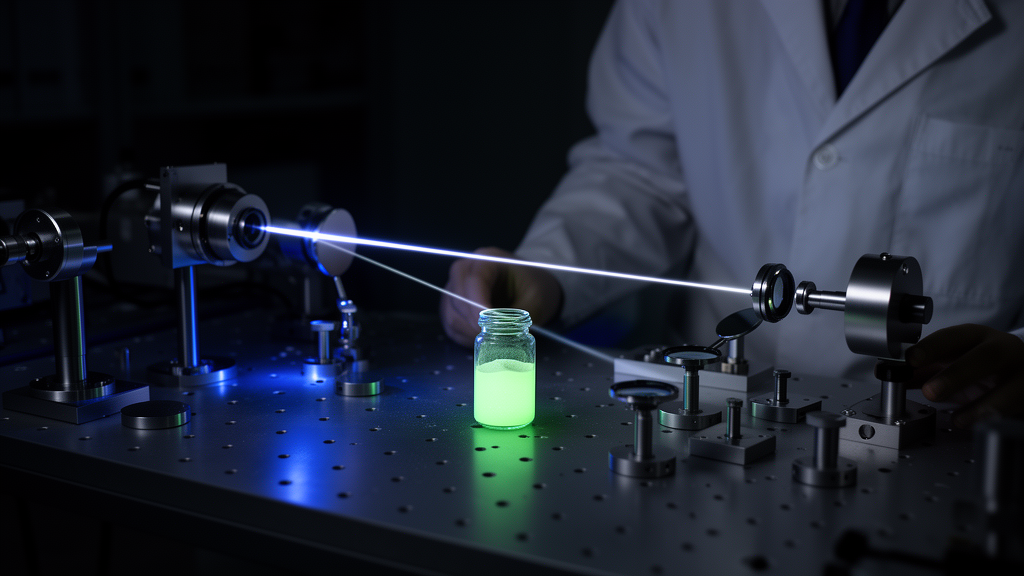
Phosphors are the quiet workhorses of modern technology. These impurity-activated luminescent materials underpin technologies including solid-state lighting, displays, sensing, and radiation dosimetry, and persistent phosphors can emit afterglow for hours after excitation ceases. For decades, scientists have characterized these impurity-activated luminescent materials by watching the light they emit, an approach that only reveals the final step of a long chain of microscopic events.
The study, published in Light: Science & Applications, focused on a benchmark persistent phosphor, strontium aluminate doped with europium and dysprosium, written chemically as SrAl2O4:Eu,Dy. When ultraviolet light strikes this material, europium ions sitting on two different crystal sites emit either blue or green light. Some of the excited electrons, however, are captured by dysprosium ions acting as trapping defects, and only released later, producing an afterglow that can persist for hours. The researchers combined transient absorption spectroscopy, which tracks changes in absorption on the picosecond to nanosecond scale, with time-resolved luminescence spectroscopy, which covers nanoseconds to milliseconds, to capture the full drama across an unprecedented time window.
The key insight is that transient absorption does not depend on light being emitted. A pump pulse excites the material, and a delayed white-light probe pulse records how the absorption of the sample changes, whether or not any photon escapes. This means processes that quietly steal excitation energy, such as non-radiative energy transfer between ions or charge transfer to a trap, become directly visible rather than being inferred indirectly from simulations or from what fails to glow.
Using single crystals grown by a Czochralski pulling process, the team first probed energy transfer between the two inequivalent europium sites. A blue pump pulse at 430 nanometers selectively excites only the green-emitting europium centers, and the resulting absorption signal stays essentially flat for the first four nanoseconds, consistent with the roughly 1.2-microsecond excited-state lifetime of those ions. When a 343-nanometer ultraviolet pump excites both centers instead, the absorption signature evolves over time: the spectrum shifts as the population of blue-emitting ions falls and green-emitting ions rise, the fingerprint of energy flowing from one site to the other.
The temperature dependence of this transfer proved striking. At room temperature the transfer takes about a nanosecond, but it accelerates as the crystal is heated, reaching an intrinsic minimum transfer time of 5 picoseconds at 475 kelvin, beyond which further heating changes nothing. A phenomenological single-barrier model fitted to the data yielded an activation energy of 0.45 electronvolts for the transfer. Notably, the spectral overlap between donor emission and acceptor absorption changes only weakly with temperature, so the familiar Förster picture based on spectral overlap alone cannot explain the kinetics; at least one step in the transfer is thermally activated. These dynamics would be invisible to ordinary luminescence measurements at high temperatures, where the blue emission is strongly suppressed by the very same transfer combined with quenching.
Charge trapping proved even faster. In the dysprosium-codoped crystal, the absorption signal after ultraviolet excitation decays rapidly as temperature rises, and above 425 kelvin it nearly vanishes within four nanoseconds. At room temperature, charge transfer from an excited Eu2+ ion to a trapping defect occurs on a timescale of roughly 100 nanoseconds, about ten times faster than the roughly 1.1-microsecond radiative decay. Based on these decay times, the researchers calculate a branching ratio of about 92 percent for charge transfer following Eu2+ excitation, meaning trapping is roughly twelve times more likely than photon emission. The fitted activation energy for trapping was 0.49 electronvolts. At elevated temperatures the transfer completes within the first 100 picoseconds, and the residual absorption spectrum matches the known ground-state absorption of Dy2+, confirming that the electron has genuinely moved onto the dysprosium codopant.
The reverse process, in which optically stimulated detrapping releases a trapped electron back to europium, is faster still. After filling traps with continuous blue illumination, the team fired a 515-nanometer pump pulse, which cannot excite Eu2+ from its ground state but can stimulate the trapped electron. The transient absorption signal that appeared, matching the Eu2+ excited-state absorption spectrum, rose with a delay of only about 2 picoseconds, constraining the charge transfer from Dy2+ back to Eu3+ to just 2 to 3 picoseconds after stimulation.
The luminescence lifetime measurements added a subtlety with implications for how persistent phosphors are modeled. Lifetimes depended strongly on trap occupancy: under intense excitation, when traps saturate, the photoluminescence lifetime recovered the intrinsic 1.1-microsecond value, while under conditions that empty the traps the optically stimulated luminescence lifetime dropped to about 0.7 microseconds. The researchers interpret this as evidence that multiple Eu2+ ions are coupled to the same trapping defect, so that once all accessible traps are occupied, remaining excited ions can only relax radiatively. The shorter stimulated lifetime arises because ions repopulated by optical stimulation are inherently coupled to an empty trap, giving charge transfer another chance to compete with emission. This contrasts with earlier suggestions that nearby quenching defects were responsible, and it suggests that simple first-order kinetic models may be insufficient whenever optical stimulation is involved.
By capturing these processes on their intrinsic picosecond timescales, the study connects microscopic mechanisms to the macroscopic observables, efficiency, thermal quenching, and decay kinetics, that actually determine whether a phosphor is useful. The authors note that their data cannot yet distinguish between local charge transfer and mechanisms involving conduction-band states, and that measurements on crystals with varying dopant concentrations would be informative, since both energy and charge transfer depend on distance. Still, the demonstration that standard, widely accessible pump-probe equipment can dissect the ultrafast inner workings of a slow phosphor opens a path toward the rational, quantitatively guided design of materials for lighting, sensing, and radiation detection, rather than the largely empirical trial-and-error that has dominated the field.
Subject of Research: Ultrafast energy and charge transfer dynamics in the persistent phosphor SrAl2O4:Eu,Dy measured by transient absorption and luminescence spectroscopy
Article Title: A direct observation of ultrafast energy transfer, charge trapping and thermal quenching in inorganic phosphors
Article References: Van der Heggen, D., Molkens, K., Joos, J. J., Rytz, D., Rodrigues, L. C. V., Geiregat, P., & Smet, P. F. (2026). A direct observation of ultrafast energy transfer, charge trapping and thermal quenching in inorganic phosphors. Light: Science & Applications, 15(1), 391. https://doi.org/10.1038/s41377-026-02433-z
Image Credits: AI Generated
DOI: 10.1038/s41377-026-02433-z
Keywords: phosphors, persistent luminescence, transient absorption spectroscopy, energy transfer, charge trapping, SrAl2O4, europium, dysprosium, thermal quenching, picosecond dynamics, optically stimulated luminescence, direct
Cite Scienmag News
Denise Maddox. (October 27, 2026). Ultrafast pump-probe spectroscopy catches slow phosphors acting in picoseconds. Scienmag. https://scienmag.com/ultrafast-pump-probe-spectroscopy-catches-slow-phosphors-acting-in-picoseconds/
Denise Maddox. "Ultrafast pump-probe spectroscopy catches slow phosphors acting in picoseconds." Scienmag, 27 October 2026, https://scienmag.com/ultrafast-pump-probe-spectroscopy-catches-slow-phosphors-acting-in-picoseconds/. Accessed 27 October 2026.
Denise Maddox. "Ultrafast pump-probe spectroscopy catches slow phosphors acting in picoseconds." Scienmag. October 27, 2026. https://scienmag.com/ultrafast-pump-probe-spectroscopy-catches-slow-phosphors-acting-in-picoseconds/


