


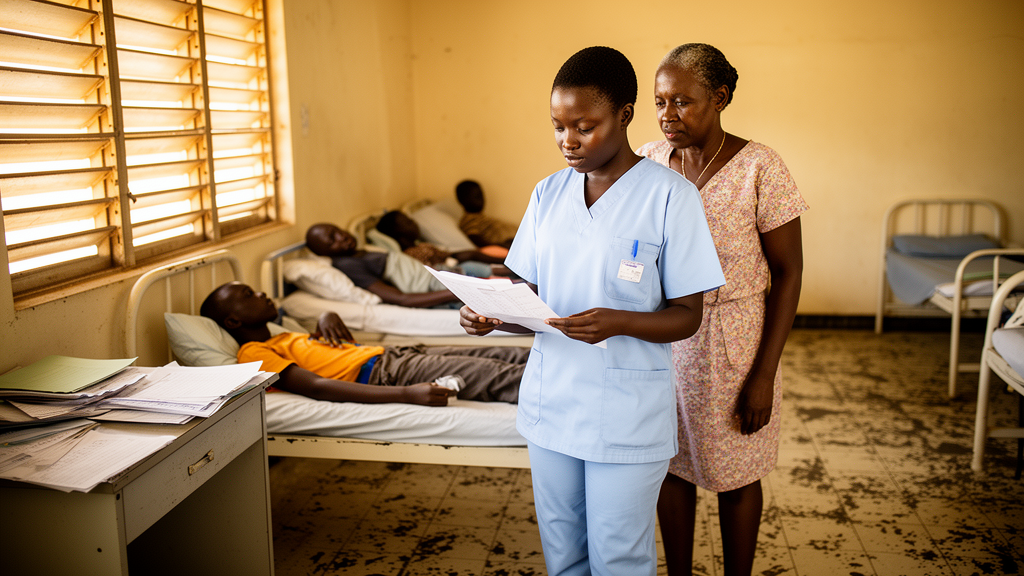
Newly qualified nurses in Ghana often begin their careers in a compulsory one-year program known as clinical rotation or national service, a period meant to bridge the gap between classroom training and independent professional practice. A qualitative study published in BMC Nursing has now documented how these nurses experience that transition, and the picture that emerges is one of both formative learning and considerable hardship. The research, led by Evans Appiah Osei and colleagues, focused on rotation nurses in the Western Region of Ghana and examined four areas in particular: supervisory practices, financial challenges, living and commuting conditions, and the nurses’ own perceptions of the rotation program.
The team used a qualitative exploratory design, recruiting participants through purposive sampling. Data were collected in face-to-face in-depth interviews with 36 rotation nurses, guided by a semi-structured interview guide. They then applied content analysis to the transcripts, identifying recurring themes and subthemes across the accounts.
Three main themes emerged from the analysis. The first concerned supervisory experiences during clinical rotation. Most participants reported experiencing stringent supervision, and many said they were frequently assigned tasks that fell outside their formal clinical duties. The study’s summary of relevance adds further texture to this finding, noting that nurses perceived limited autonomy and noticed variability in supervisory practices across different clinical settings.
The second theme centered on financial struggles and living conditions. Some nurses faced delays and inadequacies in their financial compensation, and the costs of daily living weighed heavily on them. The paper adds that financial delays and inadequate allowances shaped nurses’ everyday experiences in concrete ways: many relied on support from family members, struggled to meet transportation and food costs, and found it difficult to manage debts accumulated during the rotation period.
Closely related were the living and commuting conditions the study documented. Rotation nurses described challenges related to the cost of accommodation, geographical distance from the facilities to which they were assigned, poor road infrastructure, and unsafe transportation options. Some also reported fears related to personal safety while traveling.
The third theme captured how nurses themselves judged the rotation program, and here the accounts diverged. While some participants viewed rotation as essential for their professional development, others felt exploited, describing themselves as cheap labor. The summary of relevance elaborates on this split in perception: many nurses saw the rotation as vital for skill development and professional preparation, while others experienced it as a period of endurance or as labor-intensive work with limited learning value.
The authors conclude that participants described clinical rotation as both an important learning period and a time of significant strain. Strict supervision, financial hardship, and a sense of being undervalued were common experiences that shaped the nurses’ daily work. These accounts, the researchers argue, highlight the need for rotation practices that better reflect and respond to the realities newly qualified nurses face as they enter the profession.
The study also situates itself within a gap in the existing literature. According to the authors, most existing research, particularly in low- and middle-income countries, has focused on the challenges faced by staff nurses rather than those in clinical rotations. Studies that do address rotation challenges tend to emphasize issues related to clinical practice, with limited attention to living conditions and financial struggles. By documenting accommodation costs, commuting dangers, allowance delays and debt management alongside workplace supervision, the study broadens the frame through which the transition to professional nursing is usually assessed.
As with any qualitative study, the findings describe the experiences of a specific group of participants rather than measuring outcomes across a population. The 36 nurses interviewed came from one region of Ghana, and the sample size was determined by data saturation rather than statistical power. The themes therefore offer depth rather than generalizable prevalence figures. Nevertheless, the study provides detailed qualitative evidence on a career stage that has received comparatively little research attention, and it gives voice to nurses whose first year of practice is shaped as much by transport routes, living costs and allowance delays as by the clinical skills they are trying to build.
Subject of Research: The lived experiences of newly qualified nurses during compulsory clinical rotation in Ghana, including supervision, finances and living conditions
Article Title: Exploring the clinical rotation experiences of newly qualified nurses in Ghana: a qualitative study
Article References: Osei, E. A., Oti-Boadi, E., Quampah Wutoh, M., Obeng Amoah, E., Oware, J., Afoakwa Acheampong, C., Fuafugo, E., & Opoku-Adjei, E. (2026). Exploring the clinical rotation experiences of newly qualified nurses in Ghana: a qualitative study. BMC Nursing. https://doi.org/10.1186/s12912-026-05590-z
Image Credits: AI Generated
DOI: 10.1186/s12912-026-05590-z
Keywords: nursing, Ghana, clinical rotation, newly qualified nurses, qualitative research, national service, supervision, financial hardship, health workforce, BMC Nursing, Western Region, professional transition
Cite Scienmag News
Ophelia Keating. (October 27, 2026). Newly qualified nurses in Ghana describe strict supervision and financial strain during clinical rotation. Scienmag. https://scienmag.com/newly-qualified-nurses-in-ghana-describe-strict-supervision-and-financial-strain-during-clinical-rotation/
Ophelia Keating. "Newly qualified nurses in Ghana describe strict supervision and financial strain during clinical rotation." Scienmag, 27 October 2026, https://scienmag.com/newly-qualified-nurses-in-ghana-describe-strict-supervision-and-financial-strain-during-clinical-rotation/. Accessed 27 October 2026.
Ophelia Keating. "Newly qualified nurses in Ghana describe strict supervision and financial strain during clinical rotation." Scienmag. October 27, 2026. https://scienmag.com/newly-qualified-nurses-in-ghana-describe-strict-supervision-and-financial-strain-during-clinical-rotation/


